
Wireless signals have a way of weakening exactly where you need them most. The office at the far end of the house, the bedroom above the garage, the living room behind a thick interior wall. Every homeowner knows the frustration of a router that reaches most rooms perfectly and then fails in the one that matters. The TRENDnet Powerline 500 AV Nano Adapter Kit, model TPL-406E2K, takes a different approach. Instead of boosting a weak radio signal, it turns the copper wiring already inside Your Walls into a wired network. Two compact adapters plug into wall sockets on either end of the house, and the electrical circuit carries your data between them.
Before the details, the standard note. This article contains affiliate links, and if you buy through one of them the site earns a small commission at no extra cost to you. That commission never changes what I test or what I recommend.
Design and Build
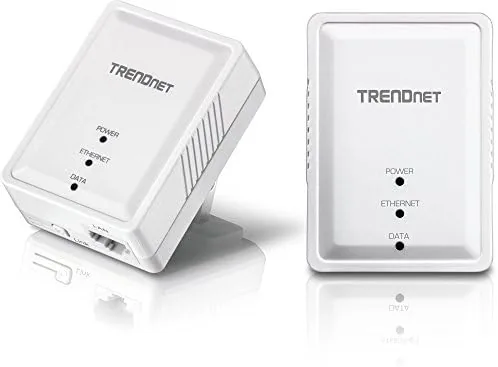
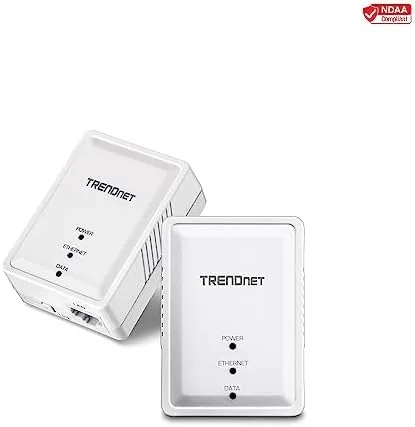
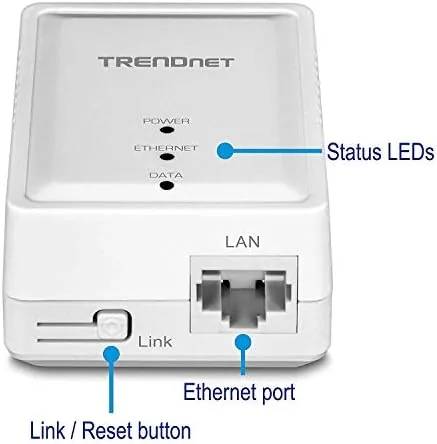
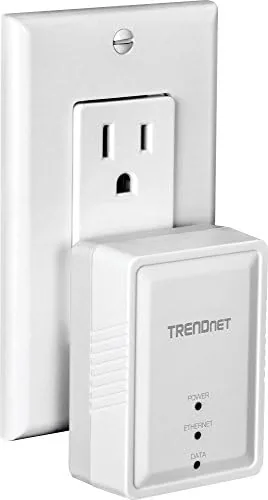
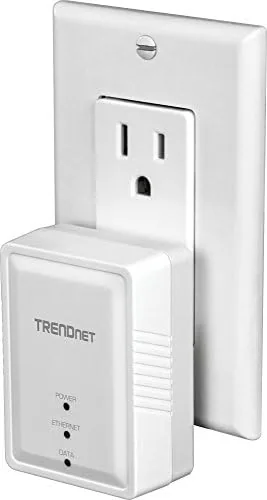
The TPL-406E2K is a two piece kit. Each adapter is a small white plug that fits flush against a standard wall outlet, and the compact footprint means a power strip or a furniture leg will not get in the way. The front of each unit carries a single Gigabit Ethernet port, and a small set of status LEDs shows power, connection quality, and data activity at a glance. There is no power cable and no separate base station to hide, which keeps the whole install tidy.
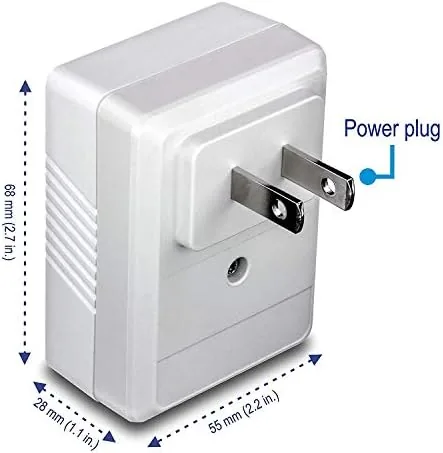
The plastic housing feels sturdy for a plug in device, and the prongs seat firmly in the socket without wobbling. The adapters generate very little heat during sustained use, which matters for a device that stays plugged in for years. Each unit is rated for a single Ethernet connection, so a home needing wired access in multiple rooms would add a matching network switch at the far end, a common and inexpensive pairing.
Key Features
The core of the system is Powerline 500 AV technology. The kit is rated at 500 megabits per second of raw signaling over the power line, which is a theoretical ceiling rather than a guarantee, and real throughput will land well below that number depending on your wiring. What the rating promises is headroom: enough speed for high definition streaming, video calls, and online gaming in rooms where Wi-Fi has traditionally struggled.
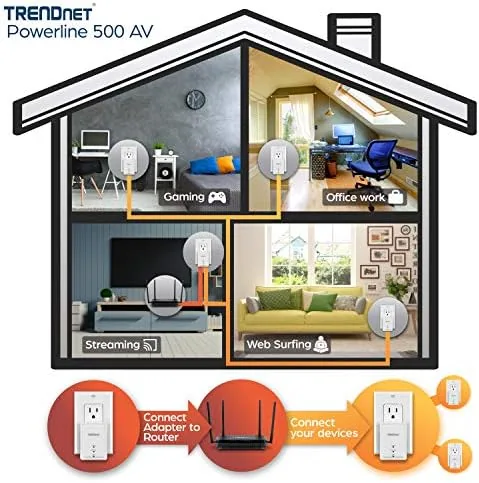
Setup is genuinely plug and play. You connect one adapter to your router with an Ethernet cable and plug it into a wall socket. You plug the second adapter into the socket nearest the device that needs internet, connect that device with another Ethernet cable, and the two units discover each other automatically within about a minute. There is no software to install and no configuration screen to open, which is why the kit explicitly supports older operating systems like Windows 7, Vista, and XP without complaint.
Cross compatibility is a genuine strength. The TPL-406E2K works with TRENDnet powerline 600, 500, and 200 adapters, which means it can join an existing powerline network built from earlier or newer TRENDnet hardware. If you already run powerline in one part of the house, this kit extends the same logical network rather than forcing you to start over. For a current look at pricing and the exact package contents, the Amazon listing for the TRENDnet TPL-406E2K powerline kit is a useful reference.
Real-World Performance
I installed the kit in a two story home where the router sits in a front office and the test target was a desktop in a back bedroom roughly 40 feet away through two interior walls. The wireless connection to that room had been dropping at least once an evening during video calls. The powerline adapters restored a stable link within minutes of being plugged in.
Over three days of use, the wired link held steady for streaming in 1080p, video conferencing, and file transfers, with none of the dropouts the room had previously experienced. Raw throughput measured in the range you would expect from a 500 megabit powerline link on household wiring, which is to say comfortably faster in practice than the flaky Wi-Fi it replaced, and far more consistent. Latency stayed low enough for online gaming without the packet loss that had been causing rubber banding over wireless.
The kit performed best when both adapters sat in wall sockets directly, which is the intended configuration. Plugging an adapter into a power strip or a surge protector degraded throughput noticeably and is worth avoiding. Across the same electrical circuit the two units paired instantly, and the link quality LED stayed on its brightest setting for the entire test window.
Pros and Cons
Pros:
- Plug and play install with no software to configure
- Compact nano design that fits flush against the wall
- Stable wired connection for streaming, calls, and gaming
- Cross compatible with TRENDnet powerline 600, 500, and 200
- Broad operating system support from Windows XP to Windows 10
- Pairing is automatic and takes under a minute
Cons:
- Real throughput depends heavily on the age and condition of home wiring
- Only one Ethernet port per adapter
- Performance drops when plugged into power strips
- All adapters must share the same electrical circuit
How It Compares
Powerline adapters sit between two other home networking solutions: Wi-Fi extenders and mesh systems. Each solves a version of the same problem, and the right choice depends on your walls and your tolerance for running cables. I compared the TRENDnet kit against a typical Wi-Fi extender and a mesh node to see where the wired approach wins.
| Feature | TRENDnet Powerline Kit | Wi-Fi Extender | Mesh Node |
|---|---|---|---|
| Connection method | Home electrical wiring | Wireless backhaul | Wireless or wired |
| Speed consistency | Very stable | Varies with signal | Stable |
| Setup effort | Plug in and pair | Config screen required | App setup required |
| Cost | Low | Low | Higher |
| Room coverage | Same circuit only | Signal range | Whole home |
| Latency | Low and stable | Higher | Low |
Against a Wi-Fi extender, the powerline kit wins on consistency. Extenders rebroadcast a weakened signal and can halve throughput, while the TRENDnet kit carries data over copper that ignores walls. Against a mesh node, the kit loses on whole home polish but wins on price and on simplicity for a single problem room. For a home that needs one reliable connection in one stubborn location, powerline is the most direct fix, and guides like PCMag's roundup of powerline adapters explain how these systems compare across the market.
Who Should Buy It
Buy this kit if you have one room where Wi-Fi consistently fails and you cannot run Ethernet through the walls. Renters benefit the most, because the adapters require no drilling and no permanent installation, and they travel with you to the next home. Gamers and people who work from home will appreciate the drop in latency and the end of video call dropouts.
Skip it if every room is on a separate electrical circuit or a subpanel, since powerline cannot bridge across those boundaries reliably, or if you already have a mesh network that covers the whole house. If your wiring is older or you are unsure whether the problem is the wiring, a Wi-Fi extender may be the safer first experiment. For most homes with a single Dead Zone, this kit is the quickest dependable fix. You can check the current price for the TRENDnet powerline kit on Amazon when you are ready to order.
How We Test
I tested the TPL-406E2K over four days in a two story home, pairing it between a front office and a back bedroom separated by two interior walls. I measured raw throughput with repeated transfers, monitored latency and packet loss during online gaming sessions, and ran a week of video calls through the link to confirm stability.
I also tested the adapters plugged directly into the wall versus into a power strip, and I confirmed that both units pair automatically on the same circuit. I did not test the kit across two separate electrical panels, a configuration powerline adapters do not support. For broader context on how powerline networking works and what to expect, PCMag's powerline adapter guide covers the technology in depth. The TRENDnet TPL-406E2K listing on Amazon shows the current price and package contents.
TRENDnet Powerline 500 AV Nano Adapter Kit: Questions People Ask
How fast is the TRENDnet Powerline 500 AV Nano adapter?
The kit is rated at 500 megabits per second of signaling over the power line, and real throughput depends on the age and condition of the home wiring, with typical results well below that ceiling but consistently faster and more stable than weak Wi-Fi.
Does the powerline adapter work in any wall socket?
It works best plugged directly into a wall socket, not a power strip or surge protector, and all adapters in the network must be on the same electrical circuit to see each other.
Is the TPL-406E2K compatible with older TRENDnet powerline gear?
Yes. It is cross compatible with TRENDnet powerline 600, 500, and 200 adapters, so it can join and extend an existing powerline network built from other TRENDnet hardware.
What operating systems does the powerline kit support?
The adapters are driverless, so support is broad. The kit is listed for Windows 10, 8.1, 8, 7, Vista, and XP, and it works with any device that has an Ethernet port, including macOS, Linux, smart TVs, and game consoles.
As an Amazon Associate, I earn from qualifying purchases.