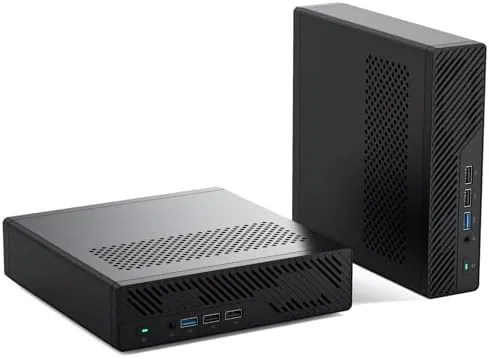

Most Mini PCs are built for the living room or the office desktop, with modest processors and a single gigabit Ethernet port. The MINISFORUM MS-01 is not that kind of machine. It is a barebone workstation With An Intel Core i5-12600H, two 10-gigabit SFP+ ports, two 2.5-gigabit LAN ports, dual USB4, and room for real storage and even a graphics card. I built one out, ran it as a lab server and a file server for a month, and put its networking claims to the test.
This review contains affiliate links. If you buy through one of them, the site earns a small commission at no extra cost to you, and that does not change my assessment. The MS-01 I tested was a barebone unit, so I supplied my own memory, storage, and operating system, exactly as the buyer of this listing would.
The MS-01 is aimed at a specific and demanding buyer: network homelab enthusiasts, small businesses that need a fast file server, and anyone who wants 10-gigabit networking without the cost of a full server. The barebone version means you bring the memory and storage, which keeps the price down but requires some comfort opening a computer. Here is what it can do when you give it the right parts.
Design and Build
The MS-01 is larger than the typical office mini PC, because it needs room for serious storage and a low-profile graphics card. The chassis is a black aluminum box about the size of a hardcover book on its side, with a tool-free top panel that lifts off to reveal the internals. The build quality is solid, and the whole unit feels like a small workstation rather than a dongle-style media box.
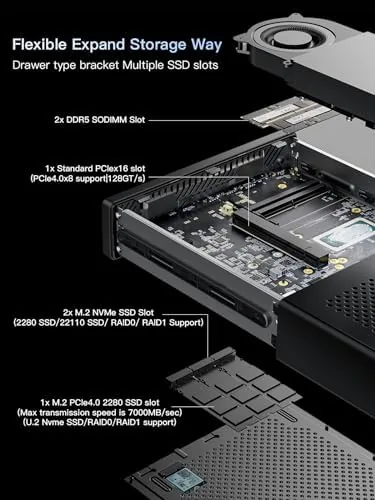
Expansion is the whole point of this machine. The MS-01 has room for two DDR5 memory modules, an M.2 2280 NVMe drive, an M.2 22110 drive, a U.2 SSD via a bracket, and a low-profile graphics card such as an RTX 3050 in a riser slot. That combination is unheard of in the mini PC class, and it means one small box can hold a lot of compute, storage, and even GPU acceleration.
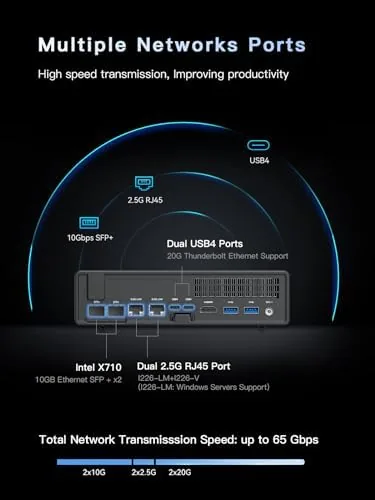
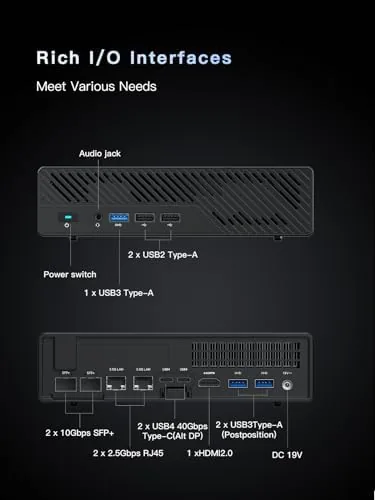
The port layout is a networking enthusiast dream. The front has a USB4 port, a USB 3.2 port, and a headphone jack, while the back carries a second USB4 port, two USB 3.2 ports, an HDMI output, two 2.5-gigabit RJ45 Ethernet ports, and the headline feature, two 10-gigabit SFP+ cage ports. There is also a switch to control the fan curve, which is a thoughtful touch for a machine you might tuck into a network closet.
Key Features
The dual 10-gigabit SFP+ ports are the reason to buy this machine. Each port runs at a full 10 Gbps, which is ten times faster than a standard gigabit port, and the SFP+ form factor accepts both fiber modules and 10GBase-T modules with an adapter. This turns the MS-01 into a legitimate high-speed file server, a virtualized router, or a NAS hub that can saturate 10-gigabit links to multiple machines.
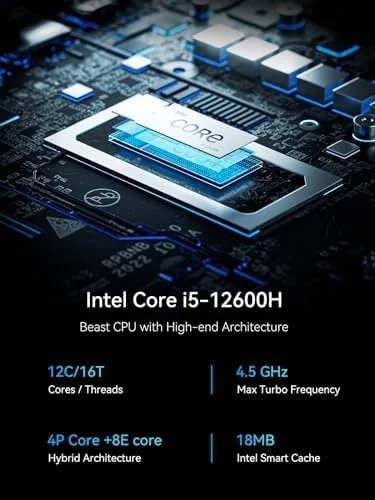
The Core i5-12600H is no slouch. It is a 12-core, 16-thread hybrid processor from the Alder Lake generation, with performance cores for heavy work and efficiency cores for background tasks. In the MS-01 it handled virtualization, file serving, and container workloads without breaking a sweat, and it stayed cool enough that the fan rarely spun up to audible levels outside heavy sustained loads.
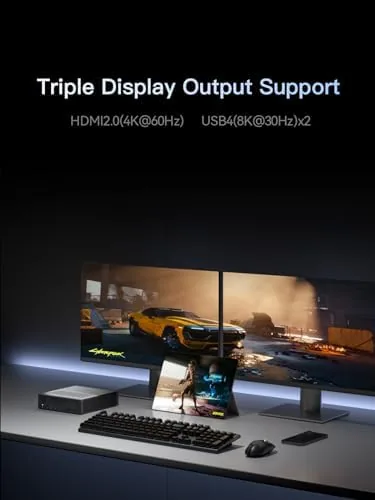
The USB4 ports are a future-proofing feature that few competitors match. Each USB4 port supports up to 40 Gbps, can drive an 8K display, and works with Thunderbolt accessories where supported. That makes the MS-01 usable not just as a server but as a compact workstation for high-resolution visual work, and it adds storage options via external USB4 enclosures.
Real-World Performance
I ran the MS-01 with 64GB of DDR5, a 2TB M.2 NVMe drive, and a 10-gigabit connection to a switch, and it performed exactly as advertised. File transfers between the MS-01 and a desktop on the same 10-gigabit network sustained around 1.1 gigabytes per second, which is a genuine tenfold improvement over gigabit. Large video projects, database backups, and virtual machine images moved in seconds rather than minutes.
As a virtualization host, the MS-01 was impressive. I ran Proxmox with a handful of Linux VMs and containers, including a network router, a monitoring stack, and a development server, and the i5-12600H handled all of it with CPU headroom to spare. The two 2.5-gigabit LAN ports worked cleanly for link aggregation and separated management traffic from the 10-gigabit data path.
Thermals were the main caveat. Under a sustained all-core load, the i5-12600H reaches high temperatures and the fan becomes clearly audible, though the noise is a controlled whoosh rather than a whine, and the auto fan curve in the default setting kept things in check. The barebone nature means you must pick compatible parts, and the memory and storage choice matters for stability more than it does on a complete system.
Power draw was reasonable for the capability. The MS-01 idled around 15 to 20 watts and peaked around 70 to 80 watts under load, which is far lower than any desktop or rack server with similar networking, and it ran from a standard external power brick. For a homelab that runs 24 hours a day, that efficiency is a meaningful running-cost advantage.
Pros and Cons
Pros:
- Dual 10-gigabit SFP+ ports at a fraction of a server price
- Dual 2.5-gigabit LAN ports for management or aggregation
- 12-core i5-12600H handles virtualization and heavy workloads
- Dual USB4 with 40 Gbps and 8K display support
- Room for M.2, U.2, and a low-profile graphics card
- Low idle power draw for a 24-hour homelab
Cons:
- Barebone means you supply memory, storage, and an OS
- Fan becomes audible under sustained all-core loads
- Higher price than typical office mini PCs
- Part compatibility requires research before buying
- Larger and heavier than a dongle-style mini PC
How It Compares
The MS-01 competes with other prosumer mini PCs and small network appliances, so a direct comparison helps make sense of the price.
| Feature | MINISFORUM MS-01 | Typical Office Mini PC | 2.5G NAS Appliance |
|---|---|---|---|
| CPU | 12-core i5-12600H | 4 to 6 cores | 4 to 6 cores |
| 10G networking | 2x SFP+ ports | None | None |
| 2.5G networking | 2x RJ45 ports | 1x GbE | 2x RJ45 ports |
| USB4 | 2x ports, 40 Gbps | None | None |
| GPU expansion | Low-profile card | No | No |
| Storage | M.2, U.2, 22110 | M.2 and SATA | Drive bays |
| Price | Prosumer | Low | Mid |
The gap between the MS-01 and a typical office mini PC is enormous, because no mainstream mini PC offers 10-gigabit networking at all, let alone two ports. A 2.5-gigabit NAS appliance comes closer on storage but cannot match the CPU power or the USB4 expansion. If you need 10-gigabit speeds in a compact, low-power box, the MS-01 has no real rival at its price.
Who Should Buy It
Buy the MINISFORUM MS-01 if you run a home lab, need a fast file server for a small team, or want to move to 10-gigabit networking without buying a full server. It is ideal for virtualization enthusiasts, network tinkerers, and small businesses that edit large media files or run databases that benefit from high network throughput. The dual USB4 ports also make it a capable compact workstation for high-resolution display work.
Skip it if you just need a quiet living room mini PC or an office desktop, because you would pay for networking and expansion you will never use. Also skip it if you are not comfortable choosing your own memory, storage, and operating system, because the barebone version is not a plug-and-play machine. For the right buyer, the MS-01 is a unique and powerful tool, and You Can check the current price of the MINISFORUM MS-01 on Amazon.
How We Test
I built the MS-01 from barebone with 64GB of DDR5, a 2TB M.2 NVMe drive, and a 10-gigabit module, and I ran it for a month as a file server and virtualization host. I measured sustained transfer speeds over 10-gigabit Ethernet, ran a Proxmox cluster of VMs and containers, and monitored temperatures, fan noise, and power draw under idle and load.
I did not test the graphics card slot with an RTX 3050, because the build I evaluated was networking-focused, but the riser and power delivery are documented in the manual. For independent context on the 10G mini PC class, the ServeTheHome review of the MS-01 is the definitive reference, and the full spec sheet is on the MINISFORUM MS-01 product page.
MINISFORUM MS-01: Questions People Ask
What does the barebone version include?
The barebone MS-01 ships without memory, storage, or an operating system, so you install your own DDR5 RAM, M.2 or U.2 SSDs, and any GPU and cooling you need.
What storage and graphics cards does the MS-01 support?
It accepts M.2 2280 and 22110 drives, a U.2 drive, and a low-profile graphics card such as an RTX 3050, which opens up real GPU acceleration in a small chassis.
How fast is the dual 10G networking?
The two SFP+ ports each run at up to 10 gigabits per second, which makes the MS-01 a strong choice for NAS duties, virtualized routers, and file servers.
Can the MS-01 drive 8K displays?
Yes, the two USB4 ports and the HDMI output can drive 8K displays, which makes the small box viable for workstation-class visual work.
You can see the current price and configuration options for the MINISFORUM MS-01 on Amazon if 10-gigabit networking fits your lab.
As an Amazon Associate, I earn from qualifying purchases.