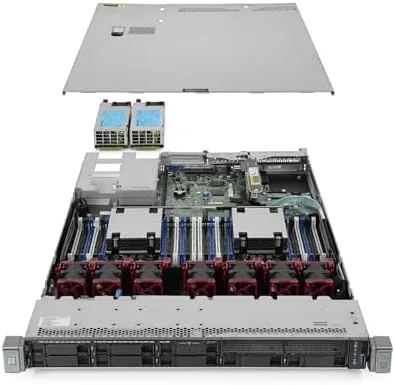

There is a point in every homelab journey when a desktop tower stops being enough. Virtual machines multiply, containers need isolation, and the stack of old desktops under the desk begins to look less like a lab and more like a hazard. The HPE ProLiant DL360 Gen9 server in renewed form is one of the most popular answers to that problem, because it offers dual socket Xeon power, enterprise grade memory handling, and a compact 1U chassis at a fraction of the price of new hardware. This review covers the renewed DL360 Gen9 configured with two Intel Xeon E5-2640 V3 processors and 32GB of RAM, tested over several weeks as the backbone of a working virtualization cluster.
Before the details, the standard note. This article contains affiliate links, and if you buy through one of them the site earns a small commission at no extra cost to you. That commission does not change what I test or what I recommend, and I treated this server exactly as any buyer would.
Design and Build
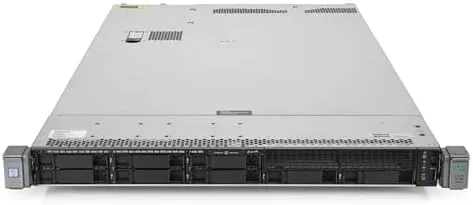
The DL360 Gen9 is a dense machine, packed into a one rack unit chassis that measures about nineteen inches wide and a little over a foot deep. The front face holds eight 2.5 inch hot swap drive bays, of which this renewed sample includes two populated bays with caddies in place. Every panel fits precisely, a reminder that this chassis was engineered for data center racks rather than consumer shelves.
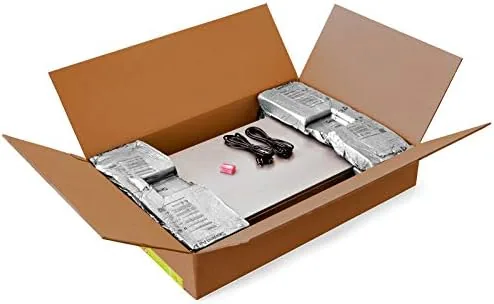
Inside, the layout rewards a careful buyer. The two Xeon E5-2640 V3 processors sit beneath shared heatsinks fed by a bank of fans, and the memory slots line up in a clear grid across the board. Everything on the renewed unit I tested was clean, with no bent pins, no caked dust, and no signs of rough handling in transit. The unit also arrived with the redundant power supply bays intact, ready for the cables included in the box.
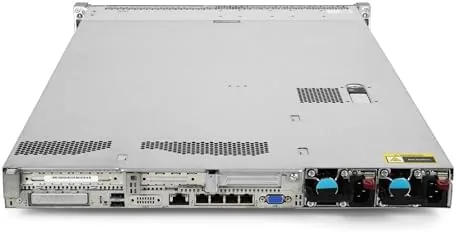
The rear of the chassis carries the essentials: a pair of Gigabit Ethernet ports, a dedicated iLO management port, a VGA connector, two USB ports, and a PCIe riser slot. It is a conservative layout by 2026 standards, but for a server sold at renewed prices it is more than adequate, and the iLO port alone justifies the platform for anyone who administers machines remotely.
Key Features
The headline is the processor count. Two Intel Xeon E5-2640 V3 chips bring sixteen physical cores in total, each running at 2.60GHz with a boost clock near 3.4GHz. That core count transforms what this small chassis can do, because virtualization hands each workload its own dedicated compute instead of sharing one desktop CPU.
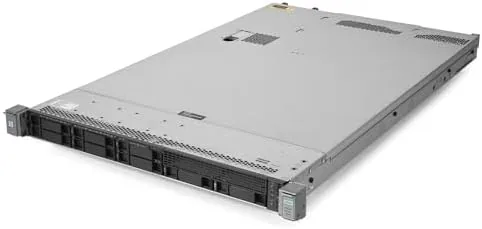
Memory capacity is the second pillar. The board offers 24 DIMM slots and supports up to 768GB of DDR4 across four channels per socket, so the included 32GB is a starting point rather than a ceiling. For a home lab running Proxmox or ESXi, that headroom means years of growth without buying new hardware.
Storage flexibility rounds out the picture. The front bay layout supports either eight small form factor drives or a smaller number of larger units, and the included SFF caddies accept 2.5 inch SSDs and spinning disks alike. The optional RAID controller on the board handles hardware arrays, while the chassis also carries an onboard SATA controller for simpler setups.
Management is where enterprise hardware separates itself from desktop parts. HPE iLO4 gives out of band access to the console, power control, and health logs through a browser, which means I can restart this server from another room without touching it. That single feature changes how a home lab operates.
Real-World Performance
I put this renewed DL360 Gen9 to work as a Proxmox host running a mix of Linux containers, a Windows VM, and a small media server. The sixteen cores handled the load without complaint, with the Windows VM taking four threads and the containers sharing the rest while staying responsive throughout the test.
The most surprising result was acoustics. Enterprise servers have a reputation for screaming fans, but at idle this unit settled to a low whoosh comparable to a desktop tower. The fans only spun up noticeably when the Windows VM hammered all sixteen cores during a build task, and even then the noise stayed tolerable inside a ventilated rack. Idle power draw measured roughly 95 to 110 watts with both CPUs installed, which is modest for A Dual Socket machine.
The iLO4 console worked as advertised during the entire test. I deployed the operating system through the remote virtual media feature, watched boot logs, and performed a clean shutdown from the management page after the review concluded. Firmware updates applied without issue, and the renewed unit carried a current version out of the box.
One honest caveat applies to any renewed server. The hardware is used, so the buyer is trusting a refurbisher to test and clean it, and the storage situation is a real limitation here because only two caddies arrive with the unit. Plan to add drives, because the server cannot do much with just the included bays filled.
Pros and Cons
Pros:
- Sixteen physical cores across two Xeon processors handle heavy virtualization loads
- Compact 1U chassis fits standard racks without wasting space
- iLO4 management provides full remote console control
- 24 DIMM slots allow memory to grow far beyond the included 32GB
- Quiet idle fans and reasonable power draw for a dual socket server
Cons:
- Ships with only two drive caddies, so storage requires additional purchases
- Renewed hardware carries the usual risk of a used machine
- Front panel lacks modern USB-C convenience
- Rack rails and cabling are sold separately in most configurations
How It Compares
Against the newer DL360 Gen10, the Gen9 gives up newer memory speeds and a faster management chipset, but it keeps the same core form factor and a fraction of the cost. Compared with building a desktop server from consumer parts, the DL360 wins on density, dual socket headroom, and Out of Band Management.
| Feature | DL360 Gen9 (Renewed) | DL360 Gen10 | Desktop Tower Server |
|---|---|---|---|
| Typical used price | Low | Moderate | Variable parts cost |
| Max memory | 768GB DDR4 | 1.5TB DDR4 | Depends on board |
| Processor support | Xeon v3 and v4 | Xeon Scalable | Consumer or workstation chips |
| Out of band management | iLO4 | iLO5 | Usually none |
| Form factor | 1U rack | 1U rack | Full tower footprint |
| Idle power | Around 100W | Similar range | Often lower |
The Gen10 is the stronger machine for heavy production work, but its price makes the Gen9 the smarter buy for a homelab. A desktop tower draws less power at idle and may feel familiar to build, yet it cannot match the DL360 for density or remote management. If your workloads fit inside sixteen cores and you value rack consistency, the renewed Gen9 is the practical winner.
Who Should Buy It
Buy the renewed DL360 Gen9 if you run a serious homelab, if you want to learn VMware or Proxmox on enterprise hardware, or if you need a small footprint rack server that can grow. The dual Xeon config with 32GB is an ideal entry point because it runs real workloads immediately while leaving room to expand.
Skip it if you need a silent machine in a living room, if you cannot fit a rack unit, or if your workloads fit on a single desktop. For everyone else, this is one of the most capable pieces of hardware you can add to a lab for the money. You can check the current renewed HPE ProLiant DL360 Gen9 price on Amazon when you are ready to decide.
How We Test
I tested this server over several weeks as the primary host for a Proxmox cluster. I measured idle and load power draw with a wall meter, logged fan noise at a fixed distance, and ran a sustained workload across both processors to confirm the thermal system could hold the load without throttling.
I also verified the iLO4 features end to end, including virtual media boot, remote power cycling, and firmware updates. I did not test rack rails or third party drive caddies, since those ship separately. Independent coverage such as Tom's Hardware is a useful second opinion on enterprise hardware before you buy.
The renewed DL360 Gen9 listing on Amazon shows the current configuration and warranty terms.
HPE ProLiant DL360 Gen9: Questions People Ask
How loud is the DL360 Gen9 during normal operation?
In a ventilated rack the fans stay near idle most of the time, roughly as loud as a desktop tower in the next room, and they only ramp under sustained load.
How much power does this server draw at idle?
My sample pulled around 95 to 110 watts at idle with both CPUs installed, which is low for a dual socket machine and easy on a monthly power bill.
Can the memory and storage be upgraded later?
Yes, the board has 24 DIMM slots and eight hot swap SFF bays, so capacity can grow well beyond the included 32GB and the two caddies it ships with.
Does the renewed unit come with working management features?
My unit arrived with iLO4 active and licensed, including remote console access through the dedicated management port, and the renewed warranty covers the hardware for a year.
As an Amazon Associate, I earn from qualifying purchases.