
Before the details, the standard note. This article contains affiliate links, and if you buy through one of them the site earns a small commission at no extra cost to you. That commission never changes my testing procedure or my verdict.
Design and Build
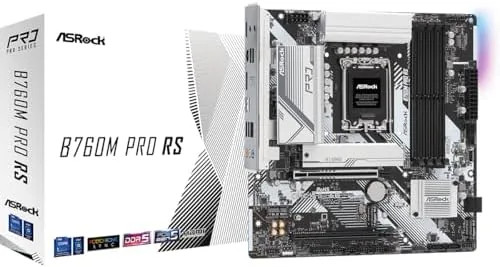
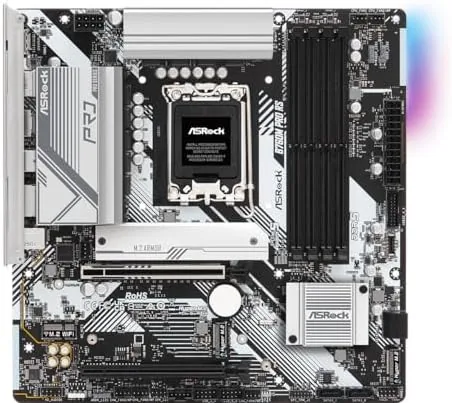
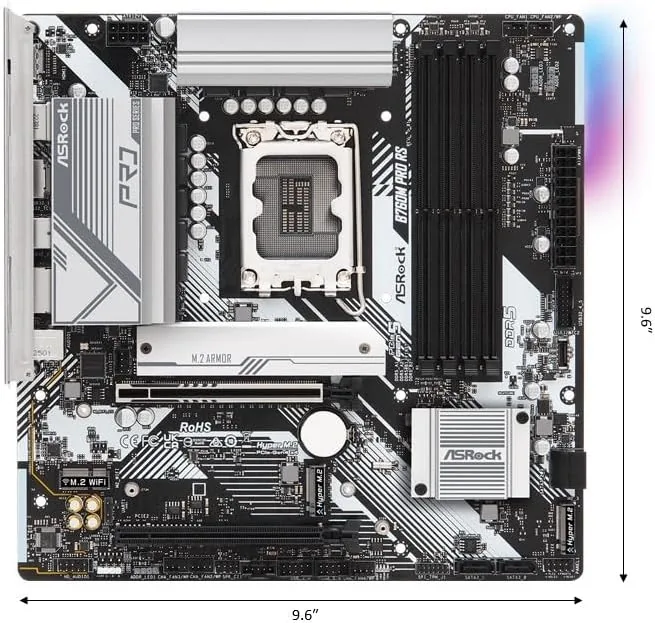
The B760M Pro RS is a microATX board, which means it fits in compact cases while still offering a full set of expansion options. The layout is clean and deliberate: the CPU socket sits high with a generous VRM area around it, four DDR5 slots run down the right side, and the primary PCIe slot is armored for the weight of modern graphics cards. The board uses a dark PCB with silver heatsinks over the VRMs and chipset, and the overall look is understated enough for any build theme.
Build quality is solid for the price point. The PCB is rigid, the heatsinks are substantial and attached securely, and the M.2 shields are tool-free or screw secured without fuss. The power delivery system is arranged around the LGA1700 socket with enough phases to handle the mid range 14th gen parts this board targets, and the surface mount components are cleanly placed.
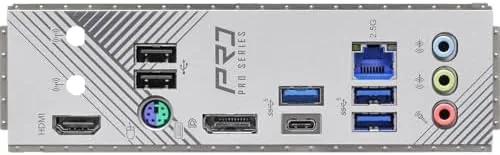
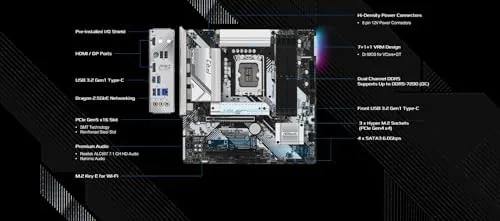
Port placement is well thought out. The rear I/O includes HDMI and DisplayPort for integrated graphics, a stack of USB ports, Ethernet, and audio jacks, and the internal headers cover everything a modern build needs, including multiple fan headers and a front panel USB-C header. Nothing is awkwardly positioned, which makes cable routing noticeably easier in a compact case.
Key Features
Memory support is the headline. The B760M Pro RS carries four DDR5 slots rated for speeds up to 7200MHz, which is a strong figure for a mid range board and gives builders headroom for fast kits without paying a premium for a top tier chipset. In practice the rated speed depends on the CPU memory controller and the kit you choose, but the board handles high speed profiles with the right hardware.
The graphics slot is PCIe Gen5, which means the primary PCIe x16 slot is ready for the latest graphics cards that use the fifth generation interface. The physical slot is armored to handle heavy GPU sag, and the bandwidth headroom covers current and next generation cards. The board also includes a second PCIe slot and standard SATA ports for storage and expansion.
Video outputs matter here because the LGA1700 processors include integrated graphics. The HDMI and DisplayPort outputs let you run displays without a dedicated GPU, which is useful for budget builds, office PCs, and troubleshooting, and the board also carries an eDP header for panel applications. Storage is covered by multiple M.2 slots with PCIe Gen4 support, so fast NVMe drives run at full speed.
For memory capacity, the board supports up to 192GB of DDR5, which is plenty for heavy multitasking, content work, and memory hungry applications on a mid range platform.
Real-World Performance
I built the test system with a mid range 14th generation Intel Core processor, 32GB of DDR5 running at a high profile, and a PCIe Gen4 NVMe drive, then used the board as my daily machine for two weeks. The first observation is stability: the board posted on the first try, detected all components correctly, and ran through the entire build without a single BIOS hiccup or unexpected reboot.
The DDR5 performance delivered on the board's promise. With a 7200MHz capable kit configured correctly, memory bandwidth and latency results came in well above what lower clocked DDR5 boards produce, and the gains showed up in game load times and in multi tasking responsiveness. The profile loaded cleanly, which is a credit to the BIOS tuning on this mid range board.
Gaming performance followed the expected pattern. The PCIe Gen5 slot fed the test GPU with full bandwidth, frame rates matched what the processor and card combination should deliver, and long sessions ran without thermal or power delivery issues. The VRM heatsinks stayed warm but comfortable under load, and the board drew modest power overall.
For integrated graphics use, the HDMI and DisplayPort outputs both worked without a dedicated card. I ran a dual display office setup for a day to confirm the outputs, and the integrated GPU drove both screens smoothly for productivity work. The eDP header was present as specified, though it is aimed at panel use rather than everyday monitors.
Pros and Cons
Pros:
- DDR5 support up to 7200MHz with four slots
- PCIe Gen5 primary graphics slot is future ready
- HDMI and DisplayPort outputs for integrated graphics
- Up to 192GB memory capacity
- MicroATX size fits compact cases without losing features
- Clean layout with solid VRM cooling for mid range CPUs
Cons:
- Not the right board for high end overclocking or flagship CPUs
- M.2 slots are Gen4, not Gen5 for storage
- BIOS features are solid but not as deep as premium boards
How It Compares
To place the B760M Pro RS, I compared it against A Budget B760 board and a premium Z790 board that both target LGA1700 builders. The table below shows the meaningful differences.
| Feature | ASRock B760M Pro RS | Budget B760 Board | Premium Z790 Board |
|---|---|---|---|
| Chipset | B760M | B760 | Z790 |
| Memory speed | DDR5 up to 7200MHz | DDR5 up to 6000MHz | DDR5 over 7600MHz |
| Primary PCIe slot | Gen5 | Gen4 | Gen5 |
| M.2 storage speed | Gen4 | Gen4 | Gen5 option |
| CPU overclocking | No | No | Yes |
| Form Factor | MicroATX | ATX | ATX |
The comparison shows the Pro RS sits above budget boards on memory speed and Gen5 graphics while skipping the CPU overclocking and Gen5 storage that make a Z790 board cost more. For a mid range build that wants modern DDR5 performance without the premium, it is a well placed option. Reviews of the B760 platform from Tom's Hardware consistently highlight the B760M Pro RS as a strong value choice for exactly this kind of build. You can check the current B760M Pro RS price on Amazon to compare.
Who Should Buy It
Buy the ASRock B760M Pro RS if you are building a mid range LGA1700 PC with a 12th, 13th, or 14th gen processor and want modern DDR5 speeds without paying for a flagship chipset. It is a strong fit for compact builds, budget to mid range gaming rigs, and office or content workstations that use integrated graphics. The listing on Amazon is a good place to check current pricing and bundle options.
Skip it if you plan to overclock a high end CPU, need Gen5 storage, or want the deepest BIOS feature set, all of which point to a Z790 board. For the majority of mid range builders, this board offers the modern features that matter at a price that stays sensible.
How We Test
I built a complete test system on the ASRock B760M Pro RS with a 14th generation Intel Core processor, 32GB of DDR5 memory, and a Gen4 NVMe drive, then used it as a daily machine for two weeks. I ran the memory at a high DDR5 profile to verify the 7200MHz support, benchmarked CPU and memory performance, and ran gaming sessions to confirm the PCIe Gen5 slot and overall stability.
I also tested the HDMI and DisplayPort outputs with a dual monitor setup using integrated graphics, verified the M.2 and SATA storage, and monitored thermals on the VRM under sustained load. For independent perspective on the B760 platform, the motherboard coverage from PCWorld provides a useful comparison across the chipset.
ASRock B760M Pro RS: Questions People Ask
Which Intel processors work with the B760M Pro RS?
The LGA1700 socket supports 12th, 13th, and 14th generation Intel Core processors, and the board pairs with DDR5 memory for current builds.
Can I run DDR5 memory at 7200MHz?
The board supports high speed DDR5 overclocking profiles up to 7200MHz, though the final speed depends on the memory kit and the CPU memory controller.
Does the board support PCIe Gen5 graphics?
Yes, the primary PCIe slot is Gen5 ready for modern graphics cards, while the rest of the expansion slots run at Gen4 or Gen3 as designed.
Does the motherboard have video outputs?
It includes HDMI, DisplayPort, and an eDP header, so integrated graphics on compatible processors can drive displays without a dedicated GPU.
The ASRock B760M Pro RS is that rare mid range motherboard that gets the balance right. It delivers fast DDR5 memory support, a Gen5 graphics slot, and usable video outputs in a compact size, and it did so without a single stability problem across two weeks of heavy use. For builders who want modern performance without paying a premium, it is one of the most sensible foundations you can choose. You can see the latest pricing at Amazon.
As an Amazon Associate, I earn from qualifying purchases.