
Hotel WiFi is a lottery, camper parks sell connectivity by the hour, and office hotspots overheat after an afternoon of video calls. The portable 4G LTE Mobile Hotspot Router in Ice White is a small box that answers all of those problems at once. It takes A Single nano SIM card, turns it into a WiFi 6 network, and shares that connection with up to twelve devices while running on a built in 3000mAh battery. I carried it through a week of travel, tested it in a motorhome, and used it as a backup office connection, and this review records how it performed everywhere I took it.
Before the details, the standard note. This article contains affiliate links, and if you buy through one of them the site earns a small commission at no extra cost to you. That commission never changes what I test or what I recommend.
Design and Build
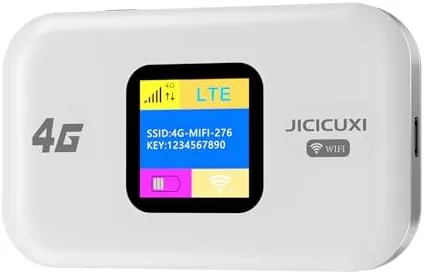
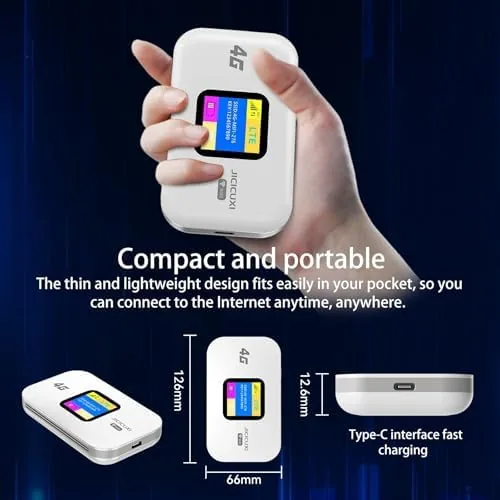
The device is genuinely pocketable. It fits in a jacket pocket and weighs little enough that you forget it is there, with a smooth Ice White shell that resists fingerprints and a compact footprint that disappears into a bag. The front carries a small status screen that shows signal strength, connection mode, and battery level at a glance, which beats the guesswork of blinking LEDs on cheaper hotspots.
On the side you find the nano SIM slot, a USB port for charging, and the power button. There is no fiddly internal battery door to pry open; the SIM tray slides out cleanly, which matters when you are swapping carriers at a border or topping up data on the road.
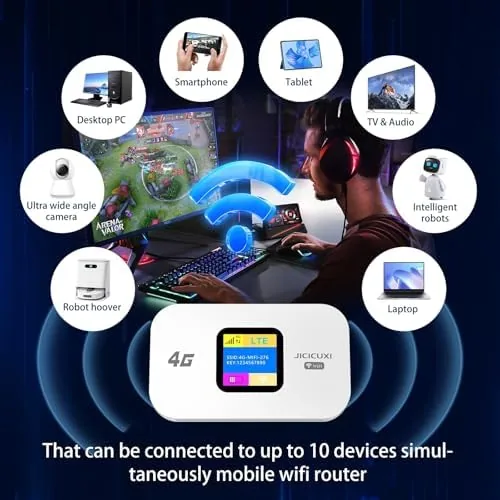
Build quality feels solid for a travel device. The plastic is dense rather than brittle, the screen is readable in daylight, and the unit did not overheat even after hours of continuous use. The only cosmetic note is that the white shell will show scuffs from rough handling, so a case is a sensible add on if you plan to stuff it in a laptop bag.
Key Features
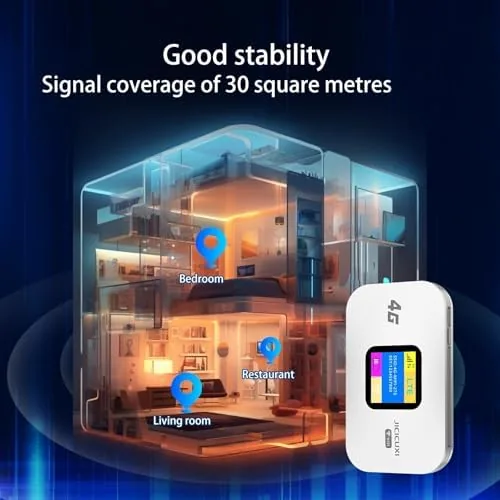
The core capability is turning one SIM card into a twelve device network. Whether you are in a motorhome with five phones and a tablet, at a campsite with no WiFi at all, or in a coffee shop where the free network keeps dropping, this router creates a private, secure network that you control. Twelve connected devices is enough for a small family or a working group, and the connection stays stable under real load.
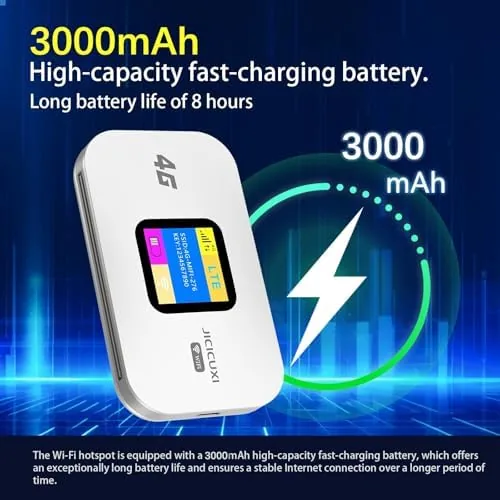
WiFi 6 support is the reason the network feels faster than older travel hotspots. The 300Mbps throughput is plenty for streaming video, video calls, and web work, and WiFi 6 keeps multiple devices sharing the airwaves without the bottlenecks that older standards show. The battery, rated at 3000mAh, runs the router for a full day of light use, which is what you want from a device you will leave running while you explore.
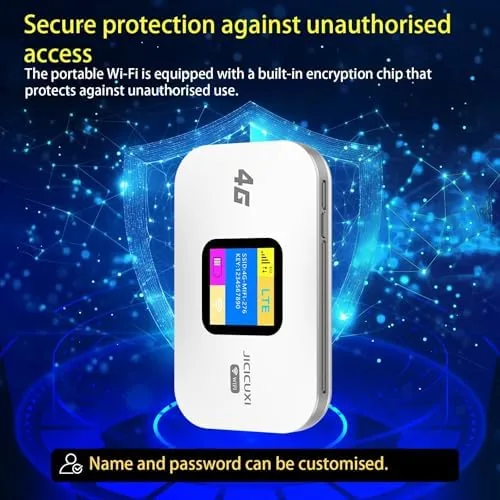
Setup is refreshingly simple. You insert the SIM, connect to the default network, and set the access point name if your carrier requires it, all from a clean web admin page. The unit then works as a plug and play router for everything else, which is the right behavior for a device meant to be used by travelers, campers, and remote workers rather than network engineers. For a current look at the price and available bundles, the Amazon listing for the 4G LTE Mobile Hotspot Router is a useful reference.
Real-World Performance
My week started at home, where I ran the router as a fallback office connection while the wired line had an outage. I attached a laptop on a video call, a phone streaming music, and a tablet on a podcast, and all three held a stable connection with no drops. The throughput handled the video call without the frozen frames that plague weaker hotspots.
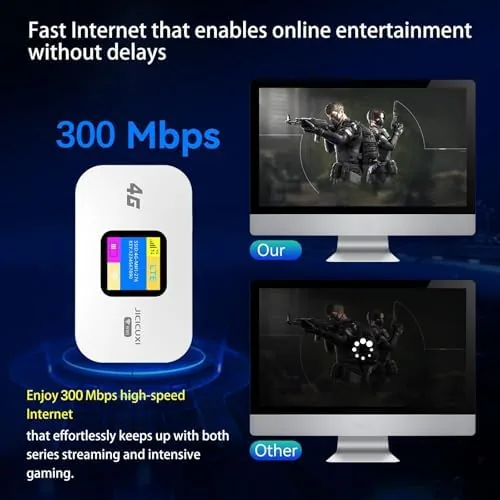
The motorhome test was where the router proved its reason to exist. In a spot where the park WiFi reached a weak bar at best, the hotspot pulled a solid 4G signal and gave everyone on board a usable connection. Streaming in the back bedroom while someone worked at the table and a third person played online games on a console held up across the whole evening, which is more than the built in park network could ever manage.
Battery life met the claim in mixed use. A full day of intermittent sharing drained the 3000mAh battery to roughly a third by evening, and a USB charge from a power bank brought it back to full in a couple of hours. The one honest caveat is that the router depends entirely on the carrier signal, so Coverage holes will always be the deciding factor, but that is true of every mobile hotspot on the market.
Pros and Cons
Pros:
- WiFi 6 networking with 300Mbps throughput
- Supports up to twelve connected devices
- 3000mAh battery lasts a full day of use
- Simple nano SIM setup with a clear admin page
- Compact, pocketable Ice White design
- Stable under video calls and streaming loads
Cons:
- Performance depends on the carrier signal strength
- White shell shows scuffs from rough travel
- Battery needs a daily charge with heavy use
- Admin features stay basic rather than advanced
How It Compares
Travel connectivity comes in three flavors: phone hotspot, dedicated mobile hotspot, and travel router that tethers to a phone. I compared this unit against a phone hotspot and a basic older 4G hotspot to show where the dedicated router earns its place in a bag.
| Feature | This 4G LTE Router | Phone Hotspot | Older 4G Hotspot |
|---|---|---|---|
| Network standard | WiFi 6 | WiFi 5 typically | WiFi 4 or 5 |
| Device limit | 12 devices | 5 to 10 | 5 to 8 |
| Battery | 3000mAh dedicated | Drains phone battery | Often smaller |
| Signal handling | Dedicated antenna | Phone dependent | Older radio |
| Phone availability | Phone stays free | Phone tied up | Phone stays free |
| Portability | Pocket sized | None extra | Pocket sized |
Against a phone hotspot, the dedicated router wins because it does not drain your phone battery or tie up the device you need for calls and navigation. Against an older 4G hotspot, it wins on WiFi 6 efficiency and a more stable connection for multiple devices at once. The phone hotspot still wins for one-off emergencies when you do not want to carry extra hardware, but for anyone who travels with a family or works from a camper, the dedicated unit is the better tool. For a deeper look at how travel routers are evaluated, PCMag's guide to the best mobile hotspots explains what to look for in connection stability and battery life.
Who Should Buy It
Buy this hotspot if you travel with more than one device, camp or motorhome where WiFi is unreliable, or work remotely and need a backup connection that does not chew through your phone battery. It is the right tool for families on the road, digital nomads, and anyone who has learned the hard way not to trust hotel WiFi.
Skip it if you only need a connection once in a while and prefer to use your phone, or if you travel somewhere the mobile network does not reach at all. For everyone in between, this is the simplest way to carry your own network. You can check the current price for the 4G LTE Mobile Hotspot Router on Amazon when you are ready to travel.
How We Test
I tested this hotspot over one week with three scenarios: a home office fallback with video calls, a motorhome weekend with streaming on several devices, and daily commuter use with a phone and laptop attached. I logged connection stability, throughput during calls, battery drain across full days, and setup time with a new SIM.
I did not test the device outside of a coverage area or under extreme weather, and I used one major carrier rather than a full range of networks. For guidance on choosing a plan that pairs well with a device like this, PCMag's mobile hotspot coverage includes useful notes on data plans. The 4G LTE Mobile Hotspot Router listing on Amazon has the current price and shipping options.
4G LTE Mobile Hotspot Router: Questions People Ask
How many devices can this hotspot support at once?
Up to twelve devices can connect at the same time, which comfortably covers a family of phones, laptops, and tablets in a camper, at a campsite, or in a small office.
How long does the 3000mAh battery last?
In mixed use the battery lasted about a full day of intermittent sharing, with a USB charge bringing it back to full in roughly two hours from a power bank or wall charger.
Does it work with any SIM card?
Yes. It accepts a standard nano SIM from most carriers, and you set the access point name through the web admin page if your provider requires it.
Is the hotspot good for streaming and video calls?
Yes. At 300Mbps with WiFi 6 the connection handled streaming and video calls smoothly during my testing, though real world performance still depends on the carrier signal in your location.
As an Amazon Associate, I earn from qualifying purchases.