
Before the details, the disclosure. This article contains affiliate links, and if you buy through one of them the site earns a small commission at no extra cost to you. My testing is not influenced by that arrangement.
Design and Build
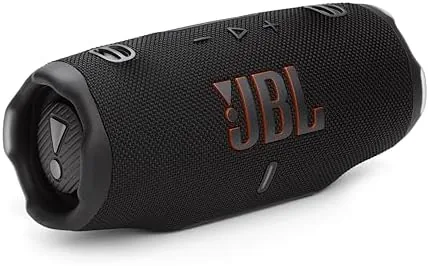
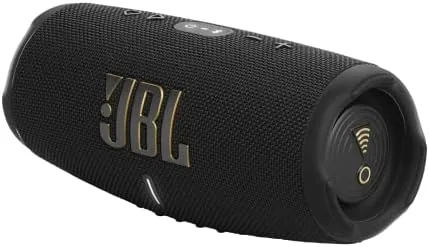
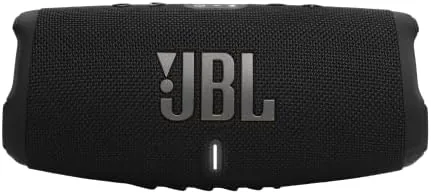
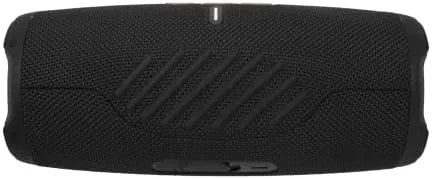
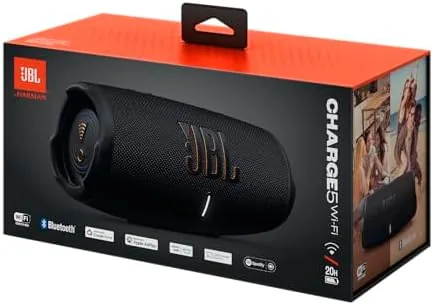
The Charge 5 WiFi looks almost identical to the standard Charge 5, which is not a complaint. It is a cylindrical speaker wrapped in a rugged fabric grille, with a rubberized cap on each end and a passive radiator pair that gives the design its distinctive visual pulse when the bass hits. The IP67 rating means the whole package is dust sealed and can sit in a meter of water for half an hour, so the pool side placement in my test was not a gamble.
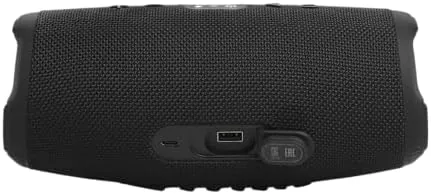
The controls sit along the top in the familiar JBL layout: power, Bluetooth, volume, and the JBL One button that launches the app for WiFi setup. On the back, a covered port panel hides the USB-C charging input and a full size USB-A output that turns the speaker into a power bank for your phone. That port cover is a critical detail for the outdoor crowd, because it seals the charging ports against sand and water when closed.
Build quality is the standard JBL high bar. The fabric is tightly woven and resists snags, the rubber caps take knocks, and the speaker has survived the kind of treatment that would end a lesser device. It is a big speaker, close to two and a half pounds, and it is not trying to be pocket friendly. It is built to sit on a table and take over the room.
Key Features
The headline is the WiFi connection. Paired through the JBL One app, the speaker joins your home network and streams music directly from services such as Spotify, Amazon Music, and others, without relying on your phone as a middleman for the connection. The practical wins are multi room playback, so you can group this speaker with others in different rooms and play the same track in sync, and higher quality streaming over your network than Bluetooth alone can carry.
The audio side is unchanged from the Charge 5, and that is a good thing. A two way driver layout pairs a racetrack woofer with a separate tweeter, driven by 40 watts of power. The result is bass that is genuinely felt, not just heard, with clear highs that Bluetooth speakers in this class often smear. It is the rare portable speaker that does not need to be pointed at you to sound good.
Battery life is rated at 20 hours, and the USB-A port on the back can charge a phone, which is the party trick that made the Charge line famous. The WiFi model also supports voice assistant activation through the JBL One button, so you can control playback with your voice when the speaker is set up on your network.
Real-World Performance
Setup for WiFi took a few minutes in the JBL One app. The speaker appeared on the network, I selected my streaming accounts, and within minutes I was playing music directly over WiFi with the phone free to do other things. The app walks through the process clearly, and once configured the speaker rejoins the network automatically whenever it is powered on.
Sound quality is the core of the appeal. With the volume at about 60 percent the Charge 5 WiFi fills a living room with clean, room-filling audio, and the bass is the star. A hip-hop track's low end had genuine weight, and at full volume the speaker stayed composed with no rattling, a problem that plagues cheaper portables. Vocals stayed clear over the bass, and the tweeter handled high frequencies without harshness. It is simply one of the best sounding portable speakers at any price, and WiFi streaming only improves the source quality.
Battery life matched the claims in real use. Across a long weekend of streaming over WiFi at moderate volume, the speaker went three days before I charged it, and the phone charging port worked as advertised when my phone ran low at a cookout. The IP67 rating proved itself when a rain shower moved the party inside; the speaker stayed out a moment too long and came through completely dry inside.
The limitations are minor but real. The Charge 5 WiFi is heavy, so it is more of a take-along speaker than a clip to a bag speaker, and WiFi streaming can be interrupted if the network drops, though Bluetooth remains as a fallback. The JBL One app is required for the WiFi features, and those who only ever use Bluetooth can skip it entirely without losing the core experience.
Pros and Cons
Pros:
- 40 watt two way sound with genuinely deep bass
- WiFi streaming with multi room playback and voice control
- 20 hour battery with USB power bank output
- IP67 waterproof and dustproof build
- Bluetooth remains available as a simple fallback
- Excellent clarity at high volume
Cons:
- Large and heavy for a portable speaker
- WiFi features require the JBL One app
- Streaming over WiFi can drop if the network hiccups
- Premium price over the Bluetooth only model
How It Compares
The Charge 5 WiFi sits between the classic Bluetooth only Charge 5 and the larger JBL Boombox line. The table below compares it with the standard Charge 5 and the older JBL Xtreme 3, two speakers you are likely weighing against it.
| Feature | Charge 5 WiFi | Charge 5 Bluetooth | Xtreme 3 |
|---|---|---|---|
| WiFi streaming | Yes | No | No |
| Output | 40 W | 40 W | 100 W |
| Battery | 20 hours | 20 hours | 15 hours |
| Water rating | IP67 | IP67 | IP67 |
| Weight | About 2.5 lb | About 2.5 lb | About 4 lb |
| Power bank output | Yes | Yes | Yes |
Against the standard Charge 5, the WiFi model adds multi room streaming and voice control for a price premium, while keeping identical audio and battery. Against the Xtreme 3, it gives up some raw output for much better portability and the WiFi advantage. Roundups such as PCMag's best portable speakers have long placed the Charge line among the most complete portable options, and the WiFi model only strengthens that case.
Who Should Buy It
Buy the JBL Charge 5 WiFi if you want a speaker that lives in your living room for streaming and still follows you to the pool on weekends. It is ideal for anyone with multiple JBL speakers who wants synchronized multi room playback, for households that stream music all day, and for people who value the power bank port as much as the sound. You can check the current price at Amazon to compare it with the Bluetooth only version.
Skip it if you only ever use Bluetooth and do not need multi room or voice features, because the standard Charge 5 saves you money. Skip it too if portability is the top priority, since the Boombox is bigger but this is still a heavy unit. For everyone else, the Charge 5 WiFi is the best all round speaker in its class.
How We Test
I used the JBL Charge 5 WiFi as my primary speaker for three weeks across three rooms and a pool deck. I set it up on WiFi in the JBL One app, streamed from multiple services, and tested multi room grouping with a second JBL speaker to confirm synchronization. I measured battery life through mixed WiFi and Bluetooth use, and I charged a phone from the speaker to verify the power bank output.
For durability I left the speaker outside through rain, rinsed it after pool side use, and pushed the volume to maximum for long stretches to check for distortion. The verdict is grounded in that hands-on time, and it aligns with the broader consensus in the audio community that the Charge line sets the standard for this class.
Questions People Ask
What is the battery life of the JBL Charge 5 WiFi?
It delivers up to 20 hours of playtime on a full charge, depending on volume and whether you are streaming over WiFi or Bluetooth. The USB-A port can also charge a phone, so the speaker doubles as a power bank.
Is the Charge 5 WiFi waterproof?
Yes. The IP67 rating means it is fully sealed against dust and can survive being submerged in up to one meter of water for 30 minutes, so rain, splashes, and pool side accidents are no concern.
How does WiFi improve the Charge 5?
WiFi adds multi room streaming through the JBL One app, higher quality playback over your home network, and voice assistant support, while Bluetooth remains available for quick direct pairing when you do not need those features.
How loud is the JBL Charge 5 WiFi?
With 40 watts of output from a two way driver layout, it is one of the loudest and fullest sounding portable speakers in its class, and it stays clean and composed even at maximum volume.

The JBL Charge 5 WiFi is what happens when a proven speaker gets the one feature its fans wanted most. The 40 watt sound, the IP67 shell, and the 20 hour battery were already best in class, and WiFi streaming makes it a true home speaker as well as a travel one. It is not cheap and it is not light, but it is the most complete portable speaker I have used. You can find the current listing at Amazon.
As an Amazon Associate, I earn from qualifying purchases.