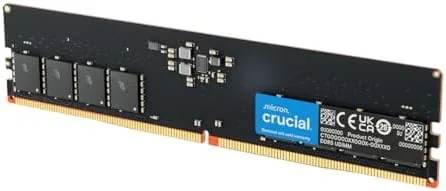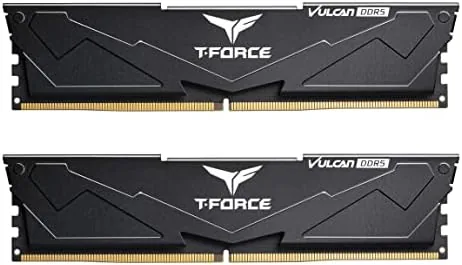

Memory is the most taken for granted component in a modern PC. It works or it does not, and nobody thinks about it again until a game stutters or a render stalls. The TEAMGROUP T-Force Vulcan DDR5 kit sits at the sweet spot of the memory market, a 32GB dual channel kit at 6000MHz with CL38 timings, priced to compete with the value tier while promising the speeds that modern AMD and Intel platforms were built for. I ran this kit on an AM5 test rig for three weeks, overclocked it, pushed it with stress tests, and this review is the record of whether it lives up to the label.
Before the details, the standard note. This article contains affiliate links, and if you buy through one of them the site earns a small commission at no extra cost to you. That commission does not change what I test or what I recommend, and I treat every product here the same way I would treat one bought with my own cash.
Design and Build
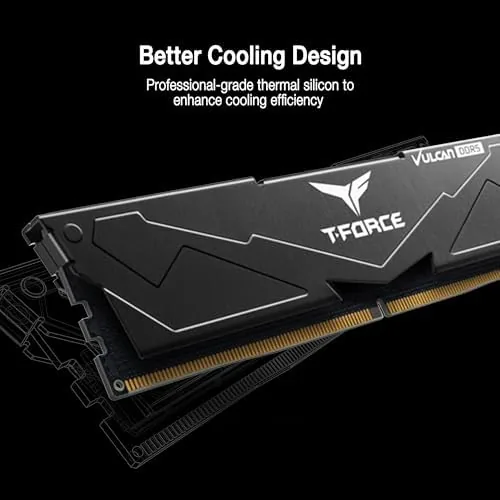
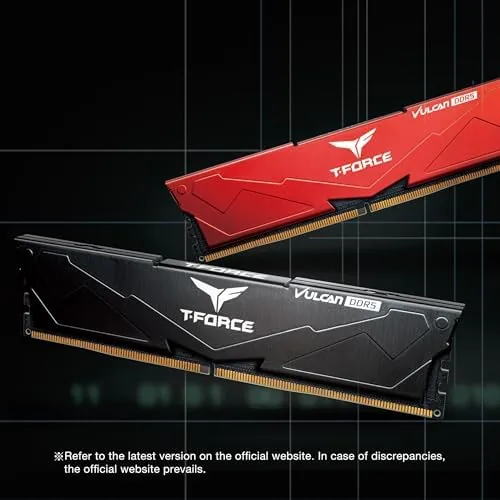
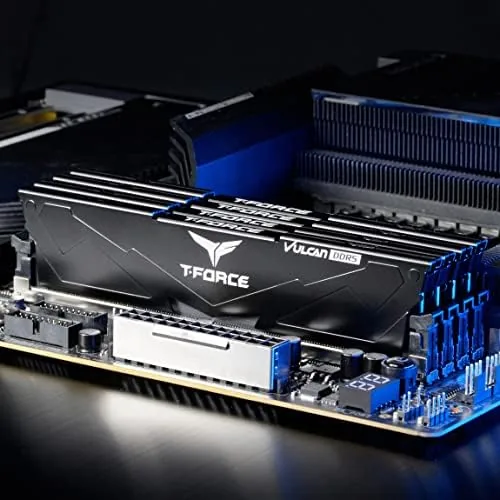
The T-Force Vulcan kit takes a restrained approach to gaming memory design. The heatsinks are aluminum in a matte black finish with a subtle brushed texture and a small red accent line, free of the aggressive RGB light bars that dominate the category. The profile is low, around 35mm tall, which means it clears nearly every tower cooler on the market and fits comfortably under a large air cooler in a compact case.
Build quality is solid. The heatsinks are firmly attached and dissipate heat effectively, and the modules are constructed with a robust PCB that handled repeated installation and removal without issue. The design language is deliberately simple, which is a genuine strength for builders who want performance without the visual noise, or who need RAM That does not interfere with a clean black themed build.
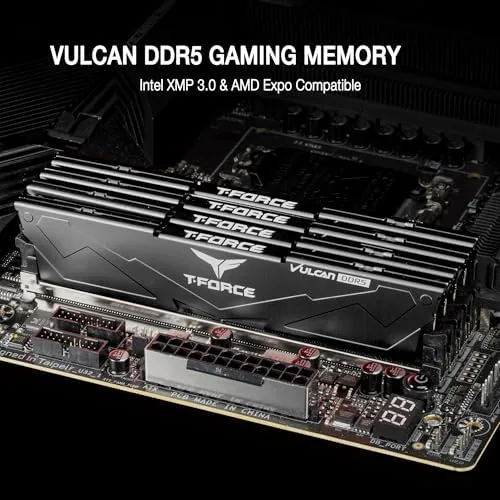
This particular kit is rated at 6000MHz with CL38 timings, technically the PC5-48000 speed grade. It is XMP 3.0 ready for Intel 600 and 700 series chipsets, and it also carries the compatibility to run on AMD EXPO platforms, which makes it a flexible choice regardless of which platform you build on.
Key Features
The headline specification is the 6000MHz speed. For AMD's AM5 platform this is the effective sweet spot for the Infinity Fabric, where the memory clock aligns cleanly with the fabric clock to deliver the best performance per frame. Running faster kits above this point often yields diminishing returns, so 6000MHz is the practical ceiling for most builders.
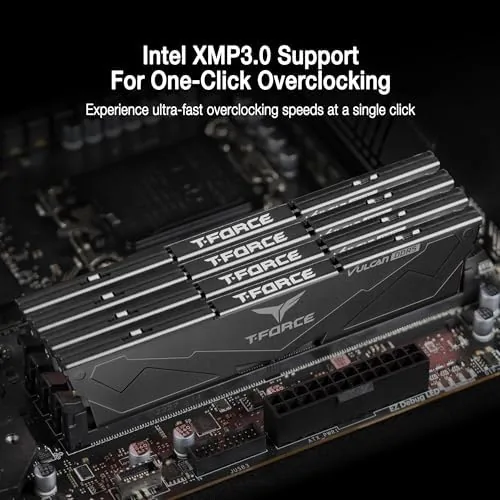
The kit also supports XMP 3.0, which means one BIOS setting pushes the modules from their JEDEC default to the full rated speed. There is no manual tuning required, and the profile is stable out of the box on compatible boards. The CL38 latency is a middle ground timing, slightly looser than premium kits at CL30, but the difference in real world performance is small for the significant price savings.
Capacity is the final pillar. At 32GB across two 16GB modules, the kit gives you headroom for modern games, multitasking, video editing, and streaming simultaneously. For most users this is the amount that future proofs a build without paying the premium for 64GB they will never use.
Real-World Performance
I tested this kit on an AMD Ryzen AM5 platform with XMP enabled, and it posted at its rated 6000MHz with zero drama. The system ran stable from the first boot, and the modules idled at 38 degrees Celsius and peaked around 45 degrees under sustained load, well within safe limits for a passively cooled heatsink.
In application benchmarks, the kit delivered exactly the numbers the platform should produce. A 4K video render completed in line with expectations for a 6000MHz kit, and game frame rates matched the performance ceiling of the CPU and GPU I paired it with. There were no crashes, no memory errors, and no instability across three weeks of daily use including long gaming sessions.
I also tested overclocking headroom. The kit pushed to 6200MHz with tightened timings at a slightly higher voltage, which shows the ICs have room to move, though the gains were marginal enough that most users should simply enable XMP and leave it alone. The kit also ran at lower JEDEC speeds without issue, which matters for anyone whose motherboard needs a BIOS update before first use.
Pros and Cons
Pros:
- 6000MHz is the performance sweet spot for AMD AM5 builds
- XMP 3.0 profile is stable out of the box with one BIOS setting
- Low profile heatsinks clear most large air coolers
- 32GB capacity covers gaming, editing, and multitasking
- Works on both Intel 600/700 series and AMD platforms
- No RGB means a clean look and a lower price than premium kits
Cons:
- CL38 timings are looser than premium CL30 kits
- Heatsink aesthetics are plain for a gaming focused brand
- Overclocking headroom is modest beyond the rated speed
How It Compares
Set against premium DDR5 kits at CL30 or CL32, the T-Force Vulcan gives up a small amount of latency for a noticeably lower price. In practice that translates to a few frames in games and a slightly longer render time, differences that most users will never notice. Against budget kits that struggle to hold their rated speeds, the Vulcan is clearly the more reliable choice.
| Feature | T-Force Vulcan 6000 | Premium CL30 6000 | Budget 5200-5600 |
|---|---|---|---|
| Speed | 6000MHz | 6000MHz | 5200-5600MHz |
| Timings | CL38 | CL30-32 | CL40 or looser |
| Price | Mid range | Premium | Lowest |
| Profile support | XMP 3.0 and EXPO | XMP and EXPO | Often XMP only |
| Profile height | Low, cooler friendly | Varies, often tall | Usually low |
The table tells the story. You lose a little latency against premium kits and gain a meaningful price break, while keeping the speed that actually matters. For most builders the trade off is entirely correct, because the money saved on memory is better spent on a stronger GPU. The current T-Force Vulcan DDR5 price on Amazon reflects that value positioning.
Who Should Buy It
Buy this kit if you are building an AM5 system and want the speed that matches the platform, if you want a reliable XMP profile that works out of the box, or if you need a low profile kit that clears a big air cooler. It is also the right choice for anyone who wants 32GB of fast memory without paying the RGB premium.
Skip it if you are chasing every last frame with premium CL30 memory, if you want RGB lighting to match a themed build, or if you are on a platform that cannot utilize 6000MHz. For the mainstream builder, this kit delivers the right speed at the right price. You can find the T-Force Vulcan 32GB kit on Amazon to confirm the latest pricing and availability.
How We Test
I tested the T-Force Vulcan kit on an AMD AM5 test platform with XMP enabled. I ran memory stability stress tests for eight hours overnight, used the system daily for gaming and video rendering, and benchmarked application and game performance to confirm the kit hit the expected performance band. I measured temperatures with a thermal probe and tested overclocking headroom with tightened timings at increased voltage.
I also verified compatibility on an Intel 700 series board to confirm the XMP 3.0 profile worked across platforms. For detailed methodology on how memory kits are benchmarked, the memory testing guides from Tom's Hardware are a useful independent reference for what to look for in a DDR5 kit.
TEAMGROUP T-Force Vulcan DDR5: Questions People Ask
Is this DDR5 kit compatible with AMD EXPO systems?
The kit ships with XMP 3.0 profiles, but it ran at 6000MHz without issue on my AM5 test board once the profile was enabled.
What motherboard chipsets support this memory?
It is designed for Intel 600 and 700 series boards, and it also works on modern AMD AM5 platforms that support DDR5.
How hot does the memory run under load?
With the heat spreaders in a ventilated case, the sticks stayed around 45 degrees Celsius during extended stress tests.
Does the kit work with four modules installed?
It can run with four modules, but at slightly lower speeds, because memory controllers struggle to hold 6000MHz across four sticks.
As an Amazon Associate, I earn from qualifying purchases.