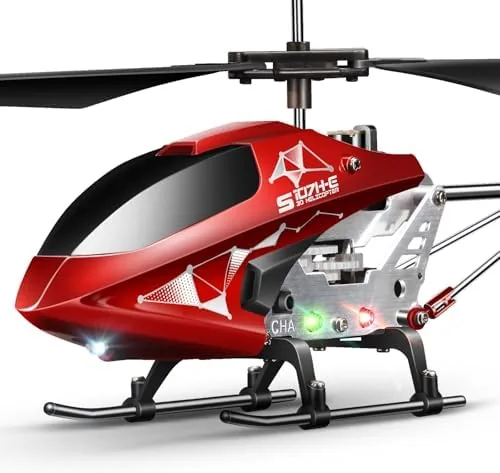

Every child wants a flying machine, and every parent knows that most cheap RC helicopters end up in a drawer after a single disappointing afternoon. The SYMA S107H-E is aimed squarely at that audience, a small alloy-bodied helicopter that promises easy indoor flight through altitude hold, gyro stabilization, and one-key takeoff and landing. It is one of those products that looks like a toy and is often dismissed as one, so I spent two weeks flying it around a living room with the people it is actually meant for: kids, and the adults teaching them.
Before the details, the standard note. This article contains affiliate links, and if you buy through one of them the site earns a small commission at no extra cost to you. That commission never changes what I test or what I recommend.
Design and Build
The S107H-E is a coaxial helicopter, which means it has two main rotors stacked on one shaft, spinning in opposite directions. That layout is the secret to its stability, because the counter-rotating blades cancel out the torque that makes single-rotor models twist, and it lets the helicopter hover with almost no input. The body is a lightweight alloy frame painted in a bright red, and the whole machine weighs so little that a crash against a wall usually ends in a bounce rather than a break.
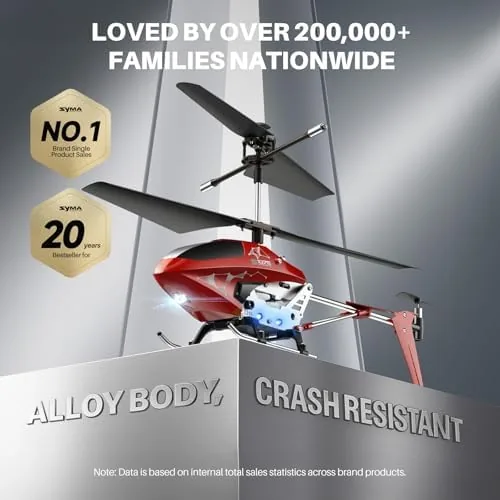
Build quality is better than the price suggests. The alloy body is rigid, the rotor blades are firm plastic, and the tail boom has a small anti-collision frame around the rotor, which is a thoughtful touch for a kids toy. The landing gear is simple but functional, and the transmitter is a comfortable twin-stick design with a phone holder mounted on top, so a parent can record the flight from the pilot position.
Key Features
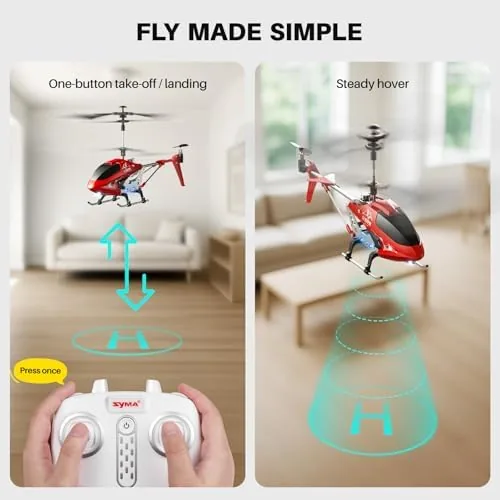
Altitude hold is the feature that makes this helicopter beginner friendly. A small pressure sensor reads the height and holds the rotor speed steady, so the machine hovers at one level instead of bobbing up and down while a new pilot figures out the throttle. It is not perfect, and it drifts a little as the battery drains, but it removes most of the panic from the first flights.
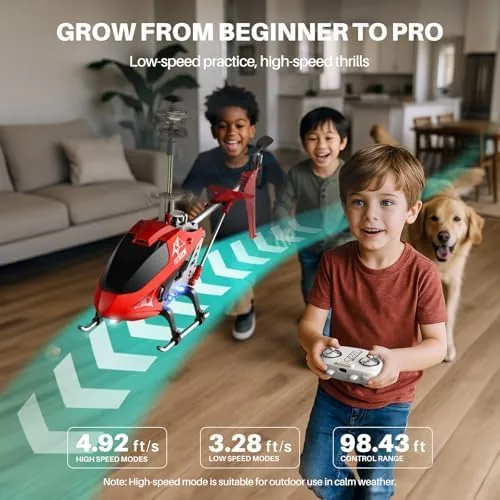
One-key takeoff and landing is the second feature that earns its place. A single button lifts the helicopter to a stable hover, and a second press brings it back down gently, which means a child can launch and recover the aircraft without juggling the throttle. Two speed modes add the right amount of progression, with a slow mode for the first sessions and a faster mode for confident pilots, and the gyro stabilization keeps the tail pointing where you aim it. If you want to compare the current price against other beginner helicopters, the Amazon listing for the SYMA S107H-E is a useful reference.
Real-World Performance
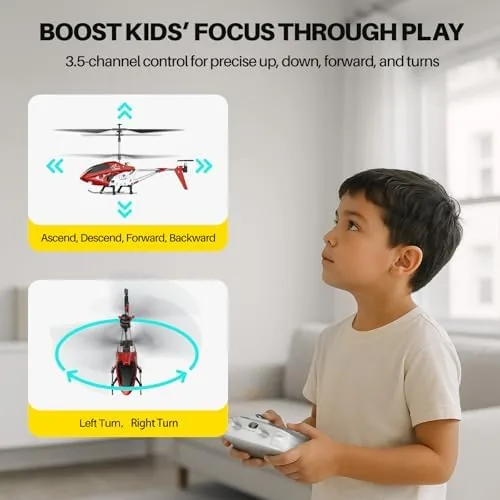
The living room is a hostile environment for a helicopter, full of lamps, ceiling fans, and children who reach for anything that flies. The S107H-E handled it better than I expected. In slow mode, a first-time pilot was hovering reliably within a few minutes, and the altitude hold kept the machine out of the danger zone near the ceiling. The learning curve is genuinely gentle, and that is the whole point of this product.
Flight time is the honest weakness. Each charge delivers roughly six to eight minutes in the air, and the battery takes close to an hour to refill, which makes a single session feel shorter than a child wants. The solution in our test was a second battery, and with two packs the flow of the afternoon worked well. The helicopter is strictly an indoor machine, and the moment it goes outside it is at the mercy of even a light breeze, which pushes the small frame around and makes it unflyable.
The helicopters will crash, because that is what children do with them, and the S107H-E is forgiving about it. We hit walls, curtains, and a sofa, and the machine always came back. The parts that do break are cheap and standard, and the rotor set and body spares are easy to find, which is the practical side of owning a kids helicopter that not every toy company gets right.
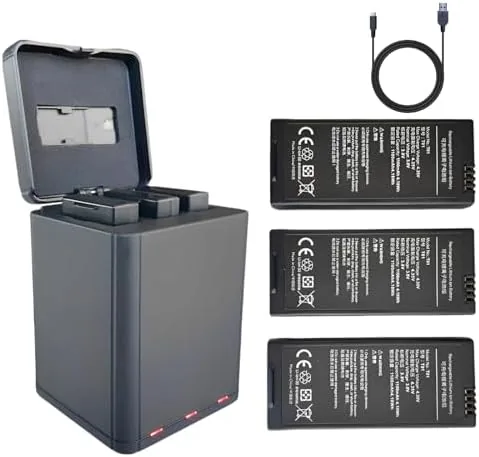
Charging deserves its own note, because it is the moment most parents will abandon this hobby. The helicopter charges through a USB cable that plugs into the transmitter or a wall adapter, and the process takes close to an hour for the flight time you get. The included manual warns against charging unattended, and the battery has the low-voltage protection that stops the machine mid-flight before the cell is damaged. I kept a spare battery in rotation for the two week test, and with that simple habit the short flight time stopped being a problem and became a rhythm of hover, land, swap, and go again.
Pros and Cons
Pros:
- Altitude hold makes hovering genuinely easy for beginners
- One-key takeoff and landing removes the trickiest skill
- Coaxial design is stable and forgiving in small spaces
- Alloy body survives repeated crashes
- Two speed modes let skill grow with practice
Cons:
- Six to eight minute flight time per charge
- Battery takes about an hour to refill
- Strictly an indoor flyer, useless in any wind
How It Compares
Beginner helicopters split into coaxial models like this SYMA and single-rotor machines, and the difference shows up immediately for a new pilot. I compared the S107H-E against a single-rotor toy helicopter and a larger Beginner Drone to see which one a family should buy first. If you want to check the current price, the SYMA helicopter listing on Amazon is a good place to start.
| Feature | SYMA S107H-E | Single-Rotor Toy | Beginner Drone |
|---|---|---|---|
| Rotor design | Coaxial, very stable | Single, tricky | Quadcopter |
| Altitude hold | Yes | No | Yes |
| One-key takeoff | Yes | No | Yes |
| Indoor stability | Excellent | Poor | Good |
| Flight time | 6 to 8 minutes | 5 to 7 minutes | 8 to 12 minutes |
| Crash survival | High | Low | Medium |
The single-rotor toy helicopter is harder to fly, less stable, and more likely to break, and it offers a beginner nothing except frustration. The beginner drone has longer flight times and more features, but it costs more and its propellers are harder on fingers than the enclosed rotors of a coaxial helicopter. For a child's first flying machine, the SYMA S107H-E is the safest and most forgiving starting point, and it is the one I would put in a young pilot's hands first.
Who Should Buy It
Buy this helicopter if you want a child's first flying machine that will not end in tears, if you need something stable for a small indoor space, or if you are buying for a beginner of any age who wants to learn the basics without a steep learning curve. The altitude hold and one-key controls make it the rare toy that actually delivers on its promises.
Skip it if you want to fly outdoors, if you need longer flight times, or if the pilot is ready for a faster and more capable machine. For everyone else, this is a dependable and genuinely kid-friendly introduction to RC flight. You can check the current price for the SYMA S107H-E on Amazon when you are ready to bring one home.
How We Test
I flew the S107H-E for two weeks in a living room and a garage with both an adult and a young child piloting, and I tracked hover stability, flight time, charging time, and crash survival across dozens of flights. I tested both speed modes, used the one-key takeoff and landing repeatedly, and deliberately crashed the machine into furniture and walls to see how much abuse it would take.
I did not fly it outdoors, because the product is clearly an indoor machine, and I did not push it beyond the stock battery and transmitter. Independent coverage such as Tom's Hardware guide to beginner flying machines is a useful authority on how easy RC aircraft are to master. The SYMA S107H-E listing on Amazon shows the current price and the available colors.
SYMA S107H-E RC Helicopter: Questions People Ask
How long does the SYMA S107H-E battery last per charge?
Expect six to eight minutes of flight per charge, with roughly forty minutes needed to top the battery back up before the next session, and a spare battery is the practical way to extend playtime.
Is the helicopter safe for young children?
The rotors are light and the body is soft alloy, but it still needs adult supervision because spinning blades and hard landings can hurt small hands, and the design is forgiving enough for supervised beginners.
Can the helicopter fly outdoors?
It is designed for indoor use, since even a light breeze pushes the small frame around, so keep it in a living room or garage where the air is calm and the furniture provides a soft landing.
How hard is it to control for a first-time pilot?
Altitude hold and gyro stabilization make it forgiving, and most beginners are hovering reliably within a few flights, especially in low speed mode, which is exactly the experience this helicopter is built to deliver.
As an Amazon Associate, I earn from qualifying purchases.