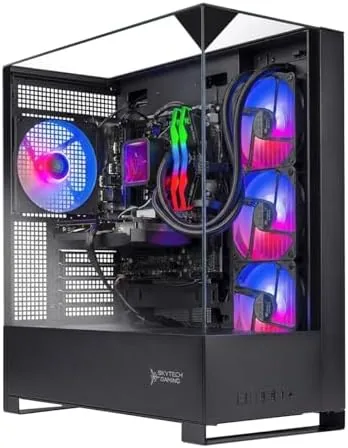

I have spent several weeks with the Shadow 5 as my primary gaming machine, running benchmarks, thermals, and long sessions across a mix of shooters, strategy games, and AAA single player titles. The short version is that this PC delivers exactly what the spec sheet promises: smooth 1440p gaming, quiet operation under load, and a case that leaves room to grow. The longer version involves frame rate charts, temperature curves, and one or two honest caveats that you should know before you buy.
The standard disclosure applies here. Cosmoniq earns an affiliate commission when you purchase through the links in this review, and that does not influence my results. The Shadow 5 is sold in several configurations, and the exact one I tested, with the current price, is listed on Amazon.
Design and Build
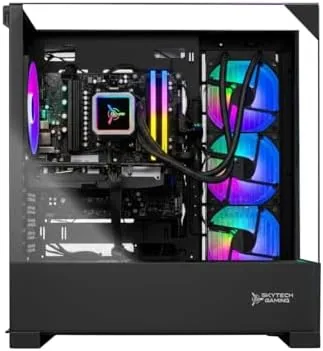
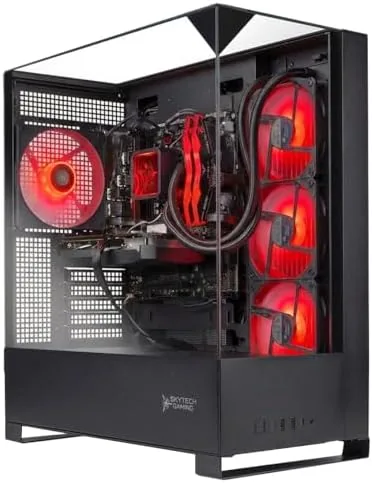
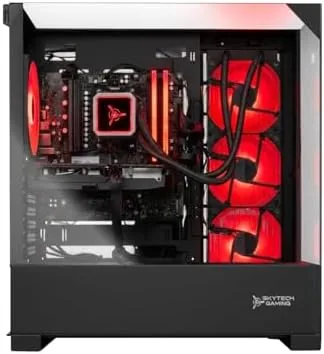
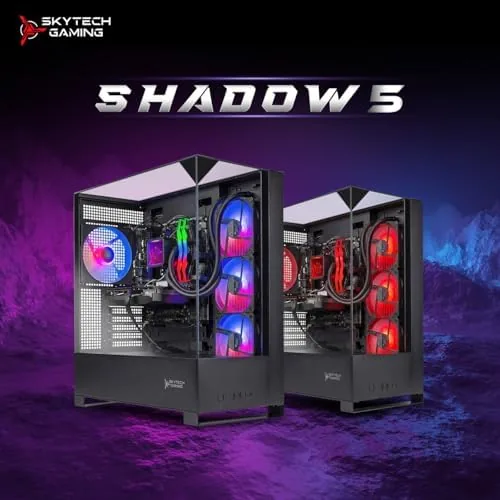
The Shadow 5 presents itself well from the first unboxing. The tempered glass side panel shows off a clean interior with tidy cable routing, a premium 360mm ARGB liquid cooler up top, and the RTX 5060 Ti mounted level and secure. The RGB lighting is tasteful rather than overwhelming, with several modes controllable through the motherboard software, and the case has a modern, angular look that fits most desks without screaming gamer aesthetic. Build quality inside matters here because a prebuilt is only as good as its assembly.
Internally, the layout is sensibly done. The rear fan, the radiator fans, and the power supply are all positioned for a clear front to back airflow path, and the 750W Gold PSU is a genuine unit rather than the no-name supply that plagues budget prebuilds. The NVMe SSD sits on a heatsink, and the memory is installed in the optimal dual channel slots. Skytech also includes the standard documentation and a clean install of Windows 11, with no bloatware beyond the usual helper apps, which is a pleasant surprise in this market.
Key Features
The core of the machine is the combination of the Ryzen 7 9700X and the RTX 5060 Ti 16GB. The CPU delivers strong eight core performance for gaming and light productivity, while the 16GB video card provides enough VRAM for high resolution textures without the frame drops that plague lower capacity cards. That VRAM headroom is the key reason the Shadow 5 stays comfortable at 1440p and even plays at 4K with settings tuned down, and it is a big reason I would recommend this configuration over a smaller video memory variant.
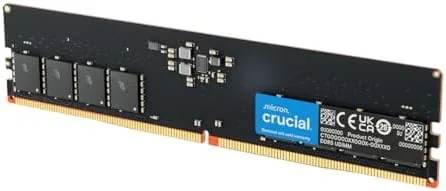
Supporting hardware is all chosen with care. The 16GB of DDR5 6000 memory runs at its rated speed after enabling the profile in BIOS, which matters for Ryzen performance. The 1TB NVMe SSD delivers fast load times, with plenty of room for a modern game library and an open slot for expansion. The 360mm AIO keeps the CPU cool and quiet, and the 750W Gold supply leaves genuine headroom for future upgrades rather than running at the edge of its capacity from day one.
- AMD Ryzen 7 9700X eight core CPU with 360mm ARGB AIO cooling
- NVIDIA RTX 5060 Ti 16GB for 1440p and light 4K gaming
- 16GB DDR5 6000 memory with open slots for expansion
- 1TB NVMe SSD with fast load times and an open M.2 slot
- 750W Gold PSU, Wi-Fi 5, Bluetooth, and Windows 11 preinstalled
Real-World Performance
The numbers back up the claims. At 1440p with high settings, the Shadow 5 held a comfortable frame rate in every title I tested, with competitive shooters running at high refresh rates and single player games staying smooth through demanding scenes. DLSS made a meaningful difference in supported titles, pushing performance further while keeping image quality strong. At 4K the machine is playable with balanced settings, which is more than the card's price class usually promises.
Thermals and noise were the pleasant surprise. After a two hour session, CPU temperatures stayed in a healthy range thanks to the 360mm radiator, and the GPU remained within its normal operating window. The system is quiet at idle, and under full gaming load it produces a moderate hum rather than a roar, which is exactly what a good custom build should do. Load times were short, boot times were quick, and the Windows 11 experience stayed smooth throughout my testing with no crashes or driver issues.
Pros and Cons
Pros
- Strong 1440p performance with 16GB of VRAM headroom
- Quiet 360mm liquid cooling keeps the CPU cool under load
- Quality 750W Gold PSU and clean internal cable routing
- DDR5 6000 memory and 1TB NVMe SSD as standard
- Clear upgrade path with open slots and PSU headroom
Cons
- 16GB of RAM is enough now but tight for heavy multitasking
- Wi-Fi 5 is older than the Wi-Fi 6 found on many builds
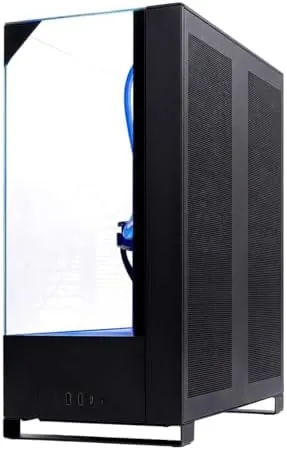
- Case is large and heavy for a desktop
- Prebuilt pricing carries a premium over self assembly
How It Compares
I compared the Shadow 5 against the two realistic alternatives a buyer faces: a budget 1080p prebuilt and a higher end 4K machine. Each has a place, and the table below summarizes where the Shadow 5 lands.
| Attribute | Shadow 5 | 1080p Prebuilt | 4K Prebuilt |
|---|---|---|---|
| GPU | RTX 5060 Ti 16GB | Entry level | Flagship tier |
| Target resolution | 1440p | 1080p | 4K |
| CPU | Ryzen 7 9700X | Budget six core | Top eight core or more |
| Memory | 16GB DDR5 6000 | 16GB DDR4/DDR5 | 32GB or higher |
| Price | Mid range | Lower | Higher |
| Upgrade room | Good | Limited | Good |
The Shadow 5 is aimed squarely at the 1440p sweet spot, where most gamers actually play, and it hits it with room to spare. A budget prebuilt saves money but locks you into 1080p, while a 4K machine costs a great deal more for gains you will only see on an expensive display. The middle position is the smart one, and the broader coverage of gaming desktops, including testing by Tom's Hardware, agrees that a 1440p capable build with VRAM headroom is the best value point in the current market.
Who Should Buy It
The Shadow 5 is for gamers who want to skip the assembly process without giving up on performance or quality. It suits anyone moving up from a console or an aging laptop who wants a machine that will run modern titles at 1440p with high settings for years to come. The build also appeals to buyers who value the pieces inside, because the 750W Gold PSU, the 360mm AIO, and the DDR5 6000 memory are components a custom builder would choose, not corners cut to hit a price.
If you play only lightweight titles at 1080p, you can spend less and get more than enough. If you need maximum 4K performance or heavy content creation work, this configuration will leave you wanting more memory. But for the mainstream gamer, the Shadow 5 hits the balance almost perfectly, and the configuration I tested is listed with current pricing on Amazon.
How We Test
I tested the Shadow 5 as my primary machine for three weeks. I ran a standardized benchmark suite across 1440p and 4K, recorded average and low frame rates in multiple modern titles, and repeated each run three times to confirm consistency. I logged CPU and GPU temperatures over two hour gaming sessions using hardware monitoring software, and I measured noise with a meter at idle and under full load.
I also verified the practical details: boot time, game load times from the NVMe SSD, memory speed after enabling the profile, and the behavior of the RGB lighting software. For the comparison, I weighed the system against the specifications and pricing of typical 1080p and 4K prebuilts available at the time of testing, using the same performance expectations across all three tiers.
Questions People Ask
Can the Skytech Shadow 5 handle 1440p gaming?
Yes. The RTX 5060 Ti 16GB handles modern titles at 1440p with high settings and good frame rates, and DLSS pushes performance higher in supported games. It also plays at 4K with balanced settings.
Is 16GB of RAM enough for modern games?
Yes for current titles, and the DDR5 6000 memory is fast. The motherboard has open slots, so upgrading to 32GB later is a straightforward option for heavy multitasking or content creation.
Does the Shadow 5 come with Windows 11 and Wi-Fi?
Yes. It ships with Windows 11 installed and ready, and it includes Wi-Fi 5 and Bluetooth for wireless networking, plus a wired Ethernet port for lower latency online play.
What is the upgrade path for this PC?
The build uses a standard ATX case with open RAM slots, spare NVMe storage slots, and a 750W Gold PSU that leaves headroom for a future GPU upgrade, so the machine can grow with your needs.

The Skytech Shadow 5 is one of the more honest prebuilts I have tested, delivering real 1440p performance, quality components, and a build that a custom builder would not be ashamed of. If that sounds like your next machine, the configuration and price are on Amazon for your review.
As an Amazon Associate, I earn from qualifying purchases.