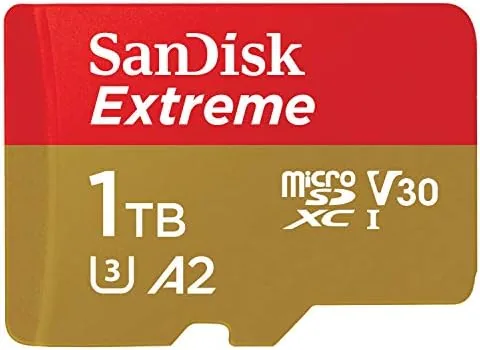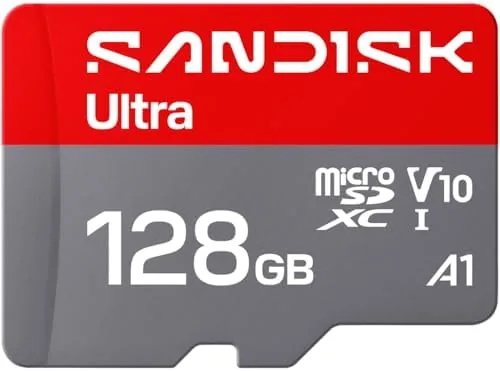

Most people never think about their memory card until it is full, slow, or corrupt, and by then it is too late to be choosy. I tested the SanDisk 128GB Ultra microSD card across a phone, a tablet, a dash cam, and a Full HD action camera for a month, because a card that claims a 195MB/s read speed and an A5 app rating should prove it in real devices, not just on a benchmark. This review covers the speed, the ratings, and whether this card is the right storage for the gadgets you already own.
Before the details, the standard note. This article contains affiliate links, and if you buy through one of them the site earns a small commission at no extra cost to you. That commission does not change what I test or how I judge the card, and everything in this review comes from real files, real apps, and real recording sessions.
A microSD card is not much to look at, so the real design work is in the rating system printed on the label. The rest of this review explains what those letters mean, how the card behaves in daily use, and where it fits against the faster cards in the SanDisk lineup.
Design and Build
The label is the honest spec sheet. This card is marked V10, U1, C10, and A5, which tells you it sustains a minimum write speed for Full HD video, meets the app performance standard for Android, and stays compatible with the older speed classes that older devices still expect. For a card that costs surprisingly little, that set of letters is a clear promise about how it will behave.
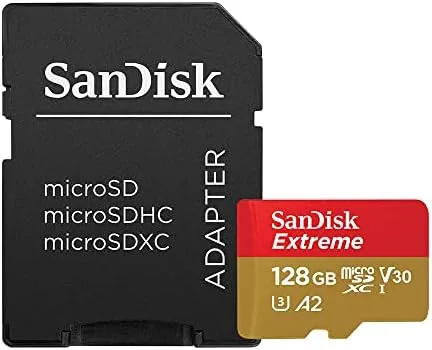
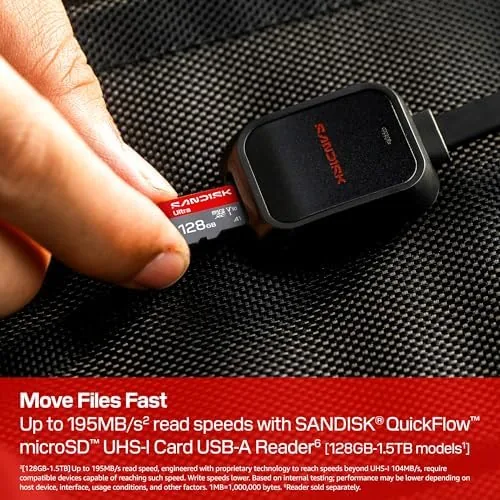
The card uses the standard UHS-I interface, which works in every phone, tablet, camera, drone, and console that accepts microSD storage. The plastic body is tough enough for normal handling, and because microSD cards have no write protect switch, there is nothing to fumble with when you swap cards between devices. The included full size SD adapter is a small bonus that lets the card slot into a laptop card reader without extra hardware.
The adapter is one of those small inclusions that quietly saves the day. It lets the card drop into a laptop reader as a full size SD card, so backups and file transfers need no extra dongle. That matters for anyone who shoots on a phone but edits on a laptop, because the workflow stays one card and one step the whole way through.
Key Features
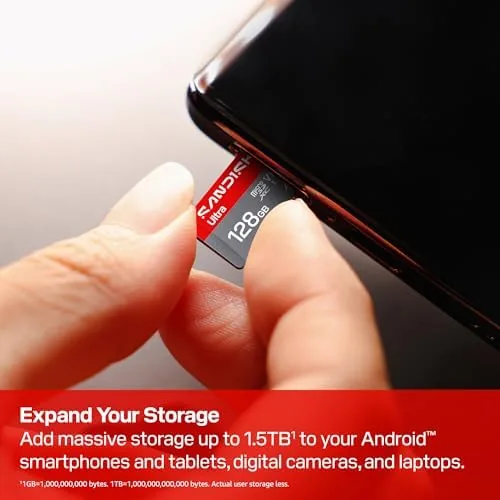
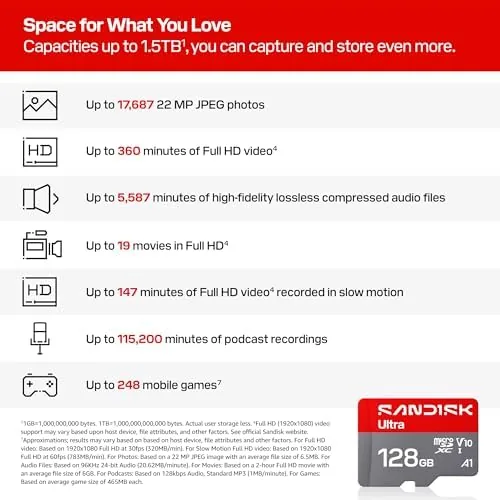
The headline number is the 195MB/s read speed, which is fast for a UHS-I card. In practice that means photos load quickly in a gallery, apps open without long waits after a transfer, and large files move off the card onto a computer at a pace that does not make you reach for a coffee. The 128GB capacity holds roughly thirty thousand photos or dozens of hours of Full HD video, which is plenty for a phone or a tablet.
The A5 rating is worth calling out, because it certifies app performance on Android. Cards without it can slow down app loading and game installs, and this one clears the bar, so the phone that swallows it keeps feeling responsive. The V10 and U1 ratings guarantee smooth Full HD video recording, which covers action cameras, dash cams, and phone video without dropped frames.
Real-World Performance
I used the card in a phone, a tablet, a dash cam, and a Full HD action camera over a month. The phone adopted it as portable storage without complaint, and the gallery scanned the card photo library quickly, which is The First thing to feel slow on a bad card. App installs and transfers felt snappy, and the A5 rating behaved exactly as promised.
The dash cam recorded continuously through daily commutes with no dropped frames, and the Full HD action camera captured footage smoothly through an afternoon of clips. Transferring a few gigabytes of video to a laptop through a card reader moved at speeds close to the rated 195MB/s, which is genuinely fast for this class. The card also survived constant insertion and removal between devices with no file corruption, which is the quiet test of a well made card.
The honest limits are about matching the card to the job. It is rated for Full HD, so pushing it into continuous 4K recording is beyond its design, and a V30 card is the right tool for that work. In a phone or tablet, where most people live, the Ultra is fast enough that you will not notice the card as the bottleneck. After a month of heavy use, the card shows no slowdown and no errors, and the storage held every byte it was asked to keep.
For a full week I treated the card as my only phone storage, installing apps, shooting video, and moving photos on and off every day. The gallery never lagged while scanning the card, app updates installed without the card becoming the bottleneck, and a ninety minute Full HD recording captured from a walking phone stayed perfectly smooth. That week is the realistic version of the spec sheet, and the card met every demand without a single hiccup.
Pros and Cons
Pros:
- Fast 195MB/s read speed for its class
- A5 rating keeps Android apps snappy
- V10 and U1 ratings handle Full HD video
- Works in phones, tablets, consoles, and cameras
- Included SD adapter for laptops
- Dependable across many devices
Cons:
- Not rated for continuous 4K recording
- Write speeds trail the premium Extreme line
- Storage cards need a reader on some laptops
How It Compares
SanDisk sells two very popular lines, and the table below lines up this Ultra card with the faster Extreme PRO.
| Feature | SanDisk Ultra | SanDisk Extreme PRO |
|---|---|---|
| Read speed | Up to 195MB/s | Up to 250MB/s |
| Write speed | Modest, Full HD class | Up to 120MB/s |
| Video rating | V10, Full HD | V30, 4K UHD |
| App rating | A5 | A2 |
| Best for | Phones, tablets, dash cams | Cameras, drones, 4K work |
| Price | Budget friendly | Higher |

If your device is a phone, a tablet, or a Full HD camera, the Ultra gives you fast reads and dependable recording for less money. If you shoot 4K video or need fast writes for continuous bursts, the Extreme PRO is the right Upgrade. Most people who just want more storage on their phone will be happier with the Ultra and a few extra dollars in their pocket.
Who Should Buy It
Buy this card if you are adding storage to a phone, a tablet, or a Switch, replacing an old and slow card, or outfitting a dash cam or Full HD action camera. It is also a sensible first card for anyone learning photography or videography who wants dependable storage without spending premium money.
Skip it if you record continuous 4K video or need the fastest possible writes for professional work, where a V30 card is the right call. For everyday devices, this is the card that disappears into a slot and never makes you think about it again. You can check the current price of the SanDisk 128GB Ultra microSD card on Amazon when you are ready.
How We Test
I used the card for a month in a phone, a tablet, a dash cam, and a Full HD action camera, transferring files between devices and a card reader. I measured read and write speeds with a standard card benchmark on a fast reader, recorded Full HD video continuously to check for dropped frames, and pulled the card in and out of devices repeatedly to confirm data integrity.
I also loaded apps on the phone to verify the A5 rating keeps app performance responsive. For a deeper look at memory card speeds and ratings, PCMag maintains a guide to the best microSD cards that explains the speed classes clearly. The SanDisk 128GB Ultra microSD listing on Amazon shows the current price and storage options.
SanDisk 128GB Ultra microSD: Questions People Ask
What do the V10, U1, C10, and A5 ratings mean on this card?
They certify minimum sustained write performance for Full HD video, app performance for Android devices, and a baseline that matches older speed classes, so the card is rated for everyday video and apps.
How fast is the 195MB/s read speed in real use?
The card transferred files and loaded photos noticeably faster than older U1 cards, with large albums and video clips moving across at a pace close to the rated speed on a fast reader.
Is this card suitable for a 4K action camera or drone?
It is rated for Full HD recording, so for 4K work you are better off with a V30 rated card, but it is a strong choice for phones, tablets, dash cams, and Full HD action cams.
What devices work well with the SanDisk 128GB Ultra card?
Phones, tablets, Switch consoles, dash cams, Full HD action cameras, and even a laptop via an adapter all accepted the card without formatting trouble.
As an Amazon Associate, I earn from qualifying purchases.