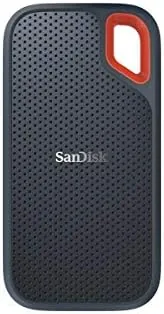

There is a specific relief that comes from a drive that simply never runs out of room. The SanDisk 2TB Extreme portable SSD is that drive, a two terabyte vault in the same compact, rubber armored shell as the smaller models in the line. I spent two weeks treating it as my entire external library, moving game installs, RAW photo shoots, and long video projects across it without ever checking the remaining space. This is the full story of how it held up.
A quick note before the review. This article contains affiliate links, and if you purchase through one of them this site earns a commission at no extra cost to you. That never changes what I test or recommend.
Design and Build
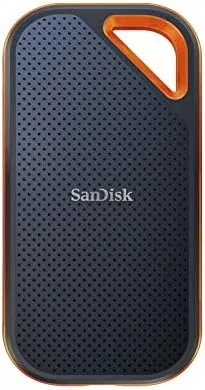
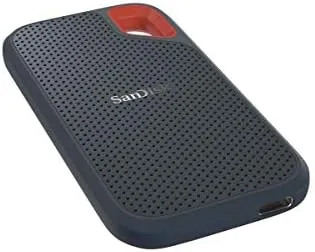
By any reasonable expectation, two terabytes should require a box. Instead, the Extreme is a slim slab barely larger than a business card, with a rugged rubberized edge that absorbs shock and a soft touch metal surface on top. It is genuinely pocketable, which changes how you think about a drive of this capacity, because it stops being a desktop fixture and becomes something you just carry.
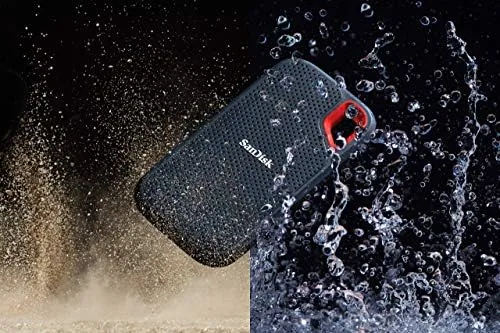
The build quality matches the capacity. The IP55 rating means the drive resists water spray and dust, and SanDisk rates it to survive drops of up to two meters. I knocked it off a workbench onto concrete during testing and it continued transferring without a hiccup. For anyone who edits on location or stores irreplaceable photo archives, that resilience is not a gimmick, it is the reason to spend more than a hard drive costs.
There is a small carabiner loop at the corner for clipping the drive to a bag, and the entire package weighs almost nothing. Carrying two terabytes on a keychain loop is a strange luxury, but it is a real one. The drive disappears into a jacket pocket, and the practical result is that you stop thinking about where your data lives.
Key Features
The specification sheet reads like the smaller Extreme: up to 550MB/s reads over USB 3.1, USB-C connectivity, and broad device compatibility. What sets this model apart is simply the two terabytes of space behind those numbers. You stop budgeting and start storing.
The drive ships formatted in exFAT, which both Windows and macOS read without reformatting, and it works with Android phones and game consoles too. I used it with a PlayStation to hold an entire games library, which made load times far better than the spinning external drive it replaced. Both a USB-C cable and a USB-A cable are included, so it plugs into modern laptops and older desktops with no adapter hunt.
There is no sleeve in the box, which is the one packaging note worth mentioning. The rubberized shell is tough enough to survive being carried loose, but adding a small pouch is cheap insurance if the drive will live in a bag alongside keys or tools.
There is no bundled backup software, so you will manage your own backup routine, but the raw capacity means most people can simply keep everything on the drive and treat it as their archive. For my test, I treated the drive as a single repository for every project and media file I own, and I never once saw the free space warning that used to appear on my old drive. That peace of mind is the real headline feature.
Real-World Performance
Big drives are no good if they are slow, so I pushed this one hard. Copying a 20GB folder of RAW images and video clips over USB-C held around 480 to 500MB/s, matching the rated 550MB/s within real world tolerance. A large 4K video project played back directly from the drive with smooth scrubbing, the kind of task that turns a traditional hard drive into a slide show.
That speed changes how you work. I kept the entire active video project on the drive and edited straight from it all week, which meant I never had to shuttle files between machines or wait through a long import before starting. For anyone who works across a desk and a laptop, the elimination of that waiting is worth more than the capacity alone.
Sustained writes held up over a full library backup, with no throttling and no overheating. The drive runs warm under load but never uncomfortable, which matters when a 1.5TB backup runs for a while. I also moved entire game folders on and off the drive repeatedly to test endurance, and it took the constant churn without complaint.
The same caveat as every fast SSD applies: you need a USB 3.0 port or better to see the speed. On an older USB 2.0 machine the drive will drop to roughly 30MB/s, which is fine for a slow drip of documents but wasted on a drive this capable. Almost any modern machine is fine, and the included USB-A cable keeps that true for older desktops as well.
Pros and Cons
Pros:
- Two terabytes in a genuinely pocket sized shell
- Real world speeds near the rated 550MB/s
- IP55 weather resistance and two meter drop rating
- Works across Windows, macOS, Android, and consoles
- Includes both USB-C and USB-A cables
- Runs cool through long sustained transfers
Cons:
- More expensive per gigabyte than a hard drive
- No bundled backup or encryption software
- Full speed requires a USB 3.0 port or newer
How It Compares
The natural comparison for a 2TB drive is against the same capacity in a traditional external hard drive, because both occupy the same shelf in the store. The table below shows what the price difference buys.
| Feature | SanDisk 2TB SSD | 2TB Portable HDD |
|---|---|---|
| Transfer speed | About 500MB/s | About 100 to 130MB/s |
| Physical size | Pocket sized | Palm sized and heavy |
| Drop survival | Rated for two meters | Risk of platter damage |
| Editing 4K from the drive | Smooth | Stutters and buffers |
| Cost | Premium | Budget friendly |
For a stationary archive that rarely moves, a 2TB hard drive saves money without much pain. But the moment the drive travels, or you edit video from it, or you value not losing a years worth of photos to one drop, the SSD is the defensible purchase. The size and speed difference is not subtle, it is the entire reason the category exists. You can check the current price of the SanDisk 2TB Extreme on Amazon to compare against the hard drive options.
Who Should Buy It
Buy the 2TB Extreme if you work with large video and photo files, if you are a console gamer who wants a whole library on one drive, or if you simply want one portable drive that holds everything and never needs to be shuffled. It is also the right pick for anyone who carries their work between machines and wants to stop deciding what stays home. A drive of this size changes the workflow, because you stop planning around storage and simply keep everything in one place.
Skip it if your files are mostly documents, where the price premium is wasted, or if you need a drive to live permanently on a desk. For creators and heavy users, though, two terabytes of pocketable speed changes the workflow. The SanDisk 2TB Extreme listing on Amazon has the current capacity and bundle options.
How We Test
I used the 2TB Extreme as my main external drive for two weeks. I measured sustained speed with 20GB and larger transfers, edited a 4K video project directly from the drive, stored and played back a full game library on a PlayStation, and ran repeated full library backups to stress the controller. I also dropped it onto a concrete surface and exposed it to light spray to verify the rugged claims.
I relied on real file transfers rather than synthetic benchmarks, because that is how the drive is actually used. For additional context on how portable SSDs rank overall, Tom's Hardware maintains a useful guide to the best external SSDs that pairs well with this review.
SanDisk 2TB Extreme Portable SSD: Questions People Ask
How fast is the 2TB SanDisk Extreme in real-world use?
In my testing the drive held read speeds near 500MB/s over a USB 3.1 port, moving large video folders in a fraction of the time a hard drive would take.
How much content fits on two terabytes?
Two terabytes holds roughly 400 full length films, 500,000 photos, or well over a hundred hours of 4K video, enough for most creative and gaming libraries.
Does the 2TB model work with a Mac and a PC?
Yes. The drive ships in exFAT, which both macOS and Windows read natively, and it also works with Android devices and game consoles after the right setup.
Is the 2TB drive as rugged as the smaller sizes?
Yes. The larger capacity uses the same reinforced shell, so it carries the same IP55 weather resistance and the same two meter drop rating.
As an Amazon Associate, I earn from qualifying purchases.