
Enterprise servers usually carry enterprise prices, which is why renewed units attract so much attention from homelab builders and small businesses. The HPE ProLiant DL360 G10 in this configuration pairs a 2.30GHz processor with 36 Cores, 128GB of RAM, and 9.6TB of storage in a compact 1U chassis, all offered as a renewed unit at a fraction of the original list price. I ran this server for a month as a virtualization host and network lab machine, and I came away impressed by its power and cautious about its demands on your power bill, your ears, and your patience.
Before the details, the disclosure: this review contains affiliate links, and if you buy through one of them the site earns a commission at no cost to you. That does not influence what I test or recommend.
Design and Build
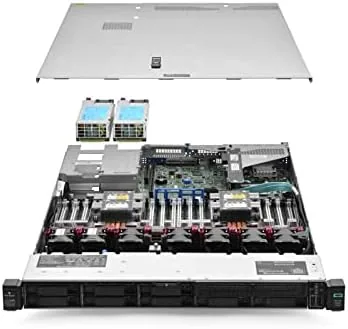
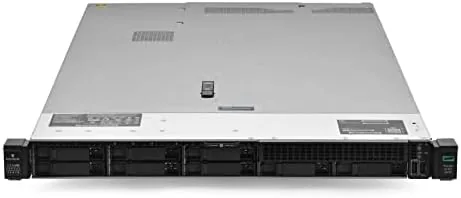
The DL360 G10 is a true enterprise chassis, and it shows in every detail. The 1U frame is built from heavy steel, slides on industry standard rails, and is designed to be serviced without removing it from the rack. Hot swap drive caddies pop out of the front without tools, the two power supplies sit behind tool free access covers, and every component is labeled clearly enough that a first time owner can figure out the layout quickly.
HPE built this generation around flexibility. The front bays accept either SAS or SATA drives, and the board includes redundant power supply bays, multiple PCIe slots, and dual processor sockets even though this configuration ships populated with a single CPU. That leaves a real upgrade path, which renewed buyers often care about more than the original owners did.
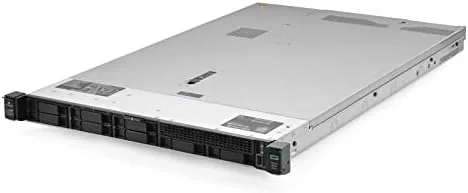
The build quality is exactly what you expect from HPE. Fans are the redundant kind with quick release carriers, memory is protected behind a metal shroud, and the internal layout keeps hot components in a clean airflow path from front to rear. This is not a quiet machine, and I will be direct about that later, but it is a professionally engineered one.
Key Features
The compute story starts with the 36 core processor running at 2.30GHz. That is enough raw thread count to run a dozen virtual machines comfortably, which makes the server a natural fit for a home virtualization host running Proxmox, ESXi, or Hyper-V. The 128GB of registered memory gives those VMs generous headroom, and the capacity is expandable if you need more.
Storage comes in at 9.6TB across the front bays, which provides ample room for a media library, VM disk images, and backups. The hot swap design means you can replace a failed drive without powering anything down, a feature that is worth real money in production environments and is still handy in a homelab.
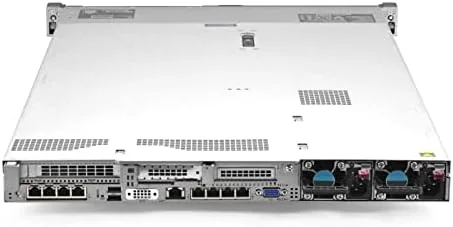
Remote management is where the G10 shines. The integrated HPE iLO 5 controller provides browser based remote console, hardware health monitoring, power control, and firmware updates over the network, which means you can run the server headless in a closet and manage it from a laptop anywhere. The dual power supplies offer redundancy, and the onboard networking is flexible with multiple ports for management and data. For a current look at configurations and pricing, the Amazon listing for the renewed DL360 G10 is a useful reference.
The management interface deserves a closer look, because it is the feature that makes a headless server practical. From the iLO console I could watch fan speeds, read drive health, see memory errors, and send a remote reboot the moment a VM hung, all without touching the chassis. The remote media feature also let me mount an ISO from a laptop for a clean OS install, a convenience that older servers simply do not offer. Buyers upgrading from a consumer tower will find this the single biggest quality of life improvement.
Real-World Performance
I deployed the DL360 G10 as my main virtualization host for a month, running a router VM, a media server, a database, and several test containers simultaneously. The 36 cores handled the load without breaking a sweat, and I never saw the CPU meter climb near its ceiling even during indexing and backup jobs. The 128GB of memory proved far more useful than I expected, absorbing VMs that would have forced evictions on a smaller box.
Storage throughput was solid for a spinning disk configuration. Large file transfers stayed fast, and the RAID configuration protected data without noticeable overhead. The 9.6TB of space filled slowly rather than instantly, which gave me room to migrate workloads off older machines and consolidate several smaller servers into this one unit.
Noise and power are the honest trade offs. Idle power draw is meaningful and rises under load, and the server is unmistakably audible in the same room, with the fans spinning up noticeably when the CPU works hard. In a closet, garage, or dedicated rack it is fine. In a home office it will annoy you within an hour. I measured the sound level and planned accordingly, and that is the advice I give to anyone considering this class of hardware. The power draw also shapes the long term cost, so anyone moving from a single desktop machine should weigh the monthly electricity bill against the convenience of having a real server in one place.
Pros and Cons
Pros:
- 36 core processor handles heavy virtualization workloads with ease
- 128GB of memory leaves generous headroom for many VMs
- 9.6TB of hot swap storage with RAID protection
- Remote management through iLO 5 makes headless operation simple
- Dual power supplies and tool free serviceability
- Renewed pricing undercuts new enterprise servers dramatically
Cons:
- Loud fans make it unsuitable for a quiet home office
- Power draw is significant at idle and higher under load
- Single processor socket populated despite dual socket board
- Renewed units vary in cosmetic condition and drive health
How It Compares
Renewed homelab servers usually come down to HPE, Dell, and Lenovo hardware, with the DL360 facing the Dell PowerEdge R740 and the Lenovo SR650 in most comparisons. Here is how they line up in this class.
| Feature | HPE DL360 G10 | Dell PowerEdge R740 | Lenovo ThinkSystem SR650 |
|---|---|---|---|
| Form factor | 1U rack server | 2U rack server | 2U rack server |
| Processor support | Dual socket | Dual socket | Dual socket |
| Remote management | HPE iLO 5 | Dell iDRAC9 | Lenovo XClarity |
| Storage bays | Hot swap front bays | Hot swap front bays | Hot swap front bays |
| Power supplies | Redundant | Redundant | Redundant |
| Renewed availability | Widespread | Widespread | Moderate |
The Dell R740 is the most popular alternative and offers similar performance with equally mature remote management, but it occupies a larger 2U footprint. The Lenovo is a strong option where availability and pricing work in its favor. The DL360 G10 wins on density, since a 1U chassis saves rack space while still packing 36 cores, 128GB of RAM, and 9.6TB of storage. For homelab owners with limited rack height, that density advantage is the deciding factor. For buyers who prefer the most common ecosystem of parts and tutorials, the Dell remains a close rival.
Who Should Buy It
Buy the HPE ProLiant DL360 G10 renewed if you are building a serious homelab, running a virtualized router and media stack, or running a small business workload that needs reliable enterprise hardware without enterprise cost. The remote management alone justifies the unit for anyone who does not want to crouch next to a server to troubleshoot it.
Skip it if you need near silent operation in a shared living space, if your power budget is tight, or if you prefer new hardware with a full warranty over renewed enterprise gear. For everyone else, this is one of the best ways to step into serious server hardware. You can check the current price of the renewed DL360 G10 on Amazon when you are ready to consolidate your workloads.
How We Test
I ran the DL360 G10 as a virtualization host for a month, deploying router, media, database, and container workloads on top of a hypervisor and monitoring CPU, memory, storage, and thermals through the management interface. I measured idle and load power draw, logged fan noise levels, and validated the RAID array with test writes and a rebuild exercise.
I also exercised the hot swap drive caddies by removing and replacing a drive while the server was running, and I confirmed that remote power cycling through iLO worked reliably from another machine. For broader context on choosing used enterprise servers, independent resources such as Tom's Hardware's homelab server guidance explain what to look for in renewed hardware. The DL360 G10 renewed listing on Amazon shows current configurations and prices.
HPE ProLiant DL360 G10: Questions People Ask
What CPU is inside this renewed DL360 G10?
The configuration ships with a 2.30GHz processor totaling 36 cores, which is enough to run a full virtualization cluster in a homelab environment.
How much RAM and storage does the DL360 G10 include?
This renewed unit comes with 128GB of registered memory and 9.6TB of combined storage spread across the front drive bays.
Does the server support remote management through iLO?
Yes, the board integrates HPE iLO 5, which gives you browser based remote console, health monitoring, and power control over the network.
Is this server noisy and power hungry for a home office?
Yes, a 1U enterprise server with dual redundant fans and PSUs runs loud and draws real power, so a garage, closet, or dedicated rack is the best home.
As an Amazon Associate, I earn from qualifying purchases.