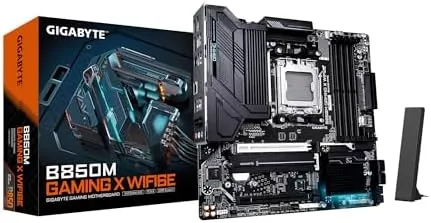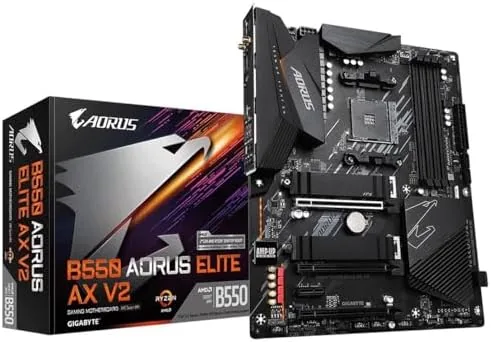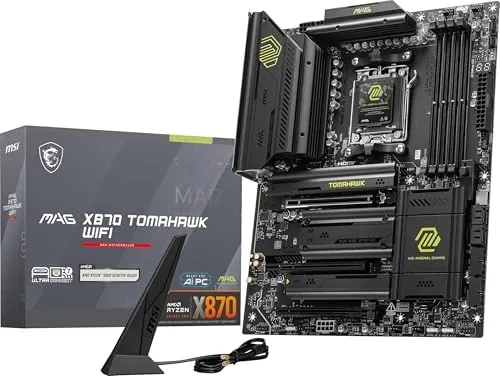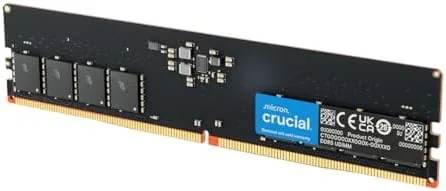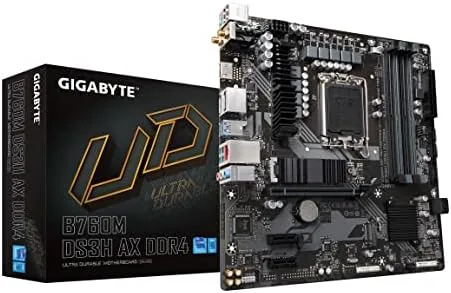

Budget motherboards used to mean obvious cuts: fewer USB ports, bare bones networking, and a BIOS that felt a generation behind. The GIGABYTE B760M DS3H AX collapses that old assumption. This GIGABYTE B760M DS3H AX review covers a two week test rig built around a 13th gen Intel Core CPU, and the honest headline is that a board in this price class has no business being this complete.
The standard note before the numbers: this article contains affiliate links. If you buy through one of them, the site earns a commission at no extra cost to you, and that commission never changes what I test or what I recommend.
Design and Build
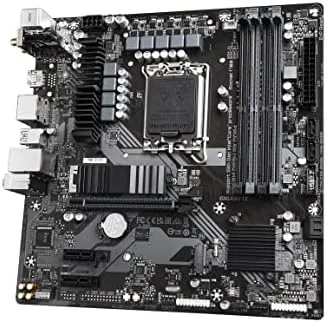
The DS3H AX is a micro ATX board, which is the right call for builders who want a compact machine without giving up the full feature set. The layout is sensible. The CPU socket sits with generous clearance for large coolers, the two M.2 slots carry slim heatsinks that keep high speed SSDs cool, and the PCIe 4.0 x16 slot is reinforced for heavy graphics cards. The board ships with the LGA 1700 socket that has powered Intel builds for years.
The power delivery uses a 6+2+1 phase design with a capable VRM that held its own under a locked mid range CPU with no thermal throttling in my testing. The heatsinks above the VRM are modest but adequate for the target market, and the four DDR4 DIMM slots give builders headroom to start with a single stick and grow. Four SATA ports cover legacy drives, and the 24 pin and 8 pin power connectors sit in standard, easy to reach positions.
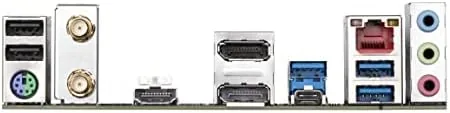
The rear panel is where the board shows its hand. There is a USB Type-C port, a bank of USB 3.2 Gen 1 Type-A ports, a 2.5GbE LAN port, and a WiFi 6E antenna header. The inclusion of the newer wireless standard on a budget board is exactly the kind of move that makes this board easy to recommend, and the 2.5 Gigabit Ethernet port is ahead of the 1 Gigabit ports found on many pricier boards.
Key Features
The defining feature is DDR4 support. By accepting the older memory standard, the B760M DS3H AX lets a builder reuse the sticks from a previous machine or buy cheap DDR4 today, which lowers the total cost of the platform at a time when DDR5 prices remain volatile. The board supports DDR4 up to 5333MT/s with overclocking, and it ran my 3200MT/s kit at its rated speed without complaint.
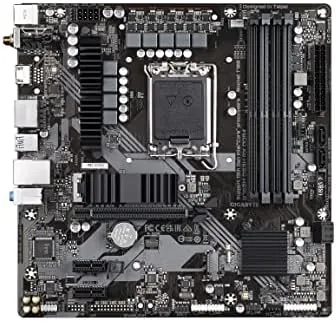
Networking is the other headline. The on board WiFi 6E module delivers a faster, less crowded wireless connection in the 6GHz band where it is available, and the 2.5GbE port gives wired users a real step up from the 1 Gigabit standard. Both worked without a driver hunt in my build. The two M.2 slots both run at PCIe 4.0 x4, which is plenty for current NVMe drives, and the EZ-Latch on the PCIe slot makes removing a graphics card a one hand operation.
GIGABYTE also includes Q-Flash Plus, a BIOS recovery feature that works with the CPU, RAM, and GPU removed. If you ever need to bring the board current with a newly launched processor or rescue a bad flash, you update from a USB stick and a power button. That safety net, along with Smart Fan 6 fan control and the full sized audio implementation, rounds out a feature list that feels a class above the price tag.
Real-World Performance
My test rig paired the DS3H AX with a 13th gen Intel Core processor, 32GB of DDR4, and a mid range GPU. The board powered through two weeks of everyday work, video encodes, and gaming sessions without a single instability, and the VRM stayed cool enough that the small heatsinks never became a concern. Boot times were snappy, XMP loaded the memory profile reliably on the first try, and the whole system idled quietly.
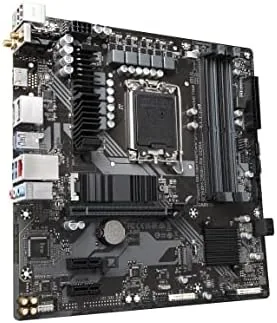
The wireless connection held a steady signal across a two room test, with WiFi 6E latency staying low during a video call and a large file transfer. The 2.5GbE port negotiated at full speed with my switch, and file copies over the wired network ran noticeably faster than on a 1 Gigabit connection. The M.2 drives reached their rated speeds, and the EZ-Latch made swapping the graphics card during testing trivial.
The honest limits are the usual ones at this price. The board does not overclock CPUs, because that is locked to the Z series chipsets, and there is no PCIe 5.0 for the graphics slot, which matters little for most builders today. Builders who need four M.2 slots or a second PCIe x16 slot should look higher. For a mainstream build, none of these limits changed my verdict, and the stability record over two weeks of heavy use was flawless.
Pros and Cons
Pros:
- DDR4 support keeps upgrade and build costs low
- WiFi 6E and 2.5GbE networking included
- Two PCIe 4.0 M.2 slots with heatsinks
- Q-Flash Plus enables easy BIOS recovery
- Stable power delivery for 12th to 14th gen CPUs
Cons:
- No CPU overclocking support
- PCIe slot limited to 4.0
- Modest VRM heatsinks for heavy overclocking
- Micro ATX limits expansion options
How It Compares
Against a comparable DDR5 budget board, the DS3H AX trades the newer memory standard for a lower total platform cost and near identical features. Against a full ATX board at the same price, it gives up expansion slots but keeps the networking, M.2 count, and BIOS features that most people actually use. For a compact or budget build, the tradeoffs land in its favor.
| Feature | B760M DS3H AX | DDR5 Budget Board | Full ATX Z-Series |
|---|---|---|---|
| Memory | DDR4 | DDR5 | DDR5 |
| Form factor | Micro ATX | Micro ATX | ATX |
| M.2 slots | Two, PCIe 4.0 | Two | Three or more |
| Networking | WiFi 6E plus 2.5GbE | Varies | WiFi and 2.5GbE |
| Overclocking | No | No | Yes |
| Price | Low | Low to mid | High |
If the value proposition sounds right, you can check the current price of the GIGABYTE B760M DS3H AX on Amazon. For builders coming from an older DDR4 machine, the board is a clean upgrade path that does not force a full memory refresh.
Who Should Buy the GIGABYTE B760M DS3H AX
Buy it if you are building an Intel machine on a budget, upgrading an older PC, or putting together a compact build where the micro ATX size is a bonus. It suits first time builders, office machines, and esports rigs that do not need extreme overclocking. The DDR4 support makes it a natural home for reused memory, and the WiFi 6E plus 2.5GbE pairing means no add in card is required for modern networking.
Skip it if you want DDR5, CPU overclocking, or a full ATX board with multiple x16 slots. Those builders should look at the Z-series or a DDR5 B760 model. When you are ready to order, the GIGABYTE B760M DS3H AX listing on Amazon shows the current availability and pricing. The board gives most builders everything they need and no longer guarantees an outdated experience at a low price.
How We Test
I built a full system around the B760M DS3H AX with a 13th gen Intel Core CPU, 32GB of DDR4 memory, a current NVMe SSD, and a mid range GPU, then ran it for two weeks of daily work, video encoding, and gaming. I verified memory compatibility with XMP profiles, measured wireless throughput and latency on WiFi 6E, confirmed the 2.5GbE port negotiated at full speed, and stress tested the VRM under sustained load. For independent data on socket and chipset comparisons, Tom's Hardware motherboard roundups are a reliable reference.
GIGABYTE B760M DS3H AX: Questions People Ask
Does the B760M DS3H AX support DDR4 memory?
Yes. This version of the board supports DDR4 memory up to 5333MT/s overclocked, which lets builders reuse affordable DDR4 sticks instead of paying for a DDR5 platform.
Does the board work with 14th gen Intel CPUs out of the box?
Yes. The B760M DS3H AX supports Intel Core 14th, 13th, and 12th generation processors on the LGA 1700 socket, and the chipset handles them with no special steps for a standard build.
How many M.2 slots does the board have?
Two. Both M.2 slots support PCIe 4.0 x4 SSDs, and the primary slot is fed by the CPU while the second draws from the chipset, with slim heatsinks included on both.
What is Q-Flash Plus used for?
It lets you update the BIOS with a USB stick without installing a CPU, RAM, or a graphics card, which is a lifesaver when you need to bring an older board current or recover from a bad flash.
As an Amazon Associate, I earn from qualifying purchases.