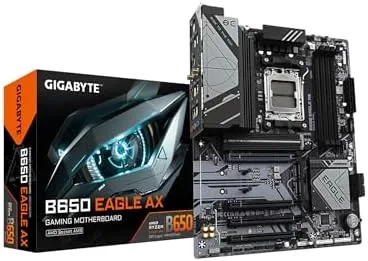

Building a gaming PC is a series of small bets, and the motherboard is the bet you make first. The GIGABYTE B650 Eagle AX is my latest pick for a test build, and this GIGABYTE B650 Eagle AX review records two weeks of gaming, streaming, and content work on the AM5 platform. The short version: this board gives you almost everything a modern build needs and keeps the price at a level that makes sense for a mid range or upper mid range rig.
The disclosure before the details. This article contains affiliate links. If you buy through one of them, the site earns a commission at no extra cost to you, and that commission never changes what I test or how I score it.
Design and Build
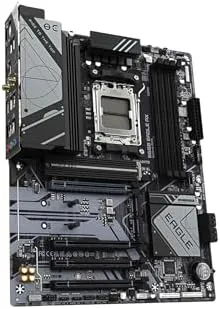
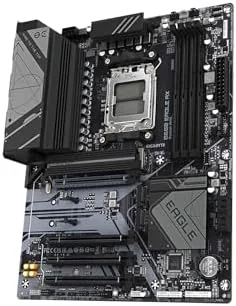
The Eagle AX is a full ATX board on the AM5 socket, built around the B650 chipset and ready for Ryzen 7000, 8000, and 9000 series processors. The layout is clean and builder friendly. The reinforced PCIe x16 slot sits in the primary position, the three M.2 slots are stacked with slim heatsinks, and the DIMM slots carry the usual GIGABYTE steel armor for support. The board looks the part too, with a dark PCB and subtle silver accents that will not fight your case lighting.
Power delivery uses a 12+2+2 phase digital design, which is more than enough for the top of the Ryzen 9000 range. In my build a Ryzen 9 class CPU ran flat out under an all core stress test with the VRM staying cool and quiet, and the heatsinks above the power stages did their job without drama. Four DDR5 slots give room for capacity growth, and the board supports high speed memory kits well beyond the 6000MT/s sweet spot that AMD builders aim for.
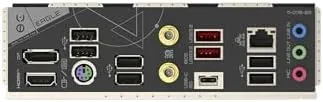
The rear panel rounds out the story with a USB 3.2 Gen2x2 Type-C port, a full complement of USB Type-A ports, a Realtek Gigabit Ethernet port, and the WiFi 6E antenna headers. Display outputs include HDMI and DisplayPort for processors with integrated graphics. For a gaming build, the port selection covers everything from fast external drives to a high refresh monitor without adapters.
Key Features
Storage is where this board wins the spec sheet war. The triple M.2 layout starts with a PCIe 5.0 x4 slot fed directly by the CPU, which unlocks the fastest drives on the market at their full speed, and adds two PCIe 4.0 x4 slots for the vast majority of current SSDs. My PCIe 5.0 drive hit its rated throughput without any configuration, and the heatsinks kept both drives well within temperature limits during long game installs.
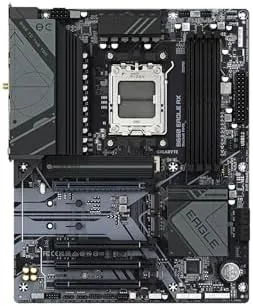
Connectivity is generous. The USB 3.2 Gen2x2 Type-C port delivers up to 20Gbps, which makes short work of copying large video files to an external drive, and the WiFi 6E module brings the faster 6GHz band to the wireless side. The EZ-Latch on the M.2 slots means drives click into place without a screwdriver, a small convenience you appreciate on your third drive install. The board also carries GIGABYTE Smart Fan 6 control and RGB Fusion lighting support.
DDR5 support is the final pillar. The board runs high speed memory kits with EXPO profiles, and my 6000MT/s kit enabled its rated profile on the first boot with zero instability across the full test period. For a gaming build, memory at this speed is the sweet spot for Ryzen, and the board treats it as a first class citizen rather than an afterthought.
Real-World Performance
My test rig paired the Eagle AX with a Ryzen 9000 series CPU, 32GB of fast DDR5, a PCIe 5.0 SSD, and a current flagship GPU. Over two weeks of gaming, streaming, and video rendering, the board did not miss a step. Frame rates matched expectations, the PCIe 5.0 drive delivered load times that are basically waiting for the game to be ready, and the whole system ran stable through extended sessions with no crashes and no thermal surprises.
The wireless connection held a strong signal for a cloud gaming session and a large file transfer from a NAS, with WiFi 6E latency staying comfortably low. The 20Gbps Type-C port moved a large video project to an external SSD in a fraction of the time a standard port would take. During the all core stress test the VRM stayed stable and quiet, which is the exact behavior you want from a board in this class.
The honest limits are modest. The B650 chipset does not offer the raw expansion of the flagship X670 boards, and the board stops at Gigabit Ethernet where some rivals add 2.5GbE. Gamers with a 2.5 Gigabit switch will want to check that detail, and builders planning four M.2 drives should look higher up the range. For the vast majority of gaming and streaming builds, neither limit moved my verdict, and the two week stability record was spotless.
Pros and Cons
Pros:
- Triple M.2 layout with one PCIe 5.0 slot
- Stable 12+2+2 phase power delivery
- USB 3.2 Gen2x2 Type-C at up to 20Gbps
- WiFi 6E and EZ-Latch convenience
- Full DDR5 support for Ryzen 7000 to 9000
Cons:
- Gigabit Ethernet only, no 2.5GbE
- B650 chipset limits high end expansion
- No USB 4 port
- Heatsinks cover only some M.2 slots
How It Compares
Against the flagship X670 boards, the Eagle AX gives up a second PCIe 5.0 slot, more USB bandwidth, and some overkill VRM headroom while keeping the price far lower. Against a micro ATX B650 board, it wins on expansion room and the full size ATX layout while staying in the same value conversation. For a gaming build, the balance is squarely in its favor.
| Feature | B650 Eagle AX | B650 mATX Board | Flagship X670 |
|---|---|---|---|
| Form factor | ATX | Micro ATX | ATX |
| M.2 slots | Three, one PCIe 5.0 | Two | Four or more |
| LAN | Gigabit | Gigabit | 2.5GbE or better |
| WiFi 6E | Yes | Varies | Yes |
| USB Type-C | Gen2x2 20Gbps | Gen2 or less | Gen2x2 and USB4 |
| Price | Mid | Low to mid | High |
If the feature set matches your build, you can check the current price of the GIGABYTE B650 Eagle AX on Amazon. The board captures the PCIe 5.0 storage and DDR5 performance that define a modern AM5 build without charging flagship money.
Who Should Buy the GIGABYTE B650 Eagle AX
Buy it for a gaming or content creation build on the AM5 platform, especially if you want PCIe 5.0 storage, DDR5 memory, and WiFi 6E without spending on an X670 flagship. It suits builders running a mid range to high end Ryzen, streamers who need reliable wireless, and anyone planning a fast drive setup with room to grow.
Skip it if you need multiple PCIe 5.0 slots, USB4 connectivity, or a 2.5 Gigabit Ethernet port, because those belong to higher end boards. If the board does fit your plan, the GIGABYTE B650 Eagle AX listing on Amazon has the current options. For the price, it is one of the most complete foundations you can put a new Ryzen build on.
How We Test
I built a full system around the B650 Eagle AX with a Ryzen 9000 series CPU, 32GB of fast DDR5, a PCIe 5.0 SSD, and a flagship GPU, then used it for two weeks of gaming, streaming, and video work. I verified EXPO memory stability, measured PCIe 5.0 drive throughput, stress tested the VRM under all core load, and checked WiFi 6E and the 20Gbps Type-C port in real use. For independent platform comparisons, Tom's Hardware motherboard roundups are a strong reference.
GIGABYTE B650 Eagle AX: Questions People Ask
Does the B650 Eagle AX support Ryzen 9000 series processors?
Yes. The board supports AMD Ryzen 7000, 8000, and 9000 series processors on the AM5 socket, and a BIOS update is available for the latest arrivals.
How many M.2 slots does the board have and which is PCIe 5.0?
Three. The first M.2 slot runs at PCIe 5.0 x4 from the CPU, while the other two run at PCIe 4.0 x4, giving fast storage plenty of headroom.
Does the B650 Eagle AX use DDR4 or DDR5 memory?
DDR5 only. The board supports DDR5 memory at high speeds, so builders need DDR5 sticks rather than the older DDR4 standard.
Does the B650 Eagle AX support WiFi 6E?
Yes. The board includes an on board WiFi 6E module that can use the faster 6GHz band, along with a Realtek Gigabit Ethernet port for wired connections.
As an Amazon Associate, I earn from qualifying purchases.