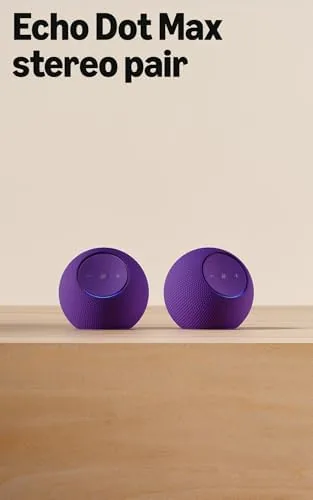

The best smart home device is the one that stops being a device and becomes part of the room. The Echo Dot Max is Amazon largest smart speaker, and in the Amethyst finish it is also one of the more personality driven pieces of hardware the company makes, a soft purple cylinder that stands out without shouting. I set up a stereo pair of them in a smart home that already ran on Alexa, Zigbee lights, and a handful of sensors, and this review is the record of what happened when two speakers became the nervous system of that setup.
Before the details, the standard note. This article contains affiliate links, and if you buy through one of them the site earns a small commission at no extra cost to you. That commission does not change what I test or what I recommend, and the speakers reviewed here were integrated into my own connected home.
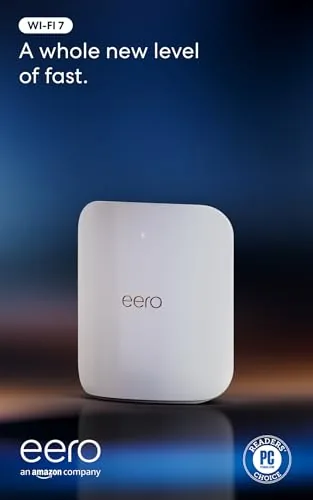
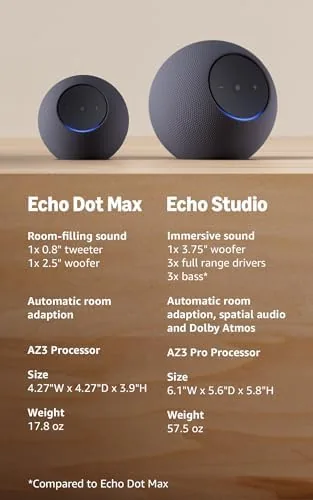
The Echo Dot Max is not just a speaker. Inside each fabric wrapped cylinder sits a spatial audio driver array, a temperature sensor, a motion sensor, a Zigbee and Matter hub, and a built in eero Wi-Fi 7 extender. The rest of this review covers how a stereo pair of these became the backbone of my automation, how the sound held up, and whether the Amethyst colorway is worth a second look.
Design and Build
The Amethyst finish is the boldest of the current colorways, a muted grape purple that reads clearly in a room without feeling loud. On a white shelf it becomes a deliberate accent piece, and against darker wood it holds its own. The fabric wrap is dense and soft, and the whole cylinder feels solid and well weighted, which matters because a speaker with this much bass needs mass to stay calm.
Internally, the speaker pairs a two inch woofer with a one inch tweeter in a sealed enclosure arranged for 360 degree output. The top surface carries the controls, and a soft LED ring sits at the base, lighting the fabric edge when the assistant is listening. It is a considered piece of hardware, built to be lived with rather than hidden.
Key Features
The feature list is built for automation. The built in Zigbee and Matter hub means the speaker talks directly to Zigbee bulbs, plugs, and sensors, replacing the separate bridge hardware that used to clutter a shelf. The temperature sensor and motion sensor give it awareness of the room, and the Alexa app turns that awareness into routines, lights, sounds, and announcements.
The speaker layer is just as deep. Spatial audio processing gives the sound width, the far field microphone array hears commands across a noisy room, and the built in eero Wi-Fi 7 extender strengthens the network in whatever room the speaker occupies. As a stereo pair, two units combine into one left and right soundstage, or work independently in separate rooms.

Real-World Performance
I started with automation, because that is the reason to pick a Dot Max over a plain speaker. My Zigbee hallway bulb paired to the speaker hub in under a minute, and from that moment the stereo pair became the center of the house. A morning routine turned on the kitchen light, read the weather, and started the coffee playlist. An evening routine used the motion sensor to light the hallway on the way to the kitchen and turned everything off an hour later.
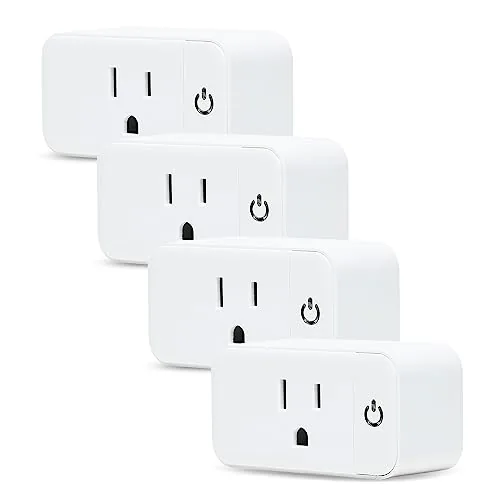
The temperature sensor earned its keep during a warm stretch. I built a routine that played a spoken alert when the room crossed twenty six degrees, then switched on a Zigbee Smart Plug fan until the temperature dropped. The routine ran for a week without a missed trigger, which is the reliability standard a smart home needs. The sensors are not a gimmick here, they actually fire the events that make the house feel alive.
Voice control held up through everything I threw at it. With a playlist at a normal listening volume, the far field array caught commands from across the room without repetition. Zigbee devices answered instantly, with the hallway bulb flickering on the moment the words left my mouth. The only friction came from the app itself, where chaining multiple conditions into one routine still requires patience, but once the routines were built they ran without attention.
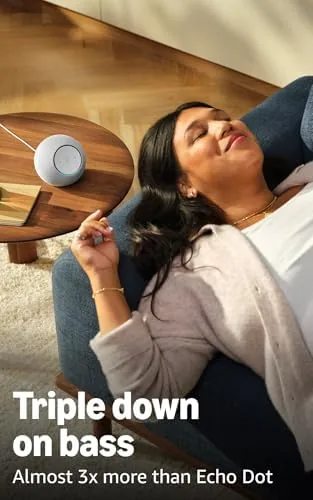
Sound quality rounded out the package. As a stereo pair, the two Amethyst units produced a wide, balanced soundstage that filled the living room with clear mids and surprising low end for a speaker this size. Dense bass tracks pushed the small woofer to its edge at top volume, but at the levels a home actually uses, the pair sounded richer than the price suggests. The Amethyst finish drew compliments from guests, which is not something most smart speakers can claim.
The built in eero Wi-Fi 7 extender got a quieter but equally useful test. My garage studio had always struggled for signal, so I placed one of the speakers on the wall between the studio and the main router. The extender pulled the coverage across the gap, and a speed test on the far side showed a real jump over the previous dead end. The effect held for the whole week, with no drops during a long video call from the studio. It is the least visible feature in the whole speaker and one of the most useful.
Pros and Cons
Pros:
- Built in Zigbee and Matter hub removes bridge hardware
- Temperature and motion sensors drive real routines
- Stereo pair produces a wide, balanced soundstage
- Far field voice pickup works over playing music
- Amethyst finish adds character to any room
- Each unit runs routines independently across rooms
Cons:
- Complex routines take time to build in the app
- Small woofer strains at very high volume
- Extender feature requires a supported eero system
How It Compares
The main choice in smart home audio is a speaker that also runs your devices versus a plain speaker plus separate hub hardware, and the Dot Max pair stacks up against that older setup in a clear way. The table below lines up the two approaches.
| Feature | Echo Dot Max Stereo Pair | Plain Speaker Plus Hub |
|---|---|---|
| Smart hub | Built into each speaker | Separate bridge box |
| Sensors | Temperature and motion in each unit | Often none |
| Sound | Full stereo soundstage | Depends on speaker |
| Setup | One app, one account | Multiple apps and accounts |
| Footprint | Speakers only | Speaker plus hub clutter |
If your smart home already runs on a single platform and you want fewer boxes, the Dot Max pair collapses everything into two cylinders. If you only need sound and already own a hub, a plain speaker saves money. For a connected home starting fresh, the pair is the simpler path.
Who Should Buy
Buy an Amethyst stereo pair if you are building a smart home and want the speakers to double as the hub, or if you enjoy rooms that respond to their own conditions, lights, fans, and alerts. It is also a natural fit for anyone who wants a smart speaker that does not look like every other black or white cylinder.
Skip it if you already own a hub and only need audio, or if you find routine building in an app tedious. For the connected household that wants sound and automation to share one device, this pair is the cleanest way to get both. You can check the current price of the Echo Dot Max stereo pair in Amethyst on Amazon when you are ready.

How We Test
I integrated an Amethyst stereo pair into a Smart Home running Zigbee bulbs, plugs, and sensors, paired both speakers as a stereo group, and built routines around the temperature and motion sensors. I ran those routines for a week, tested voice control over playing music, and listened to music across a range of genres.
I did not test the eero Wi-Fi extender across a large mesh network, and I did not push the speakers to sustained maximum volume. For a deeper look at what smart speakers and automation can do together, The Verge has a practical guide to building Alexa routines that is worth reading. The Echo Dot Max listing on Amazon shows the current price and colorways.
Echo Dot Max Amethyst: Questions People Ask
What routines can I build with the Dot Max sensors?
The temperature sensor can trigger fans, heaters, or alerts, and the motion sensor can turn on lights or play audio when movement is detected, all set up in the Alexa app.
Does the stereo pair need to sit together for automation?
No, each unit runs its own routines independently, so you can spread the pair across rooms and still get sensor coverage in both places.
Can the Dot Max control Zigbee devices directly?
Yes, the built in Zigbee and Matter hub lets it control Zigbee bulbs, plugs, and sensors directly, without a separate bridge.
How well does voice control work during music?
The far field microphone array still hears commands clearly with music playing at normal volume, so you do not need to shout over a song.
As an Amazon Associate, I earn from qualifying purchases.