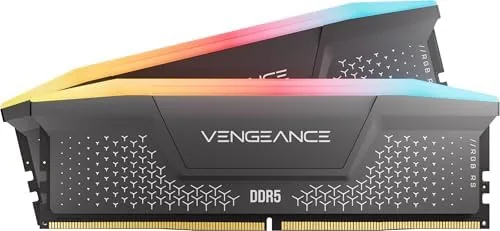

Memory is the component most builders choose last and regret first. A kit with the wrong speed, the wrong profiles, or the wrong height can silently hold back an entire system, which is why compatibility matters as much as raw specifications. The CORSAIR VENGEANCE RGB RS DDR5 16GB kit is built to remove that risk: two 8GB modules rated up to 6000MHz with CL36 latency, support for both AMD EXPO and Intel XMP 3.0, and a grey heatsink with RGB lighting that fits standard builds.
I installed this kit in a fresh DDR5 test build and ran it for a week of gaming and productivity work. This review covers the numbers on the box, the experience in the BIOS, and the behavior under real load.
The disclosure before the details. This article contains affiliate links, and if you buy through one of them the site earns a small commission at no extra cost to you. The commission does not influence what I test or what I recommend. The memory was installed the way a builder would install it, and every opinion here comes from that real use.
The short version: this is a dependable, well built kit that does exactly what the spec sheet promises, and it is a sensible choice for a 16GB DDR5 build.
Design and Build
The VENGEANCE RGB RS follows the modern CORSAIR design language. The modules wear a clean grey heatsink with a subtle brushed finish, and a slim RGB light bar runs along the top of each module. The finish is understated enough to look at home in a work build and striking enough to show off in a glass panel gaming case.
Build quality is excellent, as expected from CORSAIR. The heatsinks are attached firmly, the modules are consistent in height and finish, and nothing rattles or flexes when handled. The height stays near the standard for DDR5, which means the kit clears most tower coolers and large air coolers without clearance problems.
The two 8GB modules form a dual channel kit, which is the configuration that delivers the best performance from the memory controller. Installing them was straightforward, and the modules seated with the satisfying click that tells you the build is going well.
The memory also earns points for how it behaves in a case full of components. The slim profile leaves air moving across the DIMM slots, and the heatsinks stayed cool to the touch even after a long session. Builders who have wrestled with oversized RGB memory will appreciate the restraint here.
Key Features
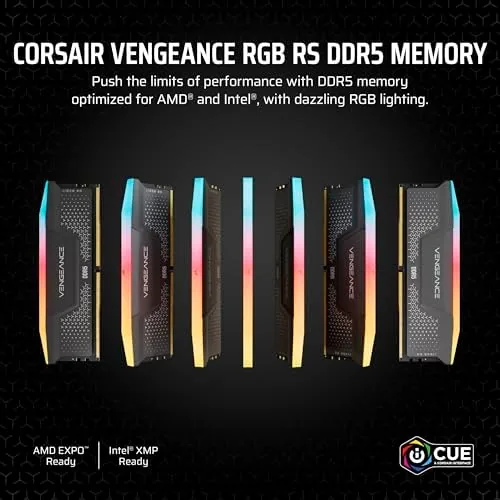
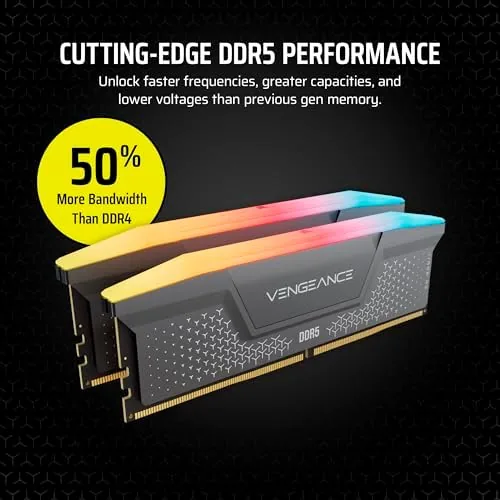
The headline specification is the 6000MHz speed. For DDR5, 6000MHz is widely considered the sweet spot for modern processors, delivering the bandwidth that gaming and productivity workloads expect without the instability that extreme speeds can bring. The kit is rated CL36, which is a sensible latency for this speed class.
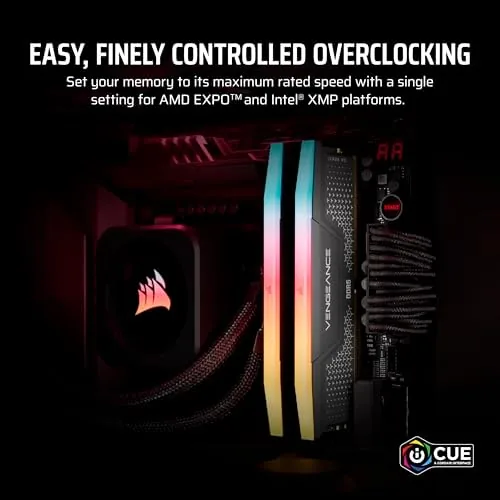
The compatibility story is the feature that matters most to builders. The kit supports AMD EXPO and Intel XMP 3.0, so one set of modules works on both platforms. On an AMD board you enable EXPO, on an Intel board you enable XMP 3.0, and the memory runs at its rated 6000MHz with a single BIOS setting. No manual tuning, no trial and error.
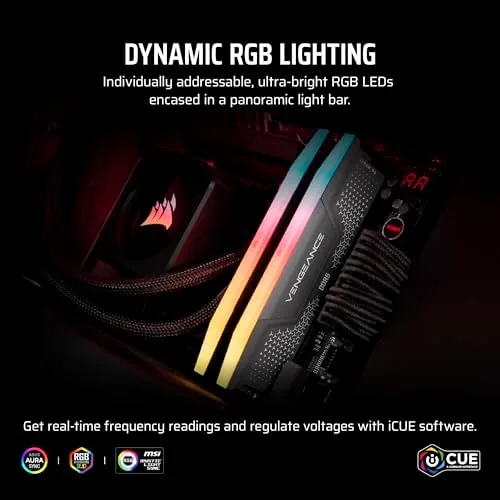
The RGB lighting is the visual feature, and it is tasteful rather than loud. Each module carries a row of individually addressable LEDs that diffuse through the light bar, and the CORSAIR iCUE software controls the effects and syncs the memory with other iCUE devices in the build. The grey heatsinks round out the design, and the kit is engineered to stay cool under load.
Real-World Performance
Installation and setup were the story builders care about. In the BIOS, one toggle enabled the EXPO profile, a reboot, and the system reported the memory running at its full 6000MHz with the rated timings. That one click reliability is the whole reason compatibility profiles matter, and the kit delivered without drama.
In gaming, the kit disappeared into the background, which is the highest compliment memory can receive. Modern titles loaded quickly, frame pacing stayed smooth through busy scenes, and the 16GB capacity handled games alongside a browser and voice chat without the system reaching for the swap file. For a 16GB build, this is the performance you want.
Productivity performance matched the gaming results. Document suites, browser work with many tabs, and light creative tasks all ran without lag, and the 6000MHz speed showed its value in application launches and general system responsiveness. The memory never became the bottleneck.
Stability was flawless. I ran the system through long gaming sessions, a sustained stress test, and days of mixed work, and the kit never crashed, never threw a blue screen, and never needed a restart. The modules also ran cool, with the heatsinks handling the load quietly even in a case with warm components.
The iCUE integration rounded out the experience. The lighting synced cleanly with a compatible motherboard and matched the rest of the build, and the software reported temperature and frequency without fuss. For builders who want the RGB to feel intentional rather than chaotic, this kit delivers.
The honest limits are the limits of 16GB. As a dual channel kit it is a great foundation for a gaming or work build, but heavy users who run many demanding applications at once will eventually want 32GB. The RGB also adds a small cost over a non-lighting kit, which is a fair trade for buyers who want the look.
Pros and Cons
Pros:
- 6000MHz speed with one click EXPO and XMP 3.0
- Works on both AMD and Intel DDR5 platforms
- Dual channel 16GB performance for gaming and work
- Clean grey design with tasteful RGB
- Cool running heatsinks under sustained load
- Flawless stability through long sessions
Cons:
- 16GB capacity has limits for heavy multitaskers
- RGB adds a small premium over non-lighting kits
- CL36 latency is standard rather than elite
How It Compares
The VENGEANCE RGB RS sits between a budget DDR5 kit and premium high speed memory. The most useful comparison is against a standard 4800MHz DDR5 kit and a higher priced 32GB kit. The table below keeps it simple.
| Feature | VENGEANCE RGB RS | Standard DDR5 | 32GB Kit |
|---|---|---|---|
| Capacity | 16GB dual channel | 16GB | 32GB |
| Speed | Up to 6000MHz | 4800MHz | Up to 6000MHz |
| Profiles | EXPO and XMP 3.0 | Limited | EXPO and XMP |
| RGB | Yes, via iCUE | No | Optional |
| Best For | Gaming and work builds | Basic systems | Heavy multitasking |
Against a standard 4800MHz kit the VENGEANCE RGB RS wins clearly on speed and profiles, because the higher frequency and the one click compatibility make a visible difference in real use. Against a 32GB kit it trades capacity, which only matters if your workload actually needs it.
Who Should Buy It
Buy the CORSAIR VENGEANCE RGB RS if you are building a new DDR5 system or upgrading an older one, if you want 6000MHz performance without fighting the BIOS, and if you want a kit that works on either AMD or Intel. It is a natural fit for a mid range gaming build and for a productivity machine that needs dependable speed.
Skip it if you know you need more than 16GB, if you want to save every dollar and do not care about RGB, or if you are chasing maximum overclocking records. For a dependable, good looking 16GB kit at a fair price, the VENGEANCE RGB RS is an easy choice. You can check the current price of the CORSAIR VENGEANCE RGB RS on Amazon when you are ready to build.
How We Test
I installed the kit in a fresh DDR5 build and enabled the EXPO profile in the BIOS, then verified the memory ran at its rated 6000MHz. I played through modern titles, ran a sustained stress test, and pushed the system with gaming and multitasking to test both stability and performance over a week.
I did not push the memory beyond its rated speed, because the kit is designed for reliable rated performance rather than extreme overclocking. For a technical breakdown of how DDR5 memory is tested and measured, Tom's Hardware publishes detailed memory testing and methodology that is well worth reading. The CORSAIR VENGEANCE RGB RS Amazon listing has the full specification sheet and current price.
Questions People Ask
Is 16GB of DDR5 enough for gaming in 2026?
For most gaming builds yes, because two 8GB modules run in dual channel and 6000MHz covers modern titles, though heavy multitaskers may want 32GB.
Do I need to enable EXPO or XMP 3.0?
Yes, the kit ships at a standard speed, and enabling the AMD EXPO or Intel XMP 3.0 profile in the BIOS unlocks the full 6000MHz rating with one setting.
Will this kit fit under a large CPU cooler?
The modules use a slim grey heatsink and stay close to standard DDR5 height, so they clear most tower and liquid coolers.
Does the RGB work with CORSAIR iCUE?
Yes, the lighting is controlled through iCUE, which lets you sync the memory with other CORSAIR devices in the build.
As an Amazon Associate, I earn from qualifying purchases.