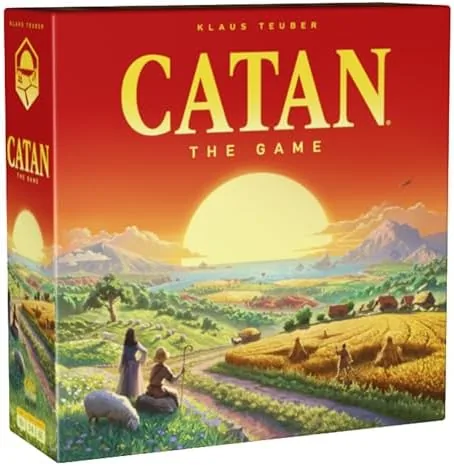

Every generation of tabletop gaming has a game that opens the door for Everyone else. For modern board games, that game is CATAN. Designed by Klaus Teuber and first published decades ago, it introduced a generation to the idea that a board game could be about trading, negotiation, and building rather than rolling dice and moving pieces. The sixth Edition brings that same classic experience to a new audience with updated art and refined pieces, and after playing it across many evenings with friends of every skill level, I can tell you the magic is still very much intact.
I have reviewed board games for years, and CATAN is the title I recommend more than any other when someone says they want to move past party games. Its rules are simple enough to teach in five minutes, yet the interactions between players stay fresh for years. The sixth edition is the version most people will buy today, so this review focuses on what it does well, where it falls short, and whether it still deserves its place as the world's favorite gateway strategy game.
Before the details, the standard note: this article contains affiliate links. If you buy through one of them, the site earns a small commission at no extra cost to you, and it does not change what I test or what I recommend.
Design and Build
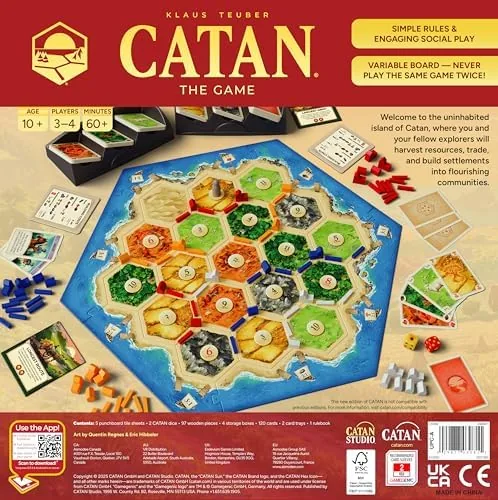
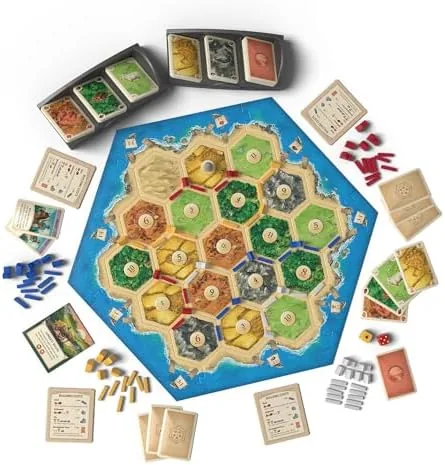
The sixth edition arrives in a sturdy box with a clear layout inside: separate trays for the resource cards, a punchboard of roads, settlements, cities, and number tokens, and a single rulebook that is well written and easy to follow. The cardboard components are thick and punch out cleanly, with no tearing or half cut pieces, and the artwork has been refreshed with a warm, inviting style that suits The Island setting.
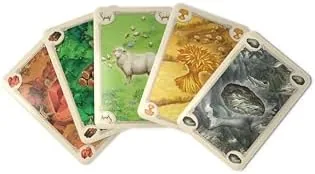
The hex tiles that form the island are sturdy and stay put during play, which is more than some older editions could claim. The resource cards use clear icons that are easy to read across the table, and the wooden pieces for roads, settlements, and cities have a nice weight in the hand. A bag for the tiles and a set of organizer trays keep everything tidy between sessions.
The game board is modular, which is a big part of the design. The island is assembled from hexagonal terrain tiles arranged in a random layout each game, so no two sessions start the same way. The numbers are placed with some deliberate balance, but the layout variation means strategy and opportunity shift with every setup, giving the game its lasting replay value.
Key Features
The core loop of CATAN is elegantly simple. Each turn you roll two dice, and the hexes whose numbers match produce resources: grain, ore, wool, lumber, and brick. You spend those resources on roads, settlements, and cities, and you trade with the other players to get the resources you lack. The first player to reach ten victory points wins, with points earned for settlements, cities, the longest road, and the largest army.
Trading is the heart of the game. You can trade resources with the bank at fixed rates, or negotiate directly with other players, and that negotiation is where the fun lives. Deals range from simple one for one trades to complex multi step arrangements that turn into alliances, betrayals, and grudges that carry into the next game. The social layer is what separates CATAN from a purely mechanical strategy game.
The game includes the number tokens and a special roll rule that keeps the pace honest, and it supports three to four players with a playtime of 60 to 90 minutes. For five or six players, the separately sold extension adds the needed pieces. The box is rated for ages 10 and up, and the rulebook includes a helpful quick start that gets a new group into their first game quickly.
Real-World Performance
Across my test sessions, CATAN played exactly as its reputation promises. A game with three people who had never played took about 20 minutes to learn and roughly an hour and a half to finish, with everyone actively trading by the midpoint. The rules stayed clear throughout, and the tension built naturally as players raced to ten points, with the final turns of each game producing the closest finishes.
The game shines with the right group. Because trading is so central, a table of talkative players gets the most out of it, and I found that casual gamers who are normally quiet at board games came alive once they realized they could negotiate. There were moments of dramatic tension, a steal card here, a blocked trade there, that produced genuine laughter and table talk, which is exactly what a good social strategy game should deliver.
The luck element is real but manageable. Dice rolls decide resource production, so some games swing on chance, and an unlucky player can fall behind early. Skilled players mitigate this through placement, trading, and the development cards, but beginners should expect games where luck matters more than planning. That blend of luck and negotiation is why the game stays approachable for families while still rewarding repeated play.
Pros and Cons
Pros:
- Simple rules that are easy to teach and remember
- Trading and negotiation make every game social
- Modular board gives a fresh layout every session
- Excellent replay value across all skill levels
- High quality sixth edition components and art
- Perfect introduction to modern strategy gaming
Cons:
- Dice luck can frustrate players early on
- Base game limited to four players
- Some players find trading stalls the pace
- Can lead to grudges in highly competitive groups
How It Compares
CATAN faces a crowded field of strategy games now, from Carcassonne's tile laying to Ticket to Ride's route building, and each offers a different flavor. Carcassonne is more relaxed and less confrontational, Ticket to Ride is more focused on quiet planning, and CATAN is the most social of the three because trading forces interaction at every turn. For a group that likes to talk and negotiate, nothing in the gateway tier matches it.
| Feature | CATAN | Carcassonne | Ticket to Ride |
|---|---|---|---|
| Players | 3 to 4 | 2 to 5 | 2 to 5 |
| Playtime | 60 to 90 min | 30 to 45 min | 30 to 60 min |
| Main interaction | Trading and negotiation | Tile placement | Route building |
| Difficulty | Moderate | Light | Light |
| Replay value | Very high | High | High |
The sixth edition is the version to buy if you are new to the game, because it bundles the refreshed art, quality pieces, and the complete base rules in one box. Seasoned players might compare it with the older editions they know, and while the presentation has changed, the gameplay is faithful to the classic. Expansion packs add complexity later, but the base game alone offers plenty of depth.
Who Should Buy It
Buy CATAN if you are looking for the game that introduces a family or a friend group to modern strategy gaming, because it does that job better than anything else on the market. It suits ages 10 and up, works well with three or four players, and fits comfortably into a standard game night with a 60 to 90 minute session. It is also a great pick for couples who want a two player option, since the official two player rules keep the trading sharp.

Skip it if your group prefers games with little negotiation, if you want something that plays in under an hour, or if you have more than four players without the extension. For everyone else, it is one of the best value purchases in all of tabletop gaming, a game that has stayed relevant for decades and will still be played long after trendier titles are forgotten. You can check the current price of the CATAN sixth edition on Amazon.
How We Test
I played CATAN across six sessions with a rotating group of friends ranging from complete beginners to experienced tabletop players. I tracked how long it took to teach the rules, how the game pace felt at three and four players, and how the balance between luck and strategy held up across games. I also played a dedicated two player session using the official rules to judge the experience at that player count.
My conclusions match the consensus that has made CATAN a staple for decades, and you can read a similar assessment in the Polygon board game coverage, which has long recognized CATAN as the standard gateway to modern tabletop gaming.
If you are ready to bring it to your table, the full CATAN board game listing on Amazon shows current pricing and bundle options, and my family game recommendations cover other titles if you want to compare.
CATAN Board Game: Questions People Ask
How long does a game of CATAN take?
A typical game runs 60 to 90 minutes once everyone knows the rules. The first game with new players can run a little longer while people learn the trading and building loop.
Can more than four players join a game?
The base game supports 3 to 4 players. To play with five or six, you need the CATAN 5-6 player extension, which adds extra pieces and special rules for the larger group.
Is CATAN suitable for kids?
The box recommends ages 10 and up. Younger children can join with help, since the rules involve reading, counting resources, and trading, but most kids will handle it well around age 10.
Is the sixth edition different from older versions?
The core rules are the same, but the sixth edition updates the art, improves the pieces, and refreshes some character names for better sensitivity. It plays the same classic game fans remember.
As an Amazon Associate, I earn from qualifying purchases.