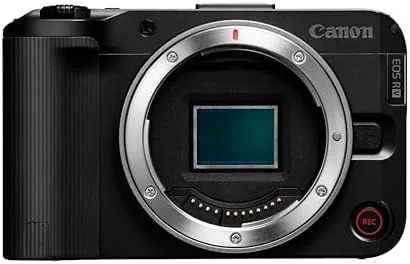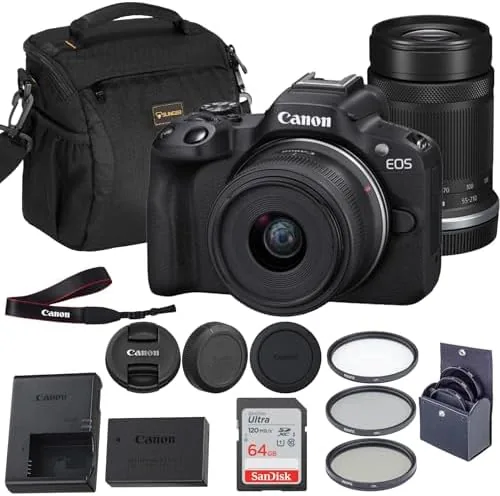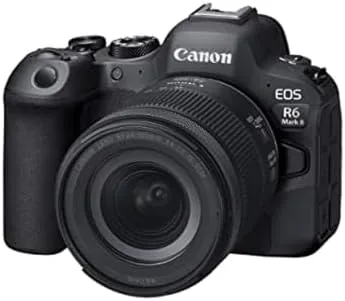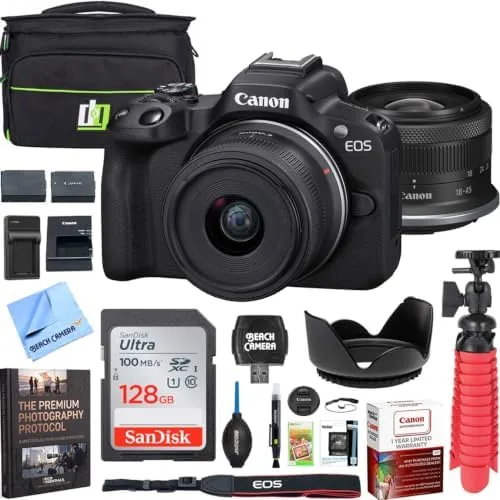

Choosing a first real camera is harder than it needs to be, because the body is only half the purchase. The Canon EOS R50 attacks that problem directly with a bundle that pairs its compact APS-C mirrorless body with the RF-S 18-45mm kit lens and a pile of accessories: a second battery, a memory card, a deluxe case, a mini tripod, and more. I carried this Kit for two weeks through street walks, family gatherings, a rainy park outing, and some casual video, and this review covers whether the camera is worth learning on and whether the bundle actually saves you money.
Standard disclosure up front. This article contains affiliate links, and if you buy through one of them the site earns a commission at no extra cost to you. That commission does not change what I test or what I recommend, and this kit was purchased as a retail unit.
Design and Build
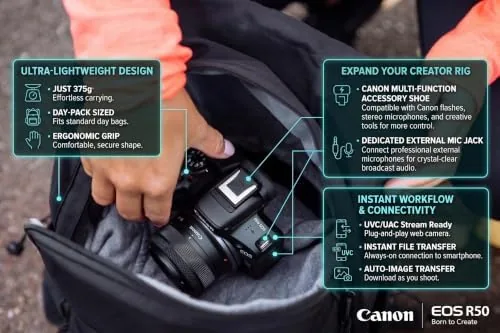
The R50 is delightfully small for an interchangeable lens camera. It weighs about 375 grams with the battery and card installed, which means it is lighter than many lenses and genuinely pocket-adjacent when paired with the compact kit zoom. The body has a chunky, grippy handhold on the right side, a control dial at the thumb, and a small mode dial on top, and everything falls where your fingers expect it. The build is weather-sealed to a modest degree and feels solid without pretending to be a pro camera.
The included RF-S 18-45mm f4.5-6.3 IS STM lens is the perfect companion in size. It collapses to a remarkably short barrel when not in use, extends smoothly when you twist to zoom, and includes optical image stabilization that helps handheld shots stay sharp. The bundle also adds a second LP-E17 battery, a memory card ready to use out of the box, a padded deluxe case with room for the whole kit, and a small tabletop tripod for self-portraits and low-light stills.
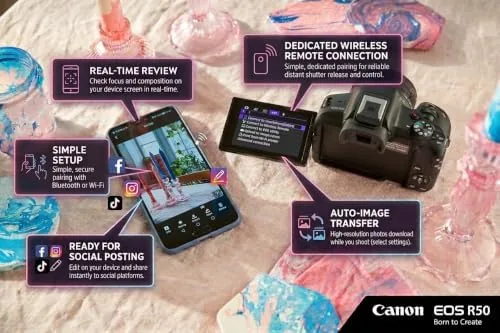
Canon clearly designed the R50 for newcomers. There is a guided menu mode that explains each setting in plain language, a scene smart auto mode that picks sensible settings for you, and a mobile app that pairs over Bluetooth and Wi-Fi for quick photo transfer. A beginner can unbox this camera, charge it, and make great photos within an hour, which is exactly the kind of experience that keeps people interested in photography.
Key Features
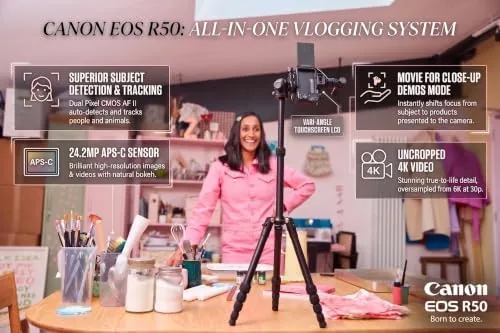
The R50 uses a 24.2-megapixel APS-C CMOS sensor, the same class of sensor Canon puts in its larger R-series bodies, and it produces images with the character Canon is known for. Colors are pleasant straight out of camera, dynamic range is respectable for the class, and the sensor does not hold back in good light. The crop factor makes the 18-45mm kit lens behave like a roughly 29-72mm lens on a full frame body, which is a versatile everyday range.
Autofocus is the standout feature. Canon's dual pixel autofocus with subject detection recognizes people, animals, and vehicles, and it locks onto faces and eyes with speed and tenacity that used to be reserved for far more expensive cameras. In my testing it tracked a moving child across a park without hesitation, and it nailed focus on a dog mid-sprint more often than not. For a beginner camera, that kind of autofocus removes one of the biggest frustrations of learning.
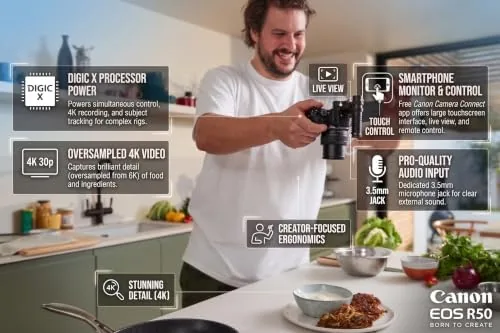
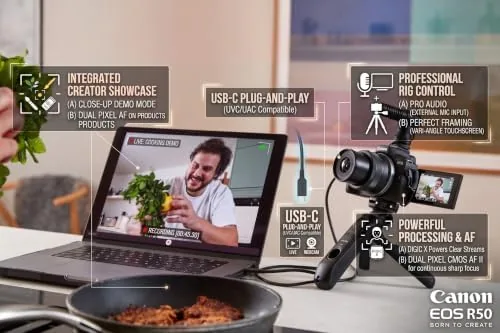
Video is genuinely capable for the price. The R50 records 4K at up to 30 frames per second using the full width of the sensor, which means wide-angle footage without the heavy crop some rivals apply. There is a headphone jack for monitoring and a clean HDMI out, so the camera works for casual vlogging and even light streaming setups.
 Camera with the subject detection overlay showing a person's face tracked" width="1200" height="800" loading="lazy" style="height:auto">
Real-World Performance
In good light, the R50 is a joy. A walk through a neighborhood produced sharp, colorful photos that needed almost no editing, with the kit lens holding up surprisingly well at its wide end and rendering background blur that looks far more expensive than the kit price. The touchscreen makes changing focus point as simple as tapping where you want sharpness, and the electronic viewfinder is crisp enough to compose in bright sun.
The autofocus really is the reason to choose this camera. At a family gathering I handed it to someone who had never shot mirrorless, and the face and eye tracking made every frame in focus without them touching a setting. That kind of reliability turns a beginner's early photos from blurry disappointments into usable keepers, which is the single biggest gift a first camera can give. The burst mode at up to 15 frames per second with electronic shutter captured action sequences effortlessly, and the buffer handled them without complaint.
Low light is the honest weak spot, as it is for almost any APS-C camera with a kit zoom. Indoors at night, the autofocus still locked on quickly, but the f4.5-6.3 lens lets in less light than a fast prime would, so photos get grainy at higher ISO and the image stabilizer can only help so much with a slow shutter. This is not a camera flaw so much as a reminder that the kit lens is the budget part of the bundle, and adding a bright prime lens later is the classic upgrade path.
Video held up well for a camera this small. A casual vlog clip in 4K30p looked clean and stabilized nicely thanks to the lens IS and the electronic stabilization working together, and the autofocus kept my face sharp while I moved. The flip-out screen rotates to face forward, which makes self-filming natural, and the included mini tripod kept the whole setup steady on a table.
Pros and Cons
Pros:
- Compact, lightweight body that is easy to carry daily
- Excellent face and eye tracking autofocus for the price
- Pleasant Canon color and good dynamic range from the 24.2MP sensor
- Full-width 4K30p video with a flip-out screen
- Guided interface makes it easy for true beginners
- Bundle adds a second battery, card, case, and tripod
Cons:
- Kit lens is slow in low light at f4.5-6.3
- No in-body stabilization, relies on the lens
- Single card slot and modest battery life
- Weather sealing is light, not for downpours
How It Compares
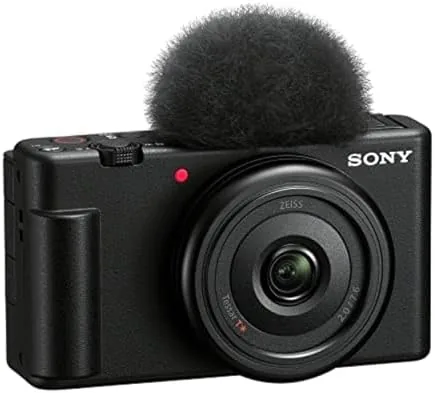
Entry mirrorless buyers usually weigh the R50 against the Sony ZV-E10 and the Nikon Z30, both capable APS-C cameras with different strengths. I compared them across the features that matter most to a new shooter.
| Feature | Canon EOS R50 | Sony ZV-E10 | Nikon Z30 |
|---|---|---|---|
| Sensor | 24.2MP APS-C | 24.2MP APS-C | 20.9MP APS-C |
| Viewfinder | Yes | No | No |
| Video | 4K30p full width | 4K30p | 4K30p |
| Autofocus | Face, eye, animal | Face and eye | Face and eye |
| Beginner menus | Excellent | Good | Good |
| Kit lens | 18-45mm IS | 16-50mm OSS | 16-50mm |
| Price | Mid range | Similar | Lower |
Against the Sony ZV-E10, the R50 wins on the electronic viewfinder and the friendlier beginner interface, while the ZV-E10 wins on vlogging-focused features like product showcase mode. Against the Nikon Z30, the R50 wins on resolution, the viewfinder, and subject detection, while the Z30 wins on a lower price. For a first camera that is equally happy shooting stills and video, the R50 is the most balanced of the three. To check the current bundle price, see the Canon EOS R50 bundle on Amazon.
Who Should Buy It
Buy the R50 bundle if you are moving up from a phone and want a real camera you can learn on, with autofocus that forgives mistakes and a guided interface that teaches as you shoot. It suits families documenting everyday life, travelers who want better quality than a phone without a heavy kit, and content creators who want a compact 4K camera for vlogs and social video. The bundle's second battery, card, case, and tripod mean you can genuinely start shooting the day it arrives.
Skip it if you need weatherproof pro-level build, if you plan to shoot mostly video and want vlogging-specific features, or if you want a bright prime lens bundled instead of a slow zoom. For everyone else, this is one of the easiest and most rewarding first cameras you can buy today. The Canon EOS R50 bundle listing on Amazon shows current pricing and what is included.
How We Test
I tested the Canon EOS R50 bundle for two weeks across street photography, a family gathering, a rainy park outing, indoor evening shots, and casual 4K video. I used the camera in scene smart auto mode and in manual mode, tested the subject detection on people and animals, exercised the burst mode, and verified the kit lens performance across its zoom range in both bright and low light.
For an independent technical look at the R50, the review published by DPReview is thorough and trustworthy, and their camera review archive is a valuable reference for anyone researching mirrorless bodies. The Amazon product page for the EOS R50 bundle has the full specifications and list of included accessories.
Canon EOS R50: Questions People Ask
What lens comes with the Canon EOS R50 bundle?
The bundle includes the RF-S 18-45mm F4.5-6.3 IS STM kit lens, a compact stabilized zoom that covers a versatile everyday range and collapses for travel.
Does the EOS R50 shoot 4K video?
Yes. The R50 records 4K video at up to 30 frames per second using the full width of the sensor, producing clean footage with good color and a flip-out screen for vlogging.
Is the EOS R50 good for beginners?
Yes. Its guided menu interface, scene smart auto mode, and reliable face and eye detection make it one of the easiest mirrorless cameras to learn on, and the bundle includes everything you need to start.
What accessories are included in this bundle?
The bundle adds a second LP-E17 battery, a memory card, a deluxe padded case, a mini tripod, and several smaller accessories, so you can begin shooting without further purchases.
As an Amazon Associate, I earn from qualifying purchases.