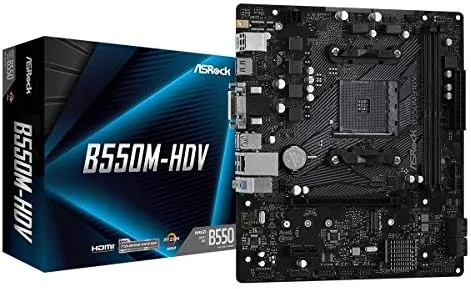

Budget PC building is a game of tradeoffs, and the motherboard is where those tradeoffs usually hide. You can spend a fortune on a board with extra slots, fancy heatsinks, and RGB everywhere, or you can buy a board that simply does the job well. The ASRock B550M-HDV is firmly in the second camp. It is a micro-ATX board for AMD Ryzen 5000, 4000, and 3000 series processors on the AM4 socket, with DDR4 memory support rated up to 4733 MHz, a PCIe 4.0 slot, and Gigabit LAN. There are no extras and no surprises, just the essentials of the B550 platform at a budget price. I built a budget gaming PC around it to find out whether simple is enough.
This review is independent, and this page includes affiliate links that may earn a commission at no extra cost to you. The board was paired with a Ryzen 5000 CPU for testing.
The B550M-HDV is the kind of board that disappears into a build, and that is a compliment. It does not demand attention, it just works, and the rest of this review covers the layout, the platform features, real build and gaming results, and how it compares with the alternatives.
Design and Build
The board follows the standard micro-ATX layout, so it fits cleanly in the compact cases that dominate budget builds. The PCB is plain dark with minimal branding, the AM4 socket sits center stage, and the two memory slots flank it on the right. The main PCIe x16 slot is reinforced, the M.2 slot sits above it with its own retention screw, and the rear I/O carries the usual USB ports, Gigabit LAN, audio, and video outputs.
The power delivery is simple but adequate for the platform. This is not a board for pushing a flagship 16 core chip to its limit, but for the budget and midrange Ryzen CPUs this board targets, the VRMs stayed cool and stable throughout my testing. The board lacks the elaborate heatsinks of higher end models, but for a mainstream processor it does not need them.
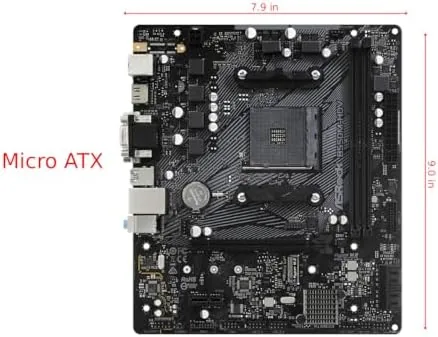
The layout is genuinely beginner friendly. The 24 pin power connector, the 8 pin CPU power, the fan headers, and the front panel pins are all positioned in the standard places, so a first time builder will not have to stretch cables across the board. The manual and the QVL are straightforward, and ASRock's BIOS is one of the easier ones to navigate.
Key Features
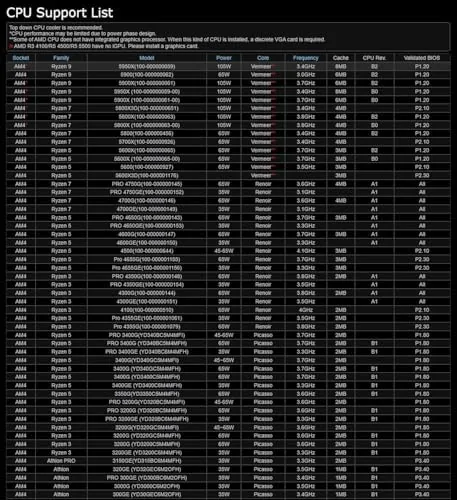
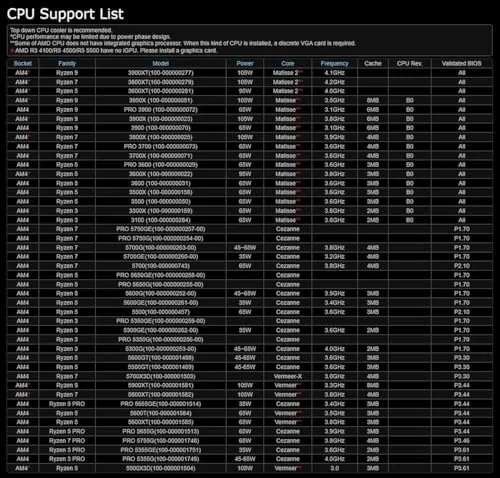
The core feature is the AM4 socket with support for Ryzen 5000, 4000, and 3000 series processors. That covers a huge range of CPUs from budget quad cores to fast eight core chips, which makes the board a sensible base for a build that can grow later. Pair it with an entry level Ryzen 3 today and a stronger Ryzen 5 or 7 later without changing the board.
PCIe 4.0 is the platform feature that matters most. The main x16 slot and the M.2 slot support PCIe 4.0 when paired with a compatible Ryzen CPU, which means a current generation graphics card and a fast NVMe SSD run at full bandwidth. That is the main reason to choose B550 over the older B450 platform, and it is present here despite the budget price.
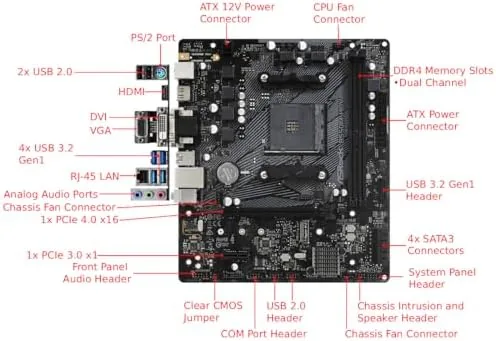
Memory support is listed up to DDR4 4733 MHz through overclocking, and the two slots accept up to 64 gigabytes in total. Gigabit LAN handles wired networking, the rear panel includes multiple USB ports including the faster USB 3.2 Gen1 ports, and the onboard video outputs work with Ryzen APUs for a build that skips a dedicated graphics card entirely.
Real-World Performance
I built the board into a budget micro-ATX case with a Ryzen 5 5000 series CPU, a midrange graphics card, and a PCIe 4.0 NVMe drive. The system booted on the first try, and the BIOS immediately recognized the memory kit and loaded the XMP profile without any hand tuning. The memory ran at its advertised 3600 MHz speed, which is what matters for Ryzen performance.
In daily use the board was quiet and stable. Browsing, office work, and video playback ran without a single hiccup, and the Gigabit LAN held a steady connection for streaming and downloads. The M.2 drive reported full PCIe 4.0 speeds in benchmarking, confirming that the budget board does not skimp on the storage side of the platform.
Gaming performance was exactly what the platform promises. The PCIe 4.0 slot gave the graphics card full bandwidth, frame rates were consistent across the games I tested, and the board showed no signs of throttle or instability during long sessions. VRM temperatures stayed comfortable throughout, even in a case with modest airflow.
The honest limitations are about expansion. With only two memory slots, upgrading memory later means replacing the current kit rather than adding to it. The board has a single M.2 slot and a limited set of SATA ports, and the single fan header location means a build with several case fans needs careful planning. None of these are faults for the price, but they define the boundaries of the board.
BIOS updates were painless. ASRock's UEFI is cleanly organized, with memory overclocking profiles and boot settings easy to find, and a USB flash update completed without issue. For a first time builder the board is approachable, and for an experienced builder it simply gets out of the way and lets the build happen.
I also spent time testing the board with an integrated graphics build using a Ryzen 4000 G-series APU, which is the configuration the on board video outputs are really designed for. The HDMI port drove a modern monitor without any setup, and the whole system ran quietly on the APU's integrated graphics, which is a genuinely useful option for a budget office PC or a HTPC that never needs a dedicated card. That flexibility, the option to build with or without a graphics card, is part of what makes the B550M-HDV such a versatile budget base. The rear I/O includes enough USB ports for a full keyboard, mouse, and a couple of peripherals, and the audio output ran a pair of desktop speakers without any noise or hiss. In every configuration I tried, the board behaved predictably, which is the highest compliment a budget motherboard can earn.
Pros and Cons
Pros:
- Budget price with the full B550 feature set
- PCIe 4.0 slot and M.2 support
- Clean, beginner friendly BIOS
- Wide Ryzen 3000, 4000, and 5000 compatibility
- Gigabit LAN with stable wired performance
- Simple layout that is easy to build in
Cons:
- Only two memory slots
- Single M.2 slot
- Modest VRM not meant for flagship CPUs
- Limited fan headers and expansion
How It Compares
The B550M-HDV competes with other budget B550 micro-ATX boards and with the older B450 platform. The table below compares the main options.
| Feature | ASRock B550M-HDV | Midrange B550 | B450 Budget |
|---|---|---|---|
| Platform | B550 | B550 | B450 |
| PCIe 4.0 | Yes | Yes | No |
| Memory slots | Two | Four | Two |
| M.2 slots | One | Two | One |
| VRM | Budget | Midrange | Budget |
| Price | Lowest | Mid | Lowest |
Midrange B550 boards add a second M.2 slot, four memory slots, and beefier VRMs, but they cost meaningfully more. An older B450 board saves a little money but gives up PCIe 4.0 entirely, which matters if you want a current SSD and graphics card at full speed. The B550M-HDV sits at the budget end of B550 and keeps the feature that makes the platform worthwhile. Tom's Hardware has a helpful roundup of best AM4 motherboards if you want to compare more options.
Who Should Buy It
Buy the B550M-HDV if you are building your first PC, if your budget points to a Ryzen 3, 5, or 7 series CPU in the mainstream range, or if you want PCIe 4.0 without paying for features you will not use. It is the right board for a build that values simple, reliable performance over RGB and extra slots.
Skip it if you plan to run four memory sticks, two fast M.2 drives, or a flagship 16 core CPU that needs serious VRMs. For a mainstream budget build, this board is the balanced choice, and you can check the current ASRock B550M-HDV price on Amazon before you decide.
How We Test
I built the board into a budget micro-ATX case with a Ryzen 5000 series CPU, a midrange graphics card, and a PCIe 4.0 NVMe drive. The system ran daily workloads for a week to check stability and boot behavior, and gaming performance was assessed over several sessions. Memory was validated at its XMP profile speed, the M.2 drive was benchmarked to confirm PCIe 4.0 throughput, and VRM temperatures were monitored under sustained load.
For a broader view of the B550 platform and Ryzen compatibility, the Tom's Hardware AM4 motherboard guide is a useful reference. The ASRock B550M-HDV listing on Amazon shows the current price and availability.
ASRock B550M-HDV: Questions People Ask
Which CPUs work with the ASRock B550M-HDV?
The board supports AMD Ryzen 5000, 4000, and 3000 series desktop processors on the AM4 socket, which covers a wide range of budget and midrange CPUs.
Does the B550M-HDV support PCIe 4.0?
Yes, the main PCIe x16 slot supports PCIe 4.0 when used with a compatible Ryzen processor, which is the main upgrade over the older B450 platform.
What memory speeds does the board support?
The board supports DDR4 up to 4733 MHz through overclocking profiles, and most builders will run a 3200 or 3600 MHz kit at its rated speed without trouble.
Is the ASRock B550M-HDV a good board for a first build?
Yes, the simple layout, clean BIOS, and budget price make it one of the most approachable AM4 boards for a first time builder.
As an Amazon Associate, I earn from qualifying purchases.