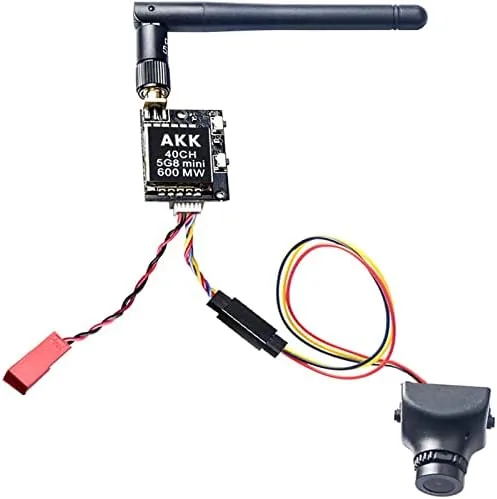

Building a racing quadcopter is a lesson in budget triage. Every gram costs you agility, every dollar spent on one part comes out of another, and the video system is where cheap builders usually get burned. Buy a weak transmitter and your goggles go to static a hundred feet out. Buy a camera that handles light poorly and you lose the gate before you see it. The AKK KC04 is built to close that gap on a budget: a 600mW 5.8GHz transmitter and a 700TVL CMOS camera fused into a single compact unit that sells for a fraction of what a premium stack costs. I flew the KC04 on a racing quad for a month to see how much race-ready video it actually delivers.
Before the details, the standard note. This article contains affiliate links, and if you buy through one of them the site earns a small commission at no extra cost to you. That commission never changes what I fly or what I recommend.
Design and Build
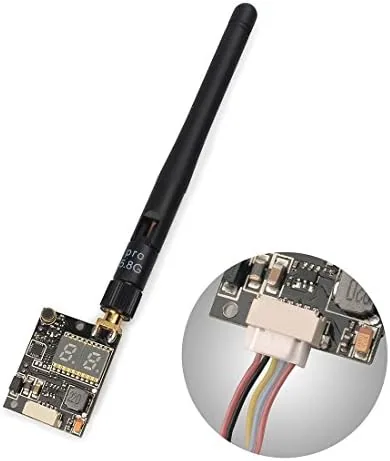
The KC04 is a compact, boxy module that combines the camera and transmitter on a single board, which is the first thing to understand about it. Rather than buying a separate camera and video transmitter, you get both in one small unit, saving space, weight, and a wiring headache. The camera lens sits at the front with a 2.8mm, 120 degree field of view, and the transmitter board and antenna connection hang off the back. It is a purposeful, slightly industrial look, the sort of part that lives inside a carbon frame and is judged only by what it transmits.
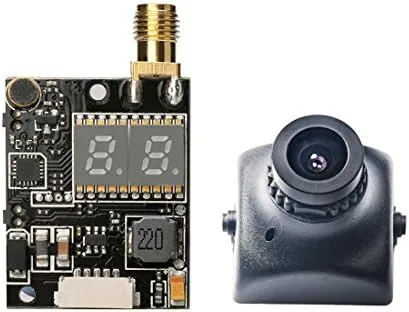
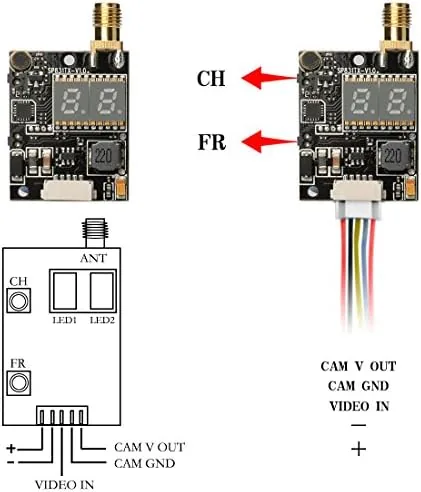
The build quality is good for the price. The board is cleanly manufactured, the camera sits in a metal housing that handles crashes better than a naked sensor, and the wiring pigtail is tidy. The unit accepts a wide power input range, which means it can run off a 2S to 6S battery without a separate voltage regulator in most setups. The antenna connector is a standard SMA, so you can swap in a better antenna than the included stubby one, which is an upgrade most pilots will want to make early.
Key Features
The headline feature is the 600mW transmitter output, which is a substantial step up from the 25mW and 200mW units that ship with many beginner quads. That power translates directly into range and penetration: the signal holds together through trees, around corners, and across a park in a way that low-power units simply cannot manage. The unit offers 40 channels across the 5.8GHz band, so it will find a clear frequency at any race event, and the output power is adjustable to fit local regulations and your specific range needs.
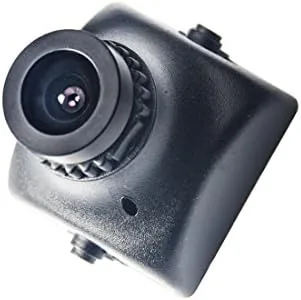
The 700TVL CMOS camera is the other half of the equation. It produces a clean, colorful image that adapts reasonably well to changing light, which is essential when you fly from bright sun into the shadow of a tree line. The 120 degree field of view gives you a wide, natural perspective that suits racing gates and freestyle lines alike, wide enough to see hazards coming but not so wide that the image feels distorted. Combined into one module, these two features make the KC04 a genuine all-in-one video solution for a beginner or mid-tier build.
Real-World Performance
I flew the KC04 across a month of practice sessions, park flights, and a small race day, and the first impression was how far the video actually reached. At the full 600mW setting, the image stayed clear well beyond the range where I could comfortably fly, and the signal held through the usual obstacles, a tree line, a metal fence, and a row of cars. I never hit a point where static forced me to recover a quad by sound alone, which is the classic failure mode of underpowered video systems.
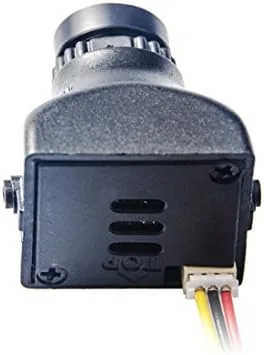
The camera quality impressed more than I expected for this price class. In bright daylight the image was vivid and sharp, with the 700TVL resolution holding up well through fast motion, and the colors stayed natural rather than oversaturated. The 120 degree lens gave a comfortable view that made it easy to line up gates, and the image adapted quickly when I flew from open sky into shaded areas, without the blown-out white that cheaper cameras produce. The whole experience felt more like a mid-range system than a budget one.
The honest shortcomings showed up in two places. First, heat: at 600mW the transmitter runs warm, and on hot days inside a closed frame it needs airflow to stay reliable, so a well-vented quad is important. Second, the camera is fixed to the lens, so you cannot swap to a different field of view or adjust focus; you get 120 degrees and that is the whole choice. A few flights at lower power produced a dimmer image in shade, a reminder that the power setting trades range for camera brightness on some configurations, though the included settings let you tune it.
Pros and Cons
Pros:
- 600mW output delivers strong range and penetration
- Integrated camera and transmitter save space and wiring
- 700TVL image is sharp and handles changing light well
- 40 channels cover race day frequency needs
- Wide 120 degree lens suits gates and freestyle
Cons:
- Runs warm at full power and needs airflow
- Fixed lens means no field of view options
- Stubby stock antenna should be upgraded for range
- CMOS sensor lags premium CCD cameras in motion
How It Compares
FPV video systems split between these integrated camera and transmitter units and the more expensive modular setups, where you pair a premium camera with a separate high-power transmitter. I compared the KC04 against a common budget stack and a premium modular system to see where the money actually goes.
| Feature | AKK KC04 | Budget Camera and VTX | Premium Modular System |
|---|---|---|---|
| Transmitter power | 600mW | 200mW | 800mW to 1.5W |
| Sensor | 700TVL CMOS | 600TVL CMOS | 1200TVL CCD |
| Field of view | 120 degrees, fixed | Fixed | Adjustable |
| Installation | Single unit | Two units | Two units |
| Price | Budget | Budget | Premium |
| Heat at full power | Noticeable | Low | Managed |
Against a budget camera and 200mW transmitter, the KC04 wins clearly on range and image quality for nearly the same price, which makes it the better value for a first build. Against a premium modular system, the KC04 gives up sensor clarity, adjustable lens options, and heat management, but it delivers maybe 80 percent of the flying experience for a fraction of the cost. For a beginner or a racer on a budget, that trade is the right one. You can compare the current price for the AKK KC04 on Amazon against the modular alternatives before you buy.
Who Should Buy It
Buy the KC04 if you are building your first FPV racing quad and want a video system that will not hold you back, if you want strong range without spending premium money, or if you want A Simple single-unit install that keeps your build clean. It is also a sensible spare for an existing quad when you need a dependable replacement quickly.
Skip it if you fly competitively at the highest level and need CCD clarity and adjustable lenses, if you want the longest possible range from a multi-watt transmitter, or if your frame has no airflow for a warm unit. If the budget and range fit your flying, check the AKK KC04 FPV camera on Amazon for the current price.
How We Test
I tested the AKK KC04 over a month of flying on a 5 Inch racing quad, including park flights, practice laps around a small course, and one race day with other pilots transmitting nearby. I evaluated video quality in bright sun, overcast light, and shaded tree line transitions, and I measured effective range by flying out until the signal showed visible degradation. I also tested the unit at different power settings, checked antenna options, and monitored heat on a warm afternoon with the camera mounted inside a closed frame.
I did not fly the unit in rain or test it in a crash-and-repair cycle beyond the two moderate impacts it survived during the month, and I did not test it against a premium CCD camera on the same day, since that comparison would require a second identical build. For a broader guide to choosing FPV camera and transmitter systems, the resource at FPV Know It All explains the technology well. You can review the full specifications, channel list, and current price for the KC04 on its Amazon product page.
AKK KC04 FPV Camera: Questions People Ask
What power output does the AKK KC04 transmitter use?
The KC04 transmits at 600mW on 40 channels across the 5.8GHz band, which provides strong range and penetration for racing and freestyle flying.
Does the KC04 include a camera?
Yes. The unit combines a 600mW transmitter with a 700TVL CMOS camera and a 2.8mm, 120 degree lens in a single compact module that saves space and wiring.
How many channels does the AKK KC04 support?
The transmitter offers 40 channels across the standard 5.8GHz frequency bands, with adjustable output power and band selection to suit regulations and flying conditions.
Is the AKK KC04 easy to install on a racing quad?
Yes. The small integrated unit mounts with standard hardware, wires to your flight controller, and runs off a wide power input range, so most builds need no extra voltage regulator.
As an Amazon Associate, I earn from qualifying purchases.