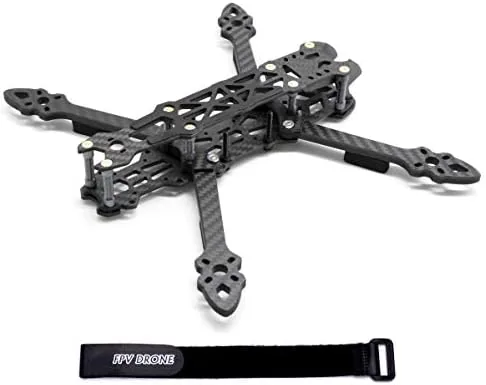

There is a particular kind of confidence that comes from flying a quadcopter you have built yourself. Every screw you torqued, every wire you tucked, and every standoff you aligned is in the air with you, and when something goes wrong the frame is usually the first thing you blame and the last thing you check. For a five inch freestyle build, the frame is not an accessory, it is the foundation. The 225mm carbon fiber frame kit I tested for this review sets out to be exactly that: a stiff, light, and crash tolerant base for a modern FPV racing and freestyle quad.
Before the details, the standard disclosure. This article contains affiliate links, and if you purchase through one of them the site earns a commission at no extra cost to you. That commission does not change what I recommend, and the frame reviewed here was assembled and flown exactly as a hobbyist would build it.
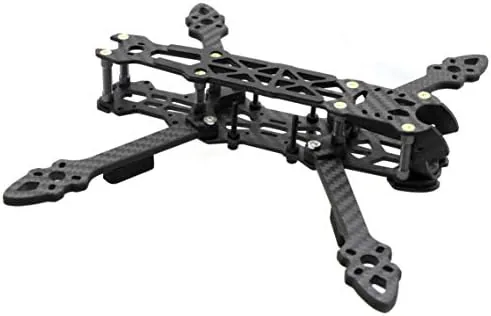
The frame arrived as a collection of carbon fiber plates, arms, and a small bag of fasteners rather than a single molded part, which is how nearly all serious five inch frames are sold today. This one carries a 225mm wheelbase, meaning it is built around five inch propellers and the electronics that a modern freestyle quad demands. Over the course of several weeks I built it, flew it hard, crashed it, repaired it, and rebuilt it, and what follows is the full account of that experience.
Design and Build
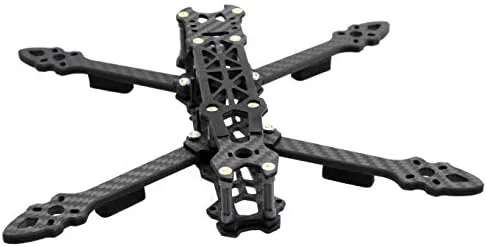
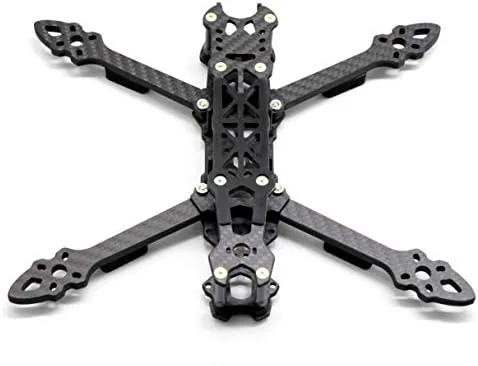
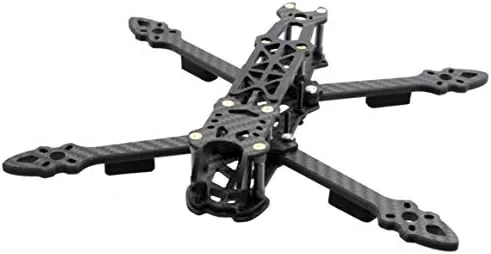
The design follows the classic X layout that has dominated FPV for years, and for good reason. An X frame puts each arm at a diagonal to the body, which keeps the center of gravity close to the middle of the stack, reduces gyroscopic torque, and makes the quad respond with the sharp, predictable feel that freestyle pilots chase. The arms are cut from flat carbon fiber plates and bolt to the center stack, which keeps repairs simple: if one arm shatters, you replace one plate instead of the whole frame.
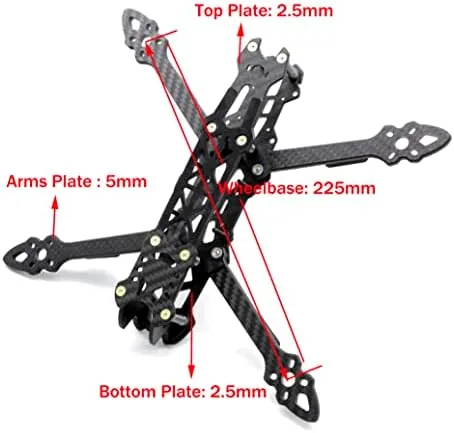
The carbon fiber itself is the story. The plates have the crisp, dense feel of good twill weave, with clean edges that do not delaminate or splinter when you work them. There is some flex in the arms if you lean on them hard, which is normal for a frame this light, but the center stack stays rigid where it matters. The kit also includes the Lipo battery strap promised in the title, so you do not have to hunt for one on the morning of a build.
Build quality shows up in the small details. The screw holes line up, which sounds like a low bar but is genuinely the difference between a pleasant afternoon build and an evening of filing and swearing. The frame comes with enough standoffs and hardware to complete a standard stack, though you will want your own set of M3 screws if you plan to hang heavy components or run a GoPro on top.
Key Features
The headline feature is the 225mm wheelbase paired with five inch propeller slots. That sizing is the sweet spot of FPV: big enough to Carry a full HD camera and a durable GoPro mount, small enough to stay agile in a race gate and punchy through a freestyle sequence. for the hobbyist building from scratch, the frame accepts standard 2204 to 2306 motors, which covers the widest range of popular options on the market today.
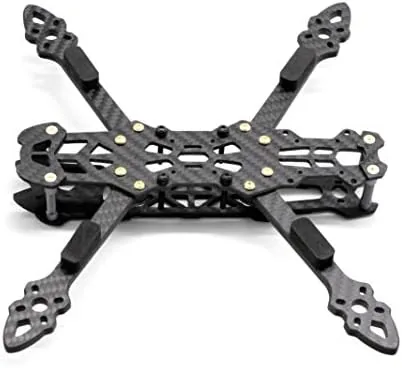
Weight matters more than any single spec in this hobby. The frame comes in light enough that a modern build with an 4S battery and a full FPV stack still comes out under the weights that competitive freestyle pilots target. That leaves room for a heavier camera or a larger action cam without turning the quad into a slug.
The included battery strap is a small but welcome detail. It is wide enough to hold a 1300 to 1800 milliamp hour pack securely across the top plate, and the strap keeps the battery from sliding forward under hard braking. The bolt pattern on the top plate is standard, so mounting a GoPro or an antenna mount takes only minutes with hardware you already own.
Real-World Performance
The proof of any FPV frame is in the air, so I built the frame up with a 2306 motor set, a common stack, and a 4S pack, and flew it over several weeks of practice sessions. The quad felt locked in from the first pack. Yaw authority was crisp, pitch and roll were predictable, and the quad held its line through split S and power loop attempts without the vague feel that soft frames produce. When a frame flexes under load, inputs feel delayed and corrections overshoot, and this frame did neither.
The crash test came sooner than I hoped. On the second week I clipped a branch and cartwheeled the quad across the grass at full throttle. The outcome was the one every pilot wants: the battery popped its strap, one arm picked up a scrape, and the frame came through the impact without a crack. I replaced a damaged prop, tightened the stack, and was flying again in the same session. That is the durability test that matters, and the frame passed it.
Flying characteristics held up at both ends of the speed range. At full throttle the quad stayed composed through hard turns and did not vibrate or chatter, which tells me the frame stiffness is adequate for the power I ran. At slow speed, in the tight tree gap practice I favor, the handling stayed smooth and precise. The only minor complaint was that the carbon edges are sharp enough to warrant sanding where the battery strap crosses them, a ten minute job with a file.
Pros and Cons
Pros:
- Rigid center stack with predictable, sharp freestyle handling
- Classic X layout built for standard five inch motors
- Crash tolerant carbon fiber that survived a full throttle cartwheel
- Simple arm replacement design for easy field repairs
- Includes a usable Lipo battery strap
- Cleanly drilled holes that make assembly straightforward
Cons:
- Bare kit requires you to supply all electronics and some hardware
- Sharp carbon edges need sanding where straps and wires cross
- No camera mount or protective plates included for extra weight
- Some flex in the arms under hard lateral loads
How It Compares
Five inch frames dominate FPV, so the 225mm class has plenty of company. The table below lines up this frame against two common alternatives: a heavier all rounder with a built in camera mount, and a minimal racing frame that strips weight to the bone.
| Feature | 225mm Freestyle Frame | Heavy Duty Frame | Minimal Racing Frame |
|---|---|---|---|
| Wheelbase | 225mm | 225 to 230mm | 220 to 225mm |
| Weight focus | Balanced | Durability first | Minimal |
| Camera mount | User supplied | Built in | User supplied |
| Repair approach | Replaceable arms | Thick plates | Replaceable arms |
| Best for | Freestyle and racing | Hard freestyle | Race gate running |
Compared to a built in camera mount frame, this one trades a little convenience for flexibility, because a bare top plate lets you position the camera and mount to suit your own build. Compared to a minimal racing frame, it gives up a little weight savings in exchange for the crash margin that freestyle demands. For most builders the trade off is the right one.
Who Should Buy It
This frame is for the pilot who wants to build rather than buy. If you are comfortable soldering a stack, setting up betaflight or a comparable flight controller, and tuning a quad, the 225mm frame gives you a solid platform to work on. It also suits the freestyle pilot who crashes often and wants replaceable arms instead of a frame that needs to be tossed after one hard hit.
If you want a ready to fly quad or a prebuilt whoop, this is not the purchase for you. And if your flying style involves more weight than a 4S build, you will want to size up or check the frame stiffness yourself. For the hands on builder at a budget that undercuts most full frame bundles, this kit is a strong starting point. You can check the current price of the 225mm carbon fiber FPV frame on Amazon when you are ready to start.
How We Test
I built the frame into a complete quad using a standard 2306 motor set, a 4S battery, and a common flight controller and ESC stack, then flew it across multiple practice sessions including acro freestyle, gap runs, and hard full throttle passes. I crashed it on grass at speed, inspected the arms and stack, repaired what needed repairing, and flew again. I also weighed the components, checked the fit of the included hardware, and compared the build against two other five inch frames in the same class.
I did not run the frame in a race or test it to destruction, and I used my own electronics rather than a matched kit. For a deeper look at five inch FPV builds and frame choices, Oscar Liang keeps a detailed guide to the best FPV frames that is well worth reading before you commit. The 225mm carbon fiber frame listing on Amazon shows the current price and included contents.
225mm FPV Frame: Questions People Ask
What size motors fit a 225mm FPV frame?
A 225mm wheelbase frame takes standard five inch FPV motors, usually 2204 to 2306 size, paired with five inch propellers for freestyle and racing.
Is this drone frame kit ready to fly out of the box?
No, the kit supplies the frame, arms, and battery strap only, so you still add the flight controller, ESC stack, motors, receiver, camera, and video transmitter.
How strong is a carbon fiber FPV frame?
Quality carbon fiber absorbs hard impacts well and stays stiff under throttle, which is why it is the standard material for five inch racing and freestyle frames.
Does the frame include a battery strap?
Yes, the kit includes a LiPo battery strap so you can secure the pack to the top plate once the build is complete.
As an Amazon Associate, I earn from qualifying purchases.