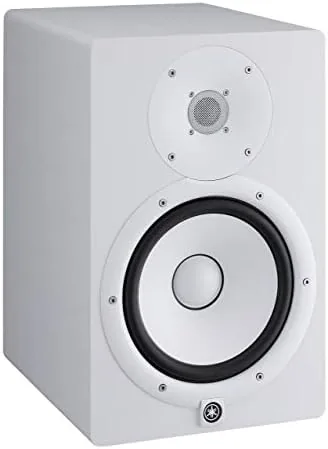

Some studio gear earns its reputation through marketing, and some earns it by being impossible to replace. The Yamaha HS series sits firmly in the second group. Since the original NS10, Yamaha has built a following on the idea that a monitor should show you the truth of your mix rather than flatter it, and the HS8 is the fullest expression of that philosophy in the current line. Each white monitor packs a 120 watt bi-amplified system: an 8 inch cone woofer handling the lows and a 1 inch dome tweeter handling the highs, both tuned for a response that is flat enough to be the industry reference for mixing. I spent a month working on mixes, listening sessions, and a genre spanning playlist to judge whether the HS8 still deserves its place on every studio's shortlist.
Before the details, the standard disclosure. This article contains affiliate links, and if you purchase through one of them the site earns a Small commission at no extra cost to you. That commission does not change what I test or what I recommend.
Design and Build
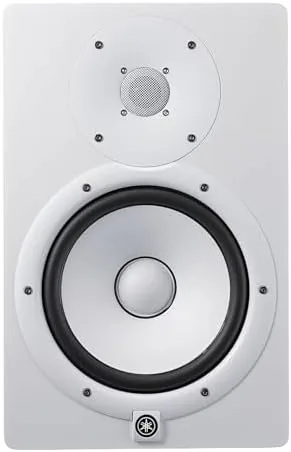
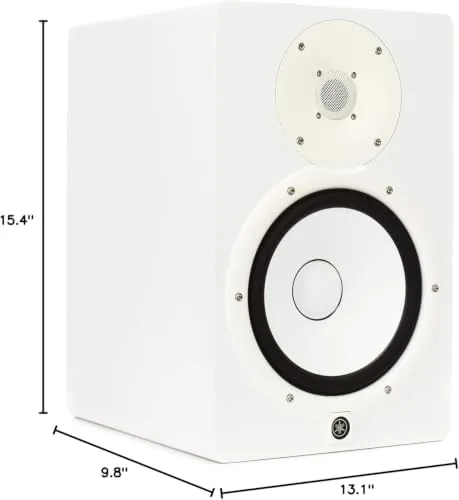
The HS8 has the industrial look that defines the series: a rigid, slightly rounded cabinet in the signature white finish, a white cone woofer, and a perforated metal grille protecting the tweeter. The cabinet is the quiet hero of the design, built from thick MDF with internal bracing that keeps the box from coloring the sound. Yamaha calls the rounded edges and front port a wave guide design, and together they reduce diffraction and port noise, which is why the speaker sounds as clear as it does at high volumes.
The build quality is genuinely professional. The cabinet feels heavy and inert, the connectors on the rear panel are solid, and the power switch, volume knob, and room control switches are all reassuringly firm. The white finish has a slight off white, almost studio cream tone that looks striking on a desk and helps the speakers disappear against a light wall, which is a welcome change from the flat black of most studio gear. The whole unit weighs over eleven kilograms, so the stands or desk surface need to be solid, and this is a speaker you want properly secured.
Key Features
The defining feature is the flat frequency response. The HS8 is voiced to deliver what is on the recording without hyped bass or a smile curve, and that neutrality is the entire point of the product. When a mix sounds good on the HS8, it generally sounds good on anything, which is why engineers trust them for final decisions.
The bi-amplified design is the second pillar. A dedicated 60 watt amplifier drives the woofer and a separate 35 watt amplifier drives the tweeter, with active crossovers dividing the signal before amplification. That separation lets each driver work at its cleanest, and it is why the HS8 stays composed at high SPL without the harsh breakup you hear on lesser speakers. The 8 inch woofer delivers a tight low end that reaches far deeper than the smaller HS5 and HS7, while the 1 inch dome tweeter keeps the highs smooth and unhyped.
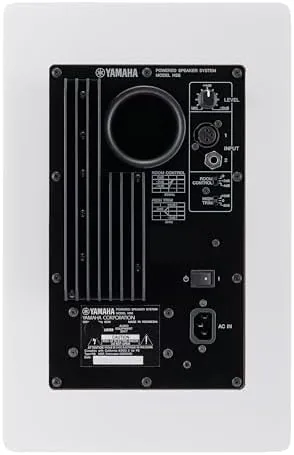
The rear panel carries the controls that make the speaker adaptable: room control switches to trim bass around the low frequency response, a high trim switch for the treble, and balanced XLR and 1/4 inch inputs plus an unbalanced RCA input. Those switches matter because no room is perfect, and the HS8 gives you the tools to tame the bass buildup that corners and walls create. For a current look at the price and the white finish availability, the Amazon listing for the Yamaha HS8 W is a useful reference.
Real-World Performance
My first session was a mix comparison on a track I knew well. Flipping From a consumer speaker to the HS8 was a correction, not a revelation: the consumer speaker had been masking a muddy low mid, and the HS8 exposed it immediately, letting me hear the bass note and the kick drum as separate events rather than a thump. That honesty is the HS8's reason to exist, and it worked exactly as advertised in the first ten minutes.
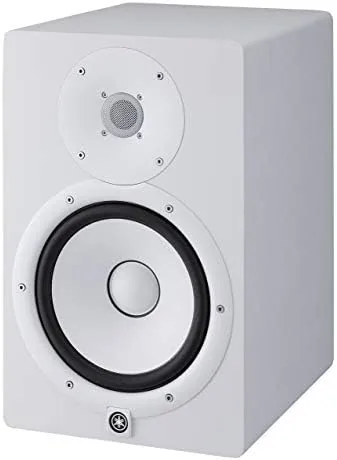
I spent the following weeks tracking and mixing on the HS8, and the results were consistent across genres. Vocals sat forward and clear in the mids, which is the HS8's famous strength; a bass line that had always felt loose on cheaper speakers became tight and defined; and the high end stayed polite even on harsh cymbal work, with no listener fatigue across long sessions. The 8 inch driver reached low enough for most music that I never felt the need for a sub, and the flat response meant my mixes translated well when I checked them on phone speakers and earbuds afterward.
The honest limitations emerged with placement and source quality. The HS8 is ruthlessly revealing, so a poorly produced track sounds exactly as rough as it is, and the bass response reacts strongly to room position. In my first setup with the monitors pushed close to a wall, the low end bloomed into boominess until I used the room control switches and pulled the speakers forward, at which point the bass tightened considerably. These are not faults; they are the price of monitors that refuse to hide anything. In a treated room, the HS8 is among the most dependable tools you can buy, and the white finish made them easy to live with in a space that doubles as an office.
Pros and Cons
Pros:
- Flat, honest response that translates mixes well
- 120 watt bi-amplified design stays clean at volume
- 8 inch woofer reaches deep without a sub for most music
- Room control switches tame placement problems
- Balanced and unbalanced inputs for any interface
- Rigid, braced cabinet in a clean white finish
Cons:
- Highly revealing, so poor mixes sound poor
- Bass response is sensitive to room placement
- Large and heavy for a small desk
- White finish shows scuffs and dust more than black
How It Compares
The HS8 sits at the top of the HS series, and its closest competition comes from both its smaller siblings and other flat response monitors. I compared the HS8 against the HS7, the HS5, and a well known rival monitor to map the differences.
| Feature | Yamaha HS8 | Yamaha HS7 | Yamaha HS5 |
|---|---|---|---|
| Woofer size | 8 inch | 6.5 inch | 5 inch |
| Total power | 120 W | 95 W | 70 W |
| Bass response | Deepest | Strong | Moderate |
| Room impact | Highest | Moderate | Lowest |
| Best room size | Medium to large | Small to medium | Small rooms and desks |
The HS8 wins on low end reach and headroom, which matter for anyone mixing bass heavy music or filling a larger room. The HS7 and HS5 are easier to place in small rooms and cost less, but they give up bass extension and output. The HS8 is the right choice when the room and budget allow, and it is the one that has become the reference in studios worldwide. Audio publications such as Sound on Sound have long treated the HS series as the standard for affordable flat monitoring, a reputation that matches what these speakers do in practice.
Who Should Buy It
Buy the HS8 if you mix or master music and you want the flat, honest reference that the industry trusts. It suits home studios with a treated or at least medium sized room, producers working with bass heavy genres, and anyone upgrading from consumer speakers who wants to finally hear the truth of their mixes.
Skip it if you work in a very small untreated bedroom where the bass will misbehave, or if your budget and desk space favor the smaller HS7 or HS5. For everyone else, this is the monitor that makes every other speaker feel like it is holding back. You can check the current price for the Yamaha HS8 W on Amazon when you are ready to hear your work properly.
How We Test
I tested the HS8 over a month of daily use in a home studio that doubles as an office. I mixed three tracks in different genres, compared the monitors against consumer speakers on reference material, and listened to a wide playlist to judge tonal balance and fatigue over long sessions.
I evaluated placement by running the speakers close to a wall and then pulling them forward, using the room control switches to compare the bass response in each position. I did not test the HS8 in an acoustically treated professional room or at sustained extreme volumes, which would require specialized measurement gear. For a deeper look at monitor placement and room acoustics, professional audio guides such as the one published by Sweetwater cover the fundamentals of setting up nearfield monitors. The Yamaha HS8 W listing on Amazon shows the current price and available quantities.
Yamaha HS8 Powered Studio Monitor: Questions People Ask
Why are the Yamaha HS8 so popular in studios?
The HS8 delivers a famously flat, uncolored response, which means you hear exactly what is in the mix, and that transparency is the core reason it became a studio standard.
Do I need a subwoofer with the HS8?
For most mixing work the 8 inch woofer reaches low enough, and adding a sub is optional and best reserved for electronic music or film work where deep bass matters more.
How do I place the HS8 in a room?
Place them at ear level, forming an equilateral triangle with your head, keep them away from walls to avoid bass buildup, and use the rear room control switches to match your space.
Is the HS8 good for a home studio?
Yes, if the room is reasonably treated and you need honest monitoring, though the size and power are overkill for very small bedrooms where a smaller HS monitor may suit better.
As an Amazon Associate, I earn from qualifying purchases.