
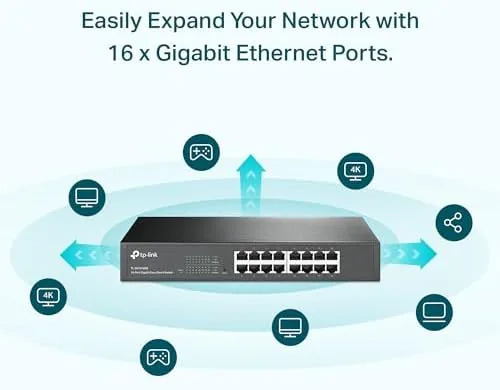
There comes a point in every network where the router simply runs out of rooms. Once the desktop, the TV, the streaming boxes, the game consoles, the printer, and the smart home hub all demand a wire, eight ports are not enough. That is the exact moment the TP-Link TL-SG1016DE enters the conversation, because it brings sixteen gigabit ports, a metal chassis, and a set of smart management tools to a growing home or small office network without demanding enterprise money. I ran it as the heart of a busy household network for a month to see how it holds up.
The disclosure belongs up front. This article contains affiliate links, and if you buy through one of them the site earns a small commission at no extra cost to you. That commission does not influence what I test or what I recommend. The switch in this review was purchased at retail, and every device it served was tested the same way I would test one I bought myself.
Design and Build
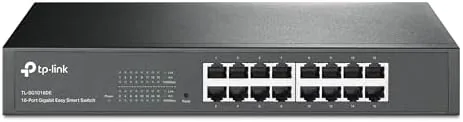
The TL-SG1016DE is built around a full-width metal chassis, and the difference between this and a plastic switch is immediately obvious when you pick it up. The metal case is rigid, cool to the touch, and doubles as a heatsink, which is why the unit can run completely fanless while moving data through all sixteen ports. There is no fan, no vents that collect dust, and no moving parts to fail, which is exactly the kind of design a network that runs for months at a time demands.
The port layout is practical. Sixteen gigabit ports sit along one edge, each shielded, with status LEDs on the front face showing link and activity for every connection. The unit works either way it sits, on a desktop with the included rubber feet or in a rack using the metal ears that ship in the box, and both setups leave room for the switch to breathe. The rack ears are the quiet difference maker for anyone building a proper network cabinet, because a switch that cannot be racked becomes shelf clutter fast.
The build quality extends to the details: the ports click positively when a cable seats, the casing does not flex under pressure, and the LED layout is readable from across the room. This is a device designed to be installed and forgotten, which is the highest compliment a switch can earn.
Key Features
The headline is the port count: sixteen gigabit ports with a 32 Gbps switching capacity, which means every port can run at full speed simultaneously without the switch becoming a bottleneck. For a household with multiple 4K streams, a NAS, and several gaming consoles, that headroom is the difference between a smooth evening and a buffering one.
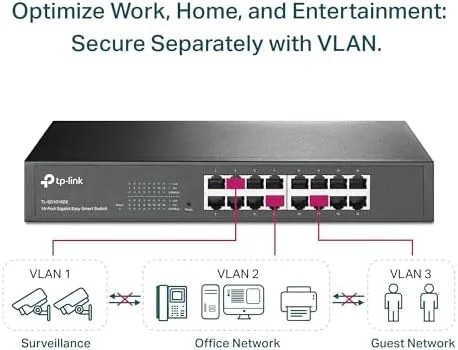
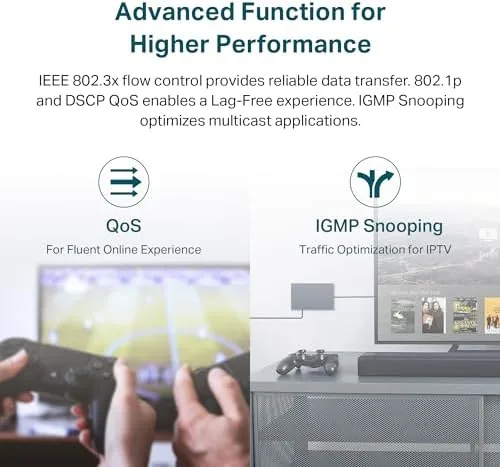
The easy smart management layer is the second headline. The switch supports QoS with 802.1p priority, so you can make sure gaming traffic and video calls cut ahead of large downloads. It supports port-based and 802.1Q VLANs, so you can partition the network and keep smart home gadgets separated from your main devices. It handles IGMP snooping to keep multicast streams from flooding every port, and it supports link aggregation, which lets you combine ports into a faster trunk to a NAS or another switch.
None of those features get in the way of basic use. Out of the box, the TL-SG1016DE behaves exactly like a simple unmanaged switch: plug in cables, and everything works. The management interface waits in the background until you choose to open it, so the switch serves a beginner today and a network tinkerer tomorrow without changing hardware.
Real-World Performance
I wired the TL-SG1016DE into a two-story house and connected every wired device I could find: two desktops, a laptop dock, three consoles, two smart TVs, a streaming box, a printer, and a pair of smart home hubs. That filled fourteen of the sixteen ports, and the switch took it all in stride. File transfers to a network drive ran at full gigabit speed, a 4K stream and a competitive game session ran simultaneously without a hiccup, and the whole thing stayed silent the entire time.
The silence is the feature I came to appreciate most. There is no fan in the TL-SG1016DE, and even under a full load of moving data it produces no noise at all. In a living room or office, a network switch you cannot hear is a network switch you will never notice, and that is the goal.
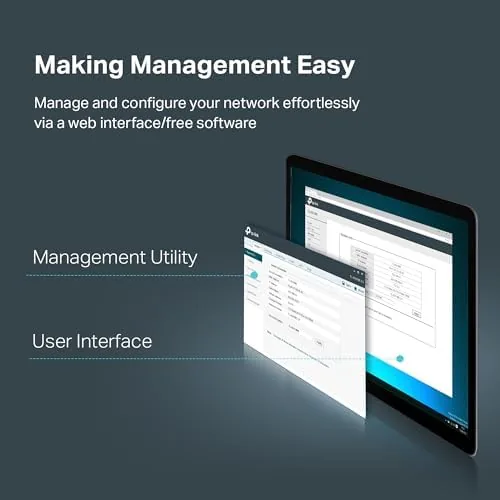
I also put the Smart Features through their paces. The one-time setup runs on a Windows PC, and after that the switch answers in a web browser. I applied a QoS rule that gave my desktop priority during a large download and confirmed a video call stayed crystal clear. I created a VLAN to isolate the smart home hubs from the main network, and both hubs kept working while disappearing from the rest of the LAN. Link aggregation combined two ports into a trunk to the NAS and delivered the expected speed gain. Every tool worked as described, and none of them required any prior networking knowledge to get running. A note on long-term stability, because that is what a switch is actually for. I left the TL-SG1016DE running for a full week without touching it, with all fourteen devices connected the entire time. There were no dropped links, no reboots, no flaky ports, and no need to cycle the power. The device simply sat there doing its job, silent and warm but never hot, which is exactly the behavior a network owner wants from a box that will live in a cabinet for years. The power consumption is low enough that it makes no noticeable difference to the electricity bill, and the switch wakes and responds instantly when a device is plugged in, with no slow link-up delay.
Pros and Cons
Pros:
- Sixteen gigabit ports with a 32 Gbps switching capacity
- Completely fanless and silent metal construction
- Works as a plug and play unmanaged switch out of the box
- QoS, VLAN, IGMP, and link aggregation for when you need them
- Desktop and rack mount options included in the box
- Runs cool without a fan under sustained load
Cons:
- Initial management setup requires a Windows PC
- No 2.5 or 10 gigabit ports for high speed NAS work
- Sixteen ports tempt you to hoard cables
- Most households will never use the smart features
How It Compares
The TL-SG1016DE compares directly with its smaller sibling, the eight-port TL-SG108E, and with the fully managed switches that cost several times as much. The table shows where each one earns its place.
| Feature | TL-SG1016DE | TL-SG108E (8 Port) | Fully Managed 16-Port |
|---|---|---|---|
| Ports | 16 gigabit | 8 gigabit | 16 gigabit |
| Switching capacity | 32 Gbps | 16 Gbps | 32 Gbps or more |
| Rack mount | Included | No | Yes |
| QoS and VLAN | Yes | Yes | Yes, more advanced |
| Setup effort | Plug and play | Plug and play | High |
| Noise | Silent | Silent | Often has a fan |
| Price | Low | Lowest | Highest |
The eight-port version is the better buy if you will never exceed eight connections. The fully managed switch offers advanced features like SNMP monitoring and ACLs, but it costs more, runs louder, and takes real networking knowledge to configure. For a growing home network that wants room to expand, the TL-SG1016DE is the sweet spot.
Who Should Buy It
Buy the TL-SG1016DE if your network has outgrown a smaller switch, if you want wired gigabit to every room in the house, or if you plan to rack your gear and want a switch that mounts properly. It is the answer for the home that has run out of ports and wants the simplest possible way to add more, with management tools waiting for the day the network gets serious.
Skip it if eight ports will always be enough, if you need faster than gigabit for a modern NAS, or if you want enterprise monitoring features. If the TL-SG1016DE matches your network plan, you can check the current TL-SG1016DE price on Amazon.
How We Test
I ran the TL-SG1016DE as the core of a busy household network for a month, wiring fourteen devices across two floors and measuring throughput, latency, and stability during simultaneous streaming, gaming, and file transfers. I left the switch running for a week straight to confirm the fanless design stayed cool, then exercised the management features: QoS rules, port-based and 802.1Q VLANs, IGMP snooping, and link aggregation.
For an independent view on how easy smart switches fit a growing home network, I compared my results with the switch coverage at Tom's Hardware networking section, which has tested this class of hardware extensively. The TL-SG1016DE listing on Amazon includes the full specifications and current pricing if you want to confirm the details yourself.
Questions People Ask
Can the TL-SG1016DE be rack mounted?
Yes. It ships with rack-mount ears that attach to the metal housing, and it can also sit flat on a desktop with the included rubber feet.
Is the 16-port switch fanless?
Yes. It is completely fanless and silent, with the metal casing doing the work of dissipating heat on its own.
Do all 16 ports run at gigabit speed?
Yes. Every port supports 1000 Mbps full duplex, with a switching capacity of 32 Gbps to keep all ports moving data at once.
What management features does it include?
It offers QoS with 802.1p priority, port-based and 802.1Q VLANs, IGMP snooping, and link aggregation for combining ports into a faster trunk.
As an Amazon Associate, I earn from qualifying purchases.