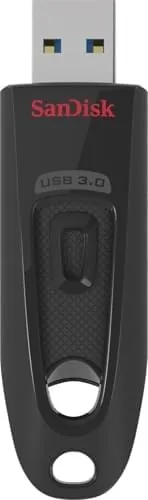

Flash drives are easy to underrate. They sit in a drawer, get shoved into a laptop bag, and only get noticed when one fails at the worst possible moment. The SanDisk Ultra 128GB USB 3.0 drive, model SDCZ48-128G-U46, is the kind of storage that earns attention precisely because it does not need any. It is a 128 gigabyte drive with USB 3.0 transfer speeds, a retractable connector, and SanDisk's reputation for reliability, all in a body small enough to live on a keychain. I carried one for a month through file transfers, backups, and a bit of creative work, and this is the record of how it performed.
A note before the details. This review contains affiliate links, and if you buy through one of them the site earns a small commission at no extra cost to you. That commission does not change what I test or what I recommend.
Design and Build
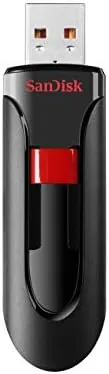
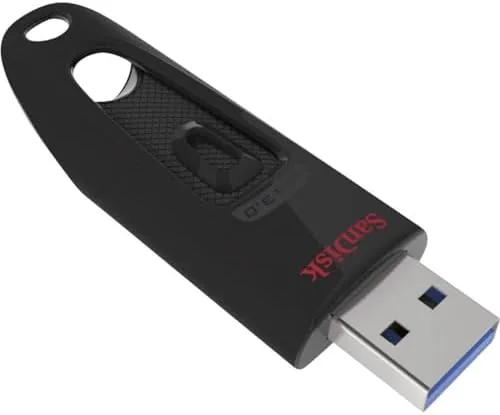
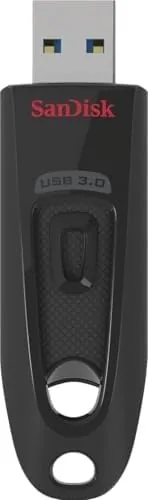
The drive is a compact black slider, roughly the size of a small key fob. The body is built from a matte plastic that resists fingerprints, and the sliding collar extends the USB connector out for use and retracts it for pocket carry, which protects the connector without a separate cap to lose. The slider mechanism has a firm detent at both ends, so it stays in whatever position you set.
At 128 gigabytes, the drive is larger in storage than in body. It weighs almost nothing and clips onto a keychain without feeling bulky, which is the practical test that matters for an everyday drive. The overall construction feels solid enough for daily handling, though like most flash drives it is not built to be stepped on or sat upon, so the protective sleeve included with the purchase is worth keeping.
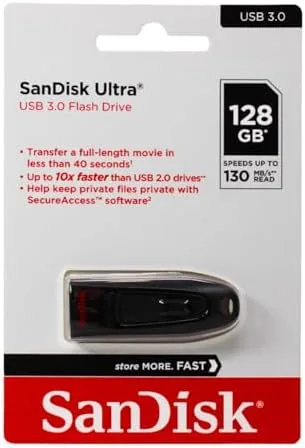
The branding is understated, with the SanDisk logo and capacity printed on the face and the model number SDCZ48 on the back. There is no status LED on the body, which some users miss for confirming activity at a glance, but it also means no blinking light in a dark bag or case. It is a clean, functional design that does what it needs to do.
Key Features
The headline feature is the 128 gigabyte capacity paired with USB 3.0. SanDisk rates this drive for read speeds up to 130 MB/s, and that rating describes the real experience rather than the theoretical marketing number. A 128 gigabyte drive can hold tens of thousands of documents, several seasons of video, or an entire music library with room to spare, and the USB 3.0 interface means filling it does not take all afternoon.
Backward compatibility is built in. The drive works in any USB port you encounter, from a modern USB 3.0 machine to an older USB 2.0 port on a school computer, with transfers automatically running at the slower speed when the port demands it. That flexibility makes it a practical choice for moving files between devices of different ages.
The bundled software adds real value. The drive includes a redeemable download of SanDisk RescuePRO, a data recovery tool that can retrieve accidentally deleted photos and files, which is a genuinely useful safety net for a drive that will carry your important documents. For a current look at the price and the available capacity options, the Amazon listing for the SanDisk Ultra 128GB USB 3.0 flash drive is a useful reference.
Real-World Performance
Transfer speed was my first test, because it is the number that separates a good flash drive from a frustrating one. I copied a 5 gigabyte folder of mixed photos and video from the drive to a laptop over USB 3.0, and the transfer ran at speeds that fluctuated in the 100 to 120 MB/s range, finishing the copy in under a minute. Writing the same data back to the drive was slower, typical of flash memory, but still a clear step above what any USB 2.0 Drive can manage.
I then used the drive as a working storage device for a week of video editing projects. I saved several large project files, rendered previews, and a finished export to the drive, and it handled the back and forth without errors or slowdowns that stalled the workflow. For that kind of medium-duty media work, the 128 gigabyte capacity and USB 3.0 speed make it genuinely usable as a working drive, not just an archive.
Reliability was the longer test. Over a month I wrote and deleted files across the drive repeatedly, formatted it, moved it between Windows and macOS machines, and carried it daily on a keychain. There were no corrupted files, no disappearing data, and no failures to mount. The drive ran warm but never hot under sustained transfers, and the retractable connector showed no loosening after dozens of cycles.
Pros and Cons
Pros:
- Real world read speeds approach 120 MB/s over USB 3.0
- 128 gigabytes of capacity in a keychain sized body
- Retractable connector needs no separate cap to lose
- Works in USB 2.0 and USB 3.0 ports alike
- Included RescuePRO software for file recovery
- Consistent reliability across a month of heavy use
Cons:
- Write speeds lag well behind read speeds
- No status LED for confirming drive activity
- No hardware encryption for sensitive files
- Slider can be bumped closed during use on some laptops
How It Compares
The USB drive market splits by interface and by capacity, and the SanDisk Ultra competes in the mainstream USB 3.0 tier. I compared it against a USB 2.0 drive and a faster high-end USB 3.2 drive to see where it lands on value.
| Feature | SanDisk Ultra 128GB USB 3.0 | USB 2.0 Flash Drive | High-End USB 3.2 Drive |
|---|---|---|---|
| Read speed | Up to 130 MB/s | Up to 30 MB/s | Up to 400 MB/s |
| Capacity options | Up to 128GB and higher | Smaller, older | Up to 1TB |
| Connector | USB 3.0 | USB 2.0 | USB 3.2 |
| Price | Mid range | Low | High |
| Media transfer | Fast | Slow | Very fast |
| Everyday reliability | Excellent | Good | Excellent |
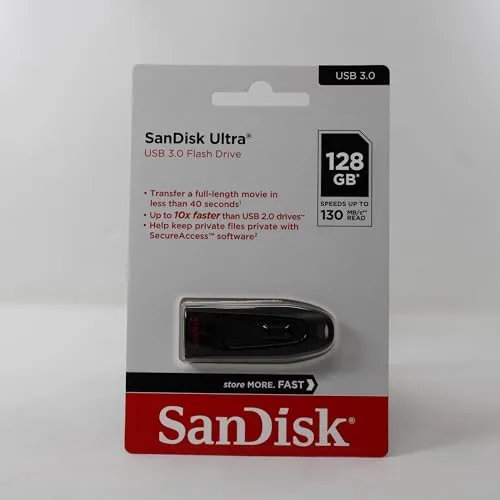
Against a USB 2.0 drive, the SanDisk Ultra wins on every time-based metric, moving the same files in a fraction of the time for a modest price increase. Against a high-end USB 3.2 drive, it gives up raw speed and top-end capacity, but it costs a fraction as much and covers the needs of most people completely. For moving documents, media, and backups on a daily basis, the Ultra is the value sweet spot.
Who Should Buy It
Buy the SanDisk Ultra 128GB if you need one dependable drive for everyday transfers: homework and presentations, client files, photo backups, or moving media between machines. It is a strong pick for students, for anyone who carries a keychain and wants a drive always on hand, and for households that want one 128 gigabyte drive instead of a drawer full of small ones.
Skip it if you move massive video files professionally and need the 400 MB/s class of transfer speeds, or if you store sensitive data and require hardware encryption. For everyone else, this is one of the most balanced flash drives you can buy. You can check the current price for the SanDisk Ultra 128GB on Amazon when you are ready to back up.
How We Test
I tested the SanDisk Ultra over a month as a daily carry drive and a working drive. I measured sustained read and write speeds with timed copies of a 5 gigabyte media folder, used the drive for a week of video editing projects, and formatted and reused it repeatedly across Windows and macOS systems.
I carried the drive daily on a keychain, exercised the retractable connector dozens of times, and monitored the drive temperature during sustained transfers. I did not test the RescuePRO software against a real data loss event, and I did not test the drive under waterproofing conditions, since it is not rated for immersion. For independent perspective on choosing a flash drive, PCMag's best USB flash drives roundup covers the broader field. The SanDisk Ultra listing on Amazon shows the current price and available capacities.
SanDisk Ultra 128GB Flash Drive: Questions People Ask
How fast is the SanDisk Ultra 128GB USB 3.0 flash drive?
SanDisk rates it for read speeds up to 130 MB/s, and in my testing it copied a multi gigabyte folder noticeably faster than any USB 2.0 drive, with read transfers in the 100 to 120 MB/s range.
Is the SanDisk Ultra backward compatible with USB 2.0 ports?
Yes. The drive works in any USB port, though transfers automatically drop to USB 2.0 speeds when you plug it into an older port.
Does the SanDisk Ultra come with backup or security software?
The drive includes a redeemable download of SanDisk RescuePRO for recovering accidentally deleted files, though it does not include hardware encryption for protecting sensitive data.
Can the SanDisk Ultra be used to extend storage on game consoles?
It works as a storage device for files and media, but for game consoles you should check your system requirements, since many consoles restrict how USB drives can hold game data.
As an Amazon Associate, I earn from qualifying purchases.