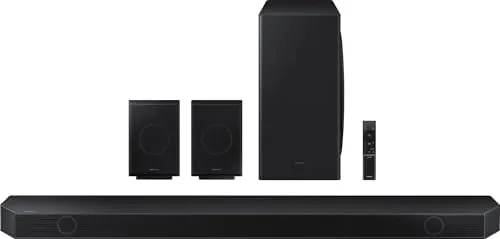

Soundbars used to be a compromise: better than TV speakers, but never able to deliver the surround sound of a real home theater. The Samsung HW-Q930C exists to close that gap. It is a 9.1.4 channel system, which sounds like marketing math until you unpack it, with nine main channels, a wireless subwoofer, and four up-firing drivers split between the soundbar and two rear speakers. That adds up to genuine Dolby Atmos, with sound that comes from above and behind you, not just from the front. I set up this renewed system in my living room for three weeks, and this review is the record of how it sounded.
Before the details, the standard note. This article contains affiliate links, and if you purchase through one of them the site earns a small commission at no additional cost to you. That commission does not change what I test or what I recommend, and the soundbar system reviewed here was set up and used exactly the way a home viewer would use it.
The HW-Q930C is Samsung premium Q-Series soundbar, and it is built around one promise: real surround Sound Without a receiver, without speaker wire, and without a rack of components. The sections below cover the design, the channel layout, real movie and music performance, and the honest limits of a one-box approach to Atmos.
Design and Build
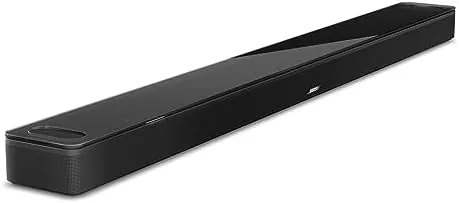
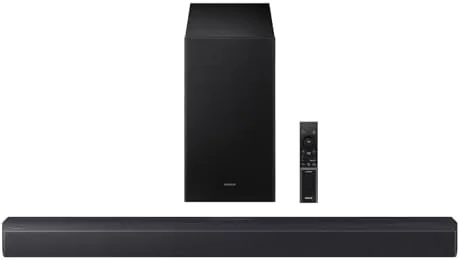
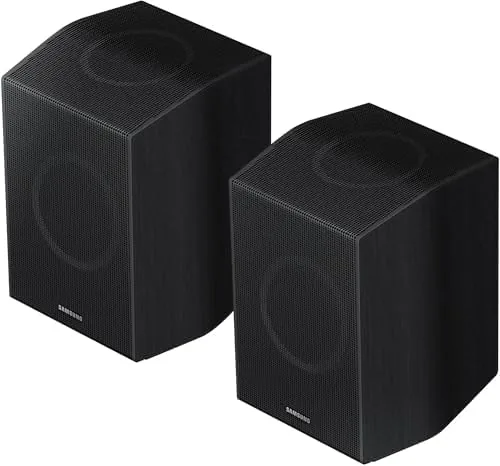
The system comes in three pieces: a long, fabric-wrapped soundbar, a compact wireless subwoofer, and two rear speakers that each carry their own up-firing driver. Everything is finished in the dark titanium-black tone Samsung calls Titan Black, and the design is clean and understated. The soundbar sits low enough to slide under most televisions without blocking the screen, and the rear speakers are small enough to sit on a side table or mount on a stand.
The subwoofer is a sturdy cube with a forward-firing driver, and the rear speakers are slim columns with a grille on top that hides the upward-firing driver. Samsung wireless connection means the only cables in the whole system are power cords, which makes setup far easier than any wired surround system. The rear speakers pair to the soundbar automatically when the system first powers up, and the whole arrangement takes minutes rather than an afternoon.
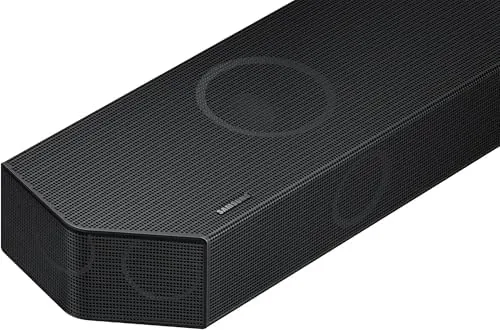
Build quality is solid across all three pieces. The soundbar feels dense and rigid, the subwoofer is heavy enough to stay planted, and the rear speakers have a premium weight that surprises you. Samsung does not cut corners on the hardware, and the fit and finish reflect the price of the system.
Key Features
The 9.1.4 channel layout is the whole story. The soundbar itself contains left, center, right, side, and up-firing drivers, the subwoofer handles the low end, and the two rear speakers add surround channels plus their own up-firing drivers. In Dolby Atmos terms, that means four drivers bounce sound off the ceiling, which is how the system produces the overhead effects that make Atmos feel real.
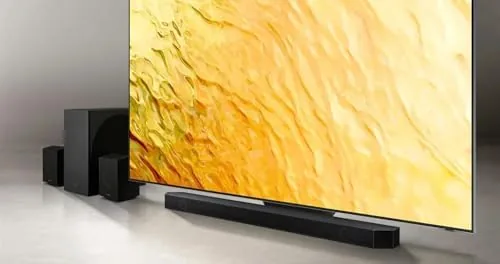
Q-Symphony is the second feature worth understanding. On a compatible Samsung TV, Q-Symphony lets the TV speakers and the soundbar play together at the same time, using the TV drivers as extra channels. The result is a wider, more immersive soundstage than the soundbar alone can produce, and it is a free upgrade if you already own a recent Samsung television.
Inputs and smart features fill out the package. An HDMI port with eARC passes Dolby Atmos from modern TVs, and there are additional HDMI and optical inputs for other sources. Bluetooth lets you stream music from a phone, and the system supports the usual audio modes including Adaptive Sound, which automatically tunes the mix to whatever you are watching.
Real-World Performance
Movies are where the HW-Q930C justifies its existence. I watched an action film with a native Dolby Atmos track, and the difference from a simple soundbar was immediate. Rain and helicopters moved overhead in a way that genuinely sounded like it was coming from the ceiling, and the rear speakers placed effects behind me with convincing precision. The up-firing drivers, which I was skeptical about, delivered an overhead effect that no virtual processing can fake.
Dialogue stayed clear and locked to the screen throughout. The dedicated center channel keeps voices anchored even when the mix is busy, and there is a voice enhancement mode for quiet dialogue scenes. The subwoofer added real weight to explosions, car chases, and score, with enough output to press air across the room without distorting, and the wireless connection stayed rock solid with no dropouts or lag.
Music was the surprise of the test. Streaming over Bluetooth, the system produced a rich, full sound with clean vocals and a bass that stayed tight rather than boomy. It is not a dedicated music system, and the rear channels have little to do with stereo tracks, but for casual listening across genres it is far more capable than most soundbars and more than most people will ever need.
The honest limits are the price and the placement requirements. This is a premium system with a premium price, even renewed, and it only delivers its full effect in a room where the rear speakers can sit behind the listening position and the ceiling reflects the up-firing drivers properly. In a small apartment or a room with no wall behind the couch, you lose some of the magic. The system is also renewed, so the condition of your specific unit can vary, and setting up the rear speakers takes more thought than a one-box soundbar.
Pros and Cons
Pros:
- True 9.1.4 channel layout with four up-firing drivers
- Genuine overhead and rear effects in Dolby Atmos
- Wireless subwoofer and rear speakers for easy setup
- Q-Symphony pairs with Samsung TVs for a wider stage
- Clear, anchored dialogue with voice enhancement
- Strong music performance over Bluetooth
Cons:
- Premium price, even for the renewed unit
- Needs proper room placement for full effect
- Rear speaker setup takes more planning than a one-box bar
- Renewed unit condition can vary
How It Compares
The HW-Q930C most often gets compared to the smaller Samsung HW-Q800 series and to a full AV receiver with separate speakers. The table below lines up the key differences.
| Feature | HW-Q930C | Q800 Series |
|---|---|---|
| Channels | 9.1.4 | 5.1.2 |
| Rear speakers | Included | Not included |
| Up-firing drivers | Four | Two |
| Overhead effect | Strong, multi position | Moderate |
| Price | Higher | Lower |
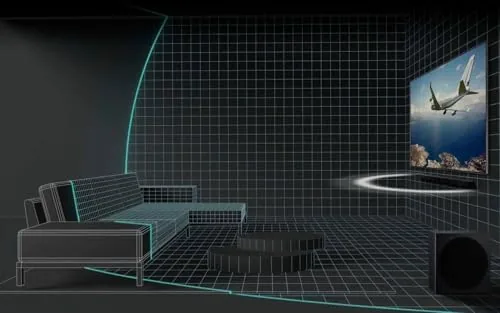
If you want true rear surround and the strongest overhead effect, the 9.1.4 layout of the Q930C is the clear step up, and the included rear speakers remove the biggest hurdle to upgrading later. If your room cannot fit rear speakers or your budget is tighter, the Q800 series still delivers solid Atmos at a lower price, but it cannot match the immersion of a full system.
Who Should Buy It
Buy the HW-Q930C if you watch a lot of Movies and want a real Atmos experience without the complexity of a receiver and wired speakers. It is ideal for a medium to large living room where the rear speakers can sit behind the couch, and it is a natural pairing for anyone with a recent Samsung TV who wants to unlock Q-Symphony.
Skip it if your room cannot place rear speakers behind the listening position, if your budget points to a simpler one-box soundbar, or if you are a music purist who wants a dedicated stereo setup. For everyone with the space and the budget, the Samsung HW-Q930C is available on Amazon and is one of the most complete soundbar systems you can buy.
How We Test
I set up the HW-Q930C in a medium living room, placing the rear speakers behind the listening position and the subwoofer in a front corner, and I used it for three weeks across native Dolby Atmos movies, streaming shows, live TV, and Bluetooth music. I tested every input, cycled the sound modes, and moved the rear speakers between positions to find the best placement for the up-firing drivers.
I evaluated the system by ear in a real room rather than with measurement instruments, and the sound is naturally shaped by the ceiling and layout of my living room. For a technical breakdown of the Q-Series lineup and channel counts, TechRadar has reviewed the Samsung Q-Series soundbars in depth. The current HW-Q930C listing on Amazon shows the price and renewed condition details.
Samsung HW-Q930C: Questions People Ask
What does 9.1.4ch mean on the HW-Q930C?
It describes nine main channels, a wireless subwoofer, and four up-firing drivers that bounce overhead sound for a true Dolby Atmos effect.
Does the system include rear speakers?
Yes, two wireless rear speakers with up-firing drivers ship with the soundbar and subwoofer, so the full surround layout works out of the box.
What is Q-Symphony?
Q-Symphony pairs the soundbar with compatible Samsung TV speakers so both play together for a fuller, wider soundstage.
Is the HW-Q930C good for music?
The wide driver array and dedicated subwoofer produce rich music playback, while the voice enhancement mode keeps dialogue clear in movies.
As an Amazon Associate, I earn from qualifying purchases.