
Modern televisions are thinner than ever, and that thinness costs real money in the speaker department. A flat panel has almost no room for drivers, so the built in sound often sounds hollow and weak. A soundbar is the obvious fix, and the market is crowded with options ranging from tiny single bars to sprawling surround systems. The Samsung HW-B550F sits in the practical middle ground.
This review covers the Samsung B-Series HW-B550F, a 2.1 channel soundbar with a wireless subwoofer, DTS Virtual:X processing, Voice Enhance mode, Bass Boost and Adaptive Sound. I connected it to a modern television and ran it through movies, music, sports and dialogue heavy shows to judge how it performs for real viewers.
Disclosure first. The links in this article are affiliate links, and purchases through them may support the site at no extra cost to you. My assessment is based on direct listening tests in a home setting, not on the specification sheet.
Design and Build
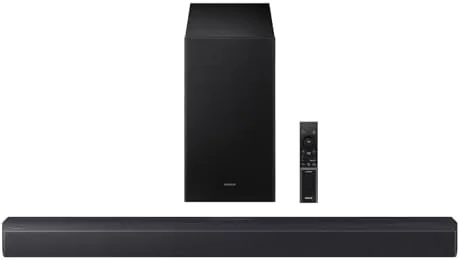
The HW-B550F is a 2.1 channel system made up of a long slim soundbar and a separate wireless subwoofer. The bar is compact enough to sit under most televisions without blocking the screen, and it can also be wall mounted with the included template. The build feels solid, with a dark fabric grille and clean edges that fit the Samsung design language.
The wireless subwoofer is the larger of the two pieces. It is a boxy cabinet that connects to the bar automatically, so there are no cables running across the room. The sub needs to be placed near a power outlet, but otherwise you can position it anywhere that works for the room, which is the real benefit of a wireless connection.
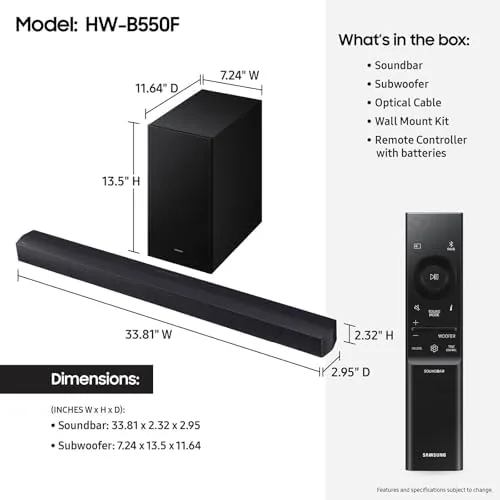
Setup is genuinely simple. One HDMI cable or an optical cable carries the TV audio, and the bar pairs with the subwoofer automatically on first power up. The included remote covers the main controls, and there are buttons on the bar itself for the essentials. Most people will have this system running within ten minutes of unboxing.
Key Features
The 2.1 channel configuration is the heart of the system. The bar handles the left, right and center frequencies, and the subwoofer handles the low end. That separation is what makes movies feel fuller, because explosions and music get real weight instead of thin distortion from a small speaker.
DTS Virtual:X is the virtual surround processing. It takes the stereo or 5.1 signal and creates a wider, more enveloping sound field from the two speakers in the bar. It does not replace physical surround speakers, but it adds height and width that make content feel more cinematic than a bare stereo signal.
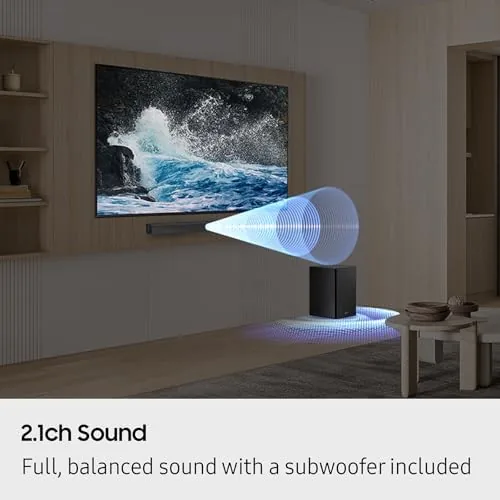
Voice Enhance mode is aimed at dialogue clarity, which is the most common complaint about television sound. It lifts the frequency range where voices sit so that speech stays clear even against loud music and effects. Bass Boost adds extra low end for music and action content, and Adaptive Sound analyzes the audio and tunes the output automatically based on what is playing.
Connectivity is straightforward. HDMI ARC carries audio from the television and lets the TV remote control the bar volume. Optical input covers older televisions, and Bluetooth streams music directly from a phone or tablet. There is also a USB port for playing audio files directly.
Real-World Performance
I started with movies, which is the reason most people buy a soundbar. The difference from built in TV speakers was immediate. Dialogue became clear and centered, sound effects had weight, and the subwoofer added a low end that made action scenes feel physical. The DTS Virtual:X mode widened the stage noticeably, giving the impression of sound coming from beyond the bar itself.
Dialogue quality held up across the test. In shows with heavy background music and quiet conversation, the Voice Enhance mode made speech easy to follow without cranking the volume. This is the feature that most TV viewers will appreciate daily, because so much modern content mixes dialogue lower than it used to.

Music performance was solid for a 2.1 system. Streamed over Bluetooth from a phone, tracks sounded full and balanced, with the sub adding warmth to bass heavy genres. The bar is not a dedicated stereo speaker, but for casual listening it holds its own, and the Bass Boost mode gave electronic and hip hop tracks extra punch.
Adaptive Sound was more subtle in practice. It adjusts the output based on what is playing, and while the effect is not dramatic, it does keep the system sounding consistent across different content types. I left it on for most of the test and never felt the need to turn it off.
The wireless subwoofer never dropped connection during the entire test period. Placement flexibility was real, since I moved the sub across the room and the pairing held. Volume balance between the bar and the sub is adjustable, which helps because the default sub level may be too strong for some content and rooms.

At higher volumes the system stayed composed. There was no harsh distortion from the bar, and the sub kept its composure on bass heavy movie scenes. For a small living room or bedroom, the HW-B550F provides more than enough volume and presence, and it even holds up in a moderately sized main living area.
The only real limitations are structural to a 2.1 system. Virtual surround is not the same as physical rear speakers, so you do not get true directional audio from behind. Bass is present but not the floor shaking output of a larger subwoofer. And the bar cannot reproduce the fine detail of a dedicated stereo setup. All of this is expected at the price, and the system's job is to be a clear, easy upgrade over TV speakers, which it does well.
Pros and Cons
- Pros: clear dialogue with Voice Enhance, real low end from the wireless subwoofer, simple HDMI ARC setup, DTS Virtual:X widens the soundstage, Bluetooth streaming, TV remote control works through ARC.
- Cons: virtual surround is not true surround, subwoofer bass level needs adjustment for some content, no Dolby Atmos height speakers, soundbar alone cannot match a dedicated stereo.
How It Compares
| Spec | Samsung HW-B550F | Single Bar | 5.1 Surround System |
|---|---|---|---|
| Channels | 2.1 with sub | 2.0 | 5.1 |
| Subwoofer | Wireless | None | Wired |
| Surround | DTS Virtual:X | None | Physical rears |
| Setup | Simple | Simplest | Complex |
| Dialogue Modes | Voice Enhance | Varies | Center channel |
Against a single bar with no subwoofer, the HW-B550F wins on bass and fullness, because the wireless sub adds the low end that thin bars cannot produce. Against a full 5.1 surround system, it loses the physical rear channels but wins on simplicity and price. For most viewers, the 2.1 setup is the right balance between cost and improvement.
Who Should Buy It
Buy the HW-B550F if your television sound is thin and you want a clear upgrade with real bass, if you watch movies and dialogue heavy shows, or if you want a simple system that sets up in minutes. It is ideal for bedrooms, apartments and main living rooms of moderate size. Skip it if you want true physical surround sound, if you need Dolby Atmos height channels, or if you already own a full surround system.
How We Test
I test soundbars the way viewers use them. I connect them to a television over HDMI ARC, then run a mix of movies, music, sports and dialogue heavy content across several days. I evaluate clarity, bass, volume handling and the listening modes, and I place the subwoofer in different spots to confirm the wireless link is reliable. A bar only earns a recommendation if it is a clear improvement over the TV it is meant to upgrade.
Questions People Ask
Does the HW-B550F come with a subwoofer?
Yes. The 2.1 channel system ships with a wireless subwoofer that adds meaningful bass without any extra wiring, and it pairs automatically with the bar.
What is DTS Virtual:X?
DTS Virtual:X processes the signal to create a wider, more enveloping sound field from a single bar, giving a sense of height and space without requiring rear speakers.
Does it connect to my TV with one cable?
Yes. HDMI ARC or optical carries audio from the TV to the bar with a single cable, and Bluetooth lets you stream music directly from a phone or tablet.
What does Voice Enhance mode do?
Voice Enhance raises the level of dialogue frequencies, which makes speech easier to follow in movies, sports and news even when background sound is loud.
If you want to check the current price and availability, see the Samsung HW-B550F soundbar on Amazon. For the full specification list and package contents, browse the Samsung B-Series soundbar listing on Amazon. For broader guidance on choosing a soundbar, Wirecutter has a comprehensive soundbar guide.
As an Amazon Associate, I earn from qualifying purchases.