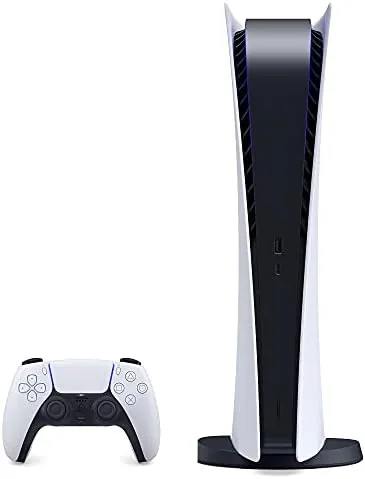

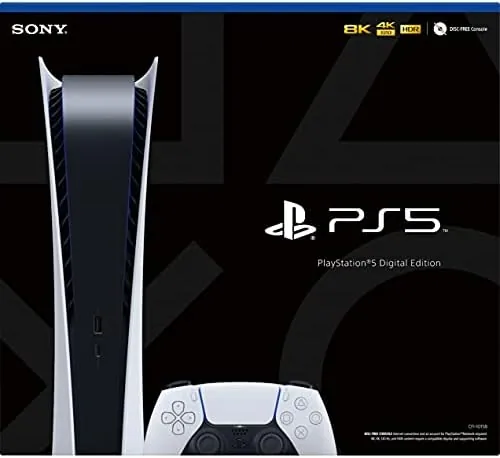
The PlayStation 5 changed how it feels to play a game at the start of a new console generation, and the Digital Edition strips away the one part many players never use. It is the same console underneath, the same lightning SSD, the same DualSense controller, the same 16GB of GDDR6 memory, but with no disc drive and a lower price. I spent a month with the Digital Edition as my main console, downloading, streaming, and pushing it hard across a range of titles. This review covers the performance, the Storage math, and the honest question of whether going all digital fits how you actually buy games.
Before the details, the standard note. This article contains affiliate links, and if you buy through one of them the site earns a small commission at no extra cost to you. That commission does not change what I recommend, and The Console reviewed here was set up the way a buyer would set it up.
The Digital Edition looks nearly identical to the standard PS5, with the same white shell and black core, but without the bulge of the disc drive. That single difference decides the entire buying argument, so this review weighs the value honestly, with the storage numbers laid out in plain terms.
Design and Build
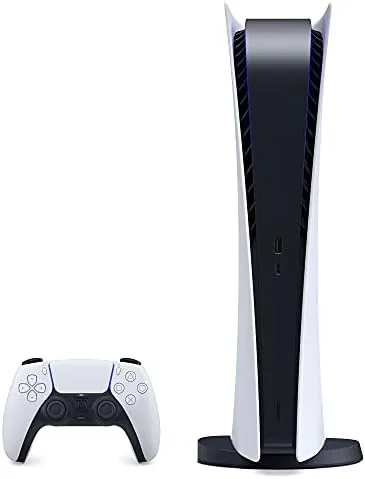
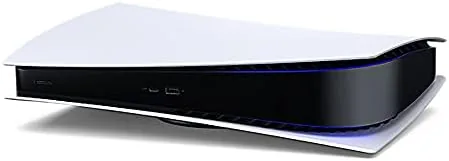
The Digital Edition is a sleek, sculpted console that looks genuinely futuristic on a media shelf. The white panels are removable, which makes cleaning and future upgrades easy, and the console can stand vertically on its bundled base or lie flat. The build quality is excellent, with tight panel gaps and a quiet whisper of a fan that is easy to forget even during a heavy load.
The absence of the disc drive makes the shell symmetrical and a little lighter, and it means the console is notably smaller in profile than the standard model. The front offers a USB port and the new USB Type C port for the controller, and the rear carries the HDMI 2.1 output, an Ethernet port, and additional USB ports. Everything is clean and sensible, and the console runs cool enough that I never worried about airflow on an open shelf.
Key Features
The DualSense controller is the feature that separates the PS5 from anything else. Its haptic feedback is precise enough to feel rain, footsteps, and a tightening rope, and the adaptive triggers add real resistance when you pull a bow or brake a car. Those two systems are not gimmicks; they change how a game feels in your hands, and they are worth the hype after a month of play.
The custom SSD is the other headline. The 825GB drive loads games in seconds, and a fast travel in an open world game goes from a loading screen to a loading shrug. The console outputs up to 120Hz and supports 8K video output, and it handles ray tracing in supported titles. The 16GB of GDDR6 memory feeds the GPU without bottlenecks, and the 3D audio engine gives a convincing sense of space through headphones or the built in speaker of the DualSense.
Real-World Performance
Load times are the first thing anyone notices, and they are startling. A sprawling action RPG went from menu to playable in under five seconds, and fast travel that used to mean a coffee break now happens before you finish the thought. The SSD also feeds new gameplay ideas, because open worlds stream in without seams, and I found myself stopping less and exploring more, which is the best measure of what this console generation is actually about.
Visual quality in performance modes is superb. Ratchet and Clank style games ran at high frame rates with ray traced reflections and zero stutter, and the 60 frames per second modes made action feel dramatically smoother than the old generation. The 120Hz support showed its value in competitive shooters, where the extra fluidity is real and measurable. The console does not render true 8K games today, but the 8K output is there for the future and for 4K content upscaled cleanly.
The DualSense transforms immersion across the library. Rain pattered with different intensity on different surfaces, footsteps varied with the floor, and the adaptive triggers made the difference between a game feeling played and a game feeling lived. It is the kind of feature that is easy to write off as marketing until you spend a month with it, and then it is hard to go back to a plain controller.
Storage is the honest weak spot. The 825GB SSD works out to roughly 667GB of usable space, and with modern games pushing past 100GB each, that holds about five or six big titles before you manage space. You can expand it with a standard M.2 SSD, and the console manages that gracefully, but the base capacity is genuinely limiting for anyone with a big library. Digital only owners will feel this more than disc owners, because there is no disc swapping to fall back on.
The digital experience itself is smooth. The PlayStation Store is fast, downloads hit the speed your connection allows, and the interface is clean and quick. The console resumed games almost instantly from standby, and system updates installed quietly in the background. The only friction is the price of games, since digital titles rarely drop as fast as their disc counterparts, and that is a recurring cost to weigh against the cheaper console.
Pros and Cons
Pros:
- Lightning fast SSD with near instant load times
- DualSense haptics and adaptive triggers are genuinely new
- Quiet, cool, and sleek build
- Excellent 60 and 120Hz performance
- Ray tracing and 3D audio support
- Lower price than the standard PS5
Cons:
- No disc drive, no disc deals or borrowing
- 825GB fills fast with modern game sizes
- Digital games often cost more than discs
How It Compares
The natural comparison is the standard PS5 with a disc drive, since that is the only real alternative at this level. The table below lines up the two.
| Feature | PS5 Digital Edition | PS5 Standard |
|---|---|---|
| Performance | Identical | Identical |
| Disc drive | None | Yes, plays discs and 4K Blu-ray |
| Storage | 825GB SSD | 825GB SSD |
| Buying games | Store downloads only | Discs, deals, and sharing |
| Price | Lower | Higher |
| Best for | All digital buyers | Disc collectors and renters |

If every game you own is digital, the Digital Edition is the smarter buy, because you pay less for the identical machine. If you buy discs, borrow games, or watch 4K Blu-rays, the standard model pays for its higher price quickly. The decision is not about power; it is entirely about how you buy and own your library.
Who Should Buy It
Buy the PlayStation 5 Digital Edition if your game library is already digital, if you have a solid internet connection, and if you want the full PS5 experience at the lowest entry price. It is also a great pick for a second console, a student setup, or a household that streams everything and never visits a game store.
Skip it if you trade games, shop clearance discs, or rely on slow data caps, because the disc model will save you money over the life of the console. For anyone comfortable with downloads, the Digital Edition is the best value in the generation. You can check the current price of the PS5 Digital Edition on Amazon when you are ready.
How We Test
I used the PS5 Digital Edition as my primary console for a month, playing a mix of first party action games, competitive shooters, and sprawling RPGs. I tested load times, fast travel, ray tracing, and 60 and 120Hz modes across those titles, and I ran the console through long sessions to check noise and heat. I streamed media, tested game resume, and filled the SSD to measure the real storage situation with modern install sizes.
I did not compare the console side by side with the standard model in a lab, and my performance notes come from real play rather than frame time graphs. For a deep technical breakdown, CNET has a detailed review of the PlayStation 5 covering the hardware and performance in depth. The PS5 Digital Edition listing on Amazon shows the current price and bundle contents.
Questions People Ask
What is the difference between the PS5 Digital Edition and the standard PS5?
The Digital Edition is identical in performance but has no disc drive, so games must be bought and downloaded from the PlayStation Store, and it costs less than the standard model.
How much storage does the PS5 Digital Edition have?
It ships with an 825GB SSD, of which roughly 667GB is usable for games, and the internal slot accepts an extra M.2 SSD to expand capacity later.
Does the PS5 support 120Hz gaming?
Yes, the console outputs up to 120Hz over HDMI 2.1 when connected to a compatible TV or monitor and when the game offers a high refresh rate mode.
Can I play physical discs on the Digital Edition?
No, the Digital Edition cannot read discs at all, so every game, movie, and app must come from the PlayStation Store download library.
As an Amazon Associate, I earn from qualifying purchases.