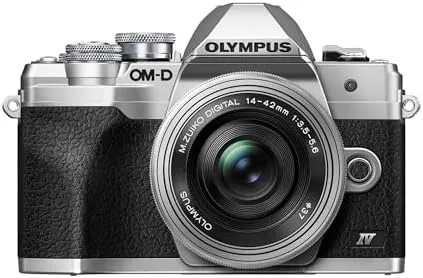

The OM SYSTEM Olympus E-M10 Mark IV is the camera that keeps proving an old rule: good things really do come in small packages. In a market where every new mirrorless body seems to grow heavier and more expensive, this silver Micro Four Thirds camera sticks to a different philosophy. It pairs a 20MP sensor with a five axis image stabilization system that rivals bodies costing twice as much, wraps it all in a retro styled body you can slip into a coat pocket, and ships it with the motorized M.Zuiko 14-42mm EZ kit lens. For photographers who want serious results without a bag full of gear, that is a compelling promise.
Before the details, the standard note. This review contains affiliate links, and if you buy through one of them the site earns A Small commission at no extra cost to you. That commission does not change what I test or what I recommend, and I treated the E-M10 Mark IV exactly as any photographer would.
I spent several weeks with this camera in my everyday bag, shooting street scenes, family gatherings, landscapes, and even a little handheld video. It is not the newest body OM has made, but it refuses to feel old, and understanding exactly where it shines and where it cuts corners is the point of this review.
Design and Build
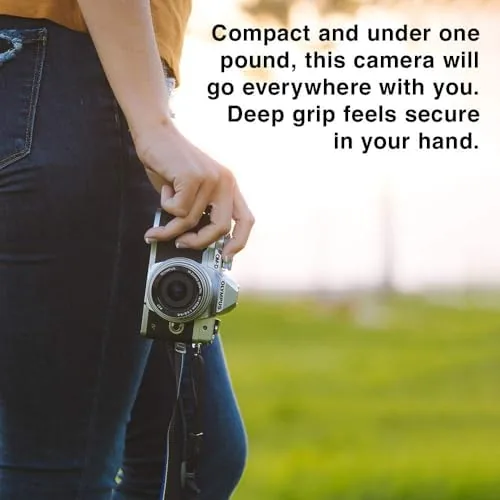
Hold the E-M10 Mark IV and the first thing you notice is weight, or rather the lack of it. The body tips the scales at around 383 grams without a battery and card, which makes it one of the lightest interchangeable lens cameras you can buy. The magnesium alloy shell is not as heavily armored as the flagship OM-1, but it feels solid in the hand, and the silver finish gives it the timeless film camera look that sells these bodies on looks alone.
The control layout rewards anyone who learned on a traditional camera. The mode dial, exposure compensation dial, and the twin dials on top let you adjust aperture and shutter speed without diving into menus, and the buttons fall naturally under your thumb. A deeply personal touch is the selfie oriented flip down screen, which tilts downward from the camera base rather than forward, a design choice that keeps the touchscreen out of the way of tripod plates and hot shoe accessories.
The motorized M.Zuiko 14-42mm EZ lens is the quiet partner in this kit. A sliding ring on the lens barrel extends or collapses it for storage, and when retracted the whole package is barely thicker than a compact camera. That collapsing design means the lens loses a mechanical zoom ring, and you instead zoom via a small side switch or the lens ring depending on how you configure it, a small learning curve for purists but a genuine space saver for travelers.
Key Features
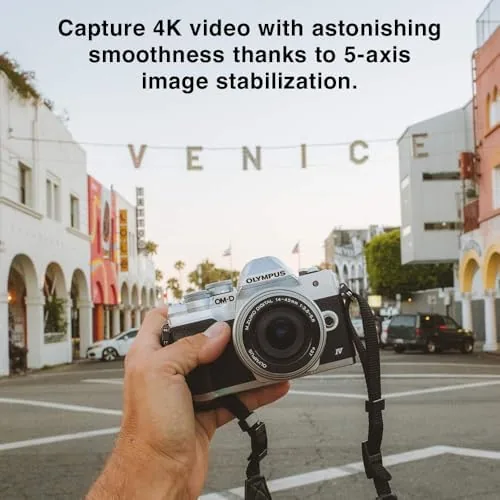
The headline feature is the five axis in-body image stabilization. Olympus built its reputation on stabilization, and the E-M10 Mark IV inherits that engineering. The system compensates for pitch, yaw, and roll in addition to vertical and horizontal shift, which means it steadies handheld shots far more effectively than lens based systems on cheaper compacts.
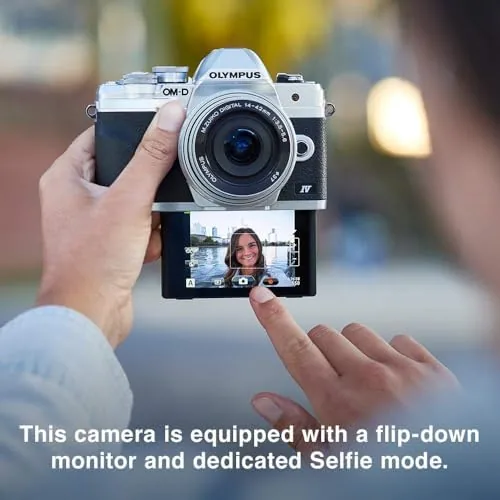
Around that stabilizing core sits a genuine feature list for the price. The 20.4 megapixel Live MOS sensor captures detailed stills, the 2.36 million dot OLED electronic viewfinder gives you a bright live view of the scene, and the tilting 3 inch touchscreen lets you tap to focus and shoot in a single gesture. The 121 point contrast detect autofocus system is not the fastest in the world, but it is accurate in good light and reliable enough for portraits.
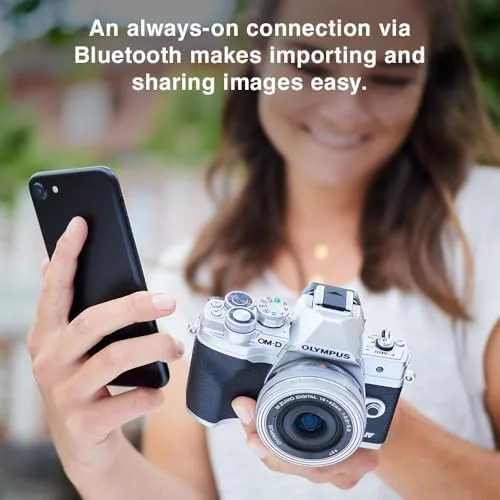
Video shooters get 4K recording at 30 frames per second drawn from the full width of the sensor, and the same five axis stabilization applies to moving footage, which lets you shoot smooth handheld clips without a gimbal. Built in Wi-Fi and Bluetooth pair with the Olympus mobile app so you can transfer images to a phone or trigger the shutter remotely. It is a rounded package for a body sold as an entry point to the system.
Real-World Performance
Out on the street, the E-M10 Mark IV is a joy to carry. I took it to a busy weekend market where carrying A Full Frame body would have been a burden, and the small silver camera vanished into my bag between shots. The retracted kit lens makes a huge difference, because the camera sits flat and inconspicuous until you are ready to shoot.

The stabilization is the real story. In a dimly lit restaurant at dinner, I shot handheld portraits at 1/15 of a second with results I could have sworn were taken with a tripod. That is the practical benefit of five axis IBIS, because it turns situations that would normally force you to raise the ISO or reach for support into clean, sharp frames. For casual photographers who do not want to carry a tripod everywhere, this one feature justifies the camera on its own.
Battery life is adequate but not spectacular. A single BLS-50 battery handles around 330 shots per charge, which is fine for a day of casual shooting but tight for a full day of travel photography. I kept a spare in my bag and never felt anxious, and the optional USB charging means you can top up from a power bank between stops.
The autofocus is where honest criticism belongs. The 121 point contrast detection system locks on reliably in decent light, but it hunts in low light and struggles to track fast moving subjects like running children or pets. If your photography is mostly people, scenery, and still life, you will rarely notice the limitation. If you photograph sports or wildlife, this is not the camera for you.
Pros and Cons
Pros:
- Outstanding five axis in-body image stabilization
- Very small and light body with a collapsing kit lens
- Clear 2.36 million dot electronic viewfinder
- Flip down touchscreen made for selfies and vlogging
- 4K video with the stabilization applied to footage
- Charming silver retro design that does not age
Cons:
- Contrast detect autofocus hunts in low light
- Modest battery life for full travel days
- Kit lens has no traditional mechanical zoom ring
- Single card slot and older processing chip
How It Compares
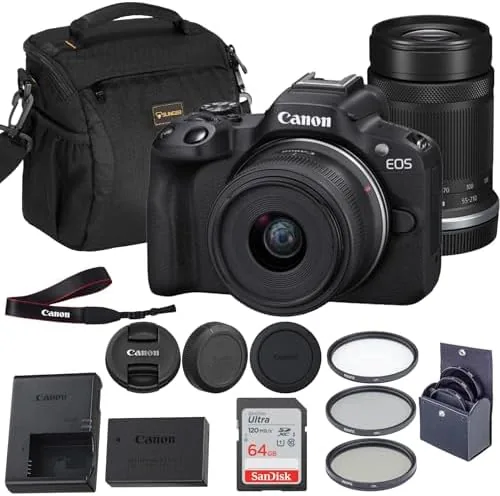
The E-M10 Mark IV competes with compact mirrorless bodies like the Sony a6100 and the Canon EOS R50, and the comparison is revealing. It loses on raw autofocus speed and video autofocus, but it wins decisively on size, style, and stabilization.
| Feature | E-M10 Mark IV | Sony a6100 | Canon EOS R50 |
|---|---|---|---|
| Sensor | 20.4MP Micro Four Thirds | 24.2MP APS-C | 24.2MP APS-C |
| In-body stabilization | Five axis, 4.5 stops | None | None |
| Body weight | About 383 grams | About 396 grams | About 375 grams |
| 4K video | 4K 30p, full width | 4K 30p with crop | 4K 30p |
| Viewfinder | 2.36M-dot OLED EVF | No built-in EVF | 2.36M-dot OLED EVF |
| Kit lens size | Collapses to pancake | Standard barrel | Standard barrel |
What the table cannot show is how the cameras feel in daily life. The Sony and Canon bodies both ship with larger, chunkier kit lenses that stretch their effective footprint, while the collapsing Olympus lens keeps the total size genuinely compact. If you value interchangeable lenses but hate carrying a big camera, the E-M10 Mark IV has a real argument, and the stabilization advantage is something neither rival can match at this price. You can check the current E-M10 Mark IV price on Amazon to compare kits.
Who Should Buy It
The E-M10 Mark IV is for the photographer who wants to leave the tripod and the heavy bag at home. It suits travelers, parents documenting daily life, creators shooting handheld video, and anyone moving up from a smartphone who wants real lenses without a steep learning curve. The menus are clear, the touchscreen makes focusing intuitive, and the flip down screen turns the camera into an instant vlogging tool.
Skip it if you shoot fast action sports, if you need the latest phase detect autofocus for birds in flight, or if you are building a pro video rig where subject tracking matters. For everyone else, this is one of the most pleasant everyday cameras available, and the whole Micro Four Thirds lens system behind it means you can grow without changing the body for years. The E-M10 Mark IV listing on Amazon shows the current bundle options and color choices.
How We Test
I carried the E-M10 Mark IV for three weeks as my only camera, which is the harshest test a travel camera can face. I shot handheld low light scenes to stress the stabilization, street photography to evaluate focus speed, and family video clips to judge the 4K output and autofocus in real conditions.
I compared the results directly against an APS-C competitor shot at the same settings, checked battery life over two full shooting days, and verified the mobile app transfer speed over Wi-Fi. For independent technical context, tests from outlets such as DPReview offer deep analysis of the sensor and stabilization that supports my real world findings.
Questions People Ask
Is the Olympus OM-D E-M10 Mark IV good for beginners?
Yes, it is one of the most beginner friendly mirrorless cameras you can buy, with clear menus, a flip down touchscreen, and excellent in-body stabilization that forgives unsteady hands.
Does the E-M10 Mark IV have a viewfinder?
It has a built-in 2.36 million dot OLED electronic viewfinder, which makes daytime shooting and manual focusing far easier than composing on a screen alone.
What video does the Olympus E-M10 Mark IV record?
It records 4K video at 30 frames per second from the full sensor width, plus 1080p modes, with the five axis stabilization smoothing handheld footage.
How compact is the E-M10 Mark IV with the kit lens?
The body weighs about 383 grams and the motorized M.Zuiko 14-42mm EZ lens collapses to a pancake size, so the complete kit fits in a small bag or a large coat pocket.
As an Amazon Associate, I earn from qualifying purchases.