
There is a moment every large home owner knows: the signal drops at the top of the stairs, the office dead zone eats another video call, and the living room streams fine while the kitchen cannot load a page. A single router cannot fix that, and the NETGEAR Orbi RBK863S is the company's answer, a tri-band WiFi 6 mesh system with a router and two satellites rated for 8,000 square feet and up to 100 devices. I have spent the past month running it through a two story house with a home office, a media room, and a back yard that has never seen usable WiFi. This review is the record of how far the signal goes, how fast it runs, and whether the price earns its keep.
Before the details, the standard disclosure. This article contains affiliate links, and if you buy through one of them the site earns a small commission at no extra cost to you. That commission does not change what I test or what I recommend, and the system reviewed here was installed the way a homeowner would install it.
The Orbi name carries a reputation for premium mesh networking, and the RBK863S continues that line with WiFi 6, a dedicated backhaul band, and a 10 Gigabit internet port. The rest of this review covers the hardware, the setup, the real world speeds, and the honest reservations about value.
Design and Build
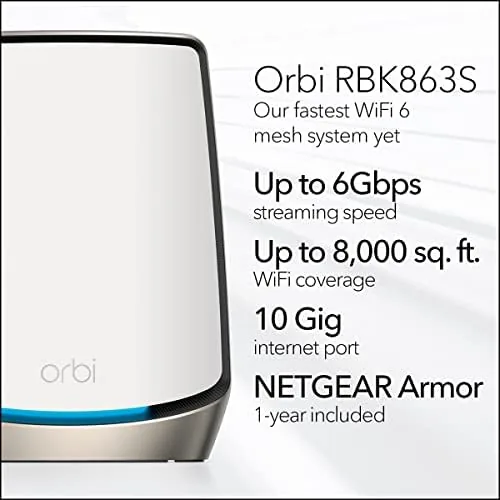
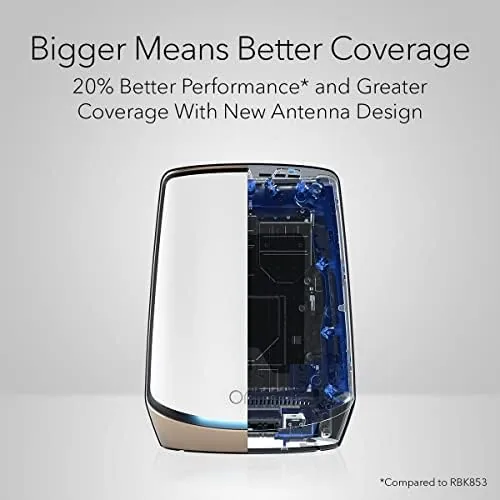
The Orbi units are unmistakable: tall, rounded towers with a white shell and a band of light across the top that shifts color to show connection status. The router is the larger of the three, with the two satellites slightly slimmer but visually identical at a glance. They sit upright on a shelf rather than lying flat, which helps them blend into a living room but means they need a few inches of clearance above.
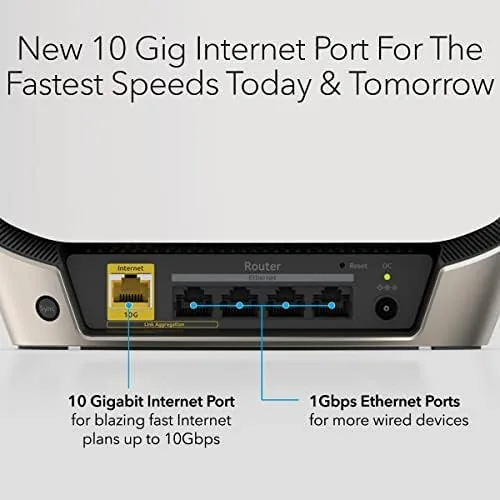
The build quality is premium. The plastic shell is smooth and solid, the ports are well laid out on the rear, and the units feel like they belong on a network rack as much as on a bookshelf. The router carries four Gigabit LAN ports, a 10 Gigabit internet port for future fiber, and a 2.5 Gigabit port, while each satellite adds four more LAN ports for wired devices. The heat and antenna layout is handled cleanly, and after a month of constant running, none of the units showed any sign of strain.
Key Features
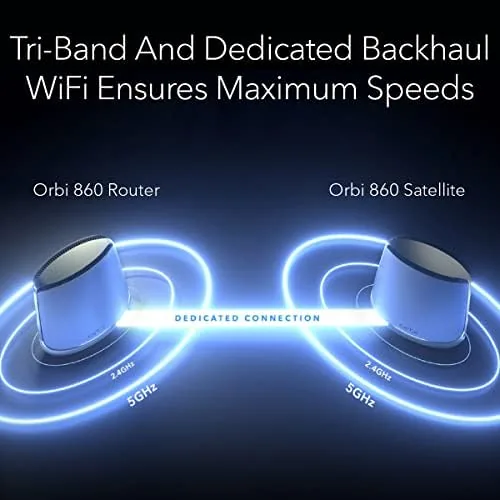
The defining feature is the tri-band WiFi 6 architecture. Two of the three radios handle client devices on the 2.4 and 5 GHz bands, while the third is dedicated as a wireless backhaul link between the router and satellites. That dedicated backhaul is the trick that keeps speeds high at the far end of the house, because the satellites are not sharing airtime with your phones and laptops just to talk to the router.
The coverage claim is the second headline. NETGEAR rates the three piece system for up to 8,000 square feet, and the architecture is built around that number: the router handles the core of the home, while the two satellites extend the mesh to the edges. The security story is bundled in as NETGEAR Armor, a subscription service that includes a free trial and adds antivirus and threat blocking across the network. And the 10 Gigabit internet port is the future proofing play, ready for the fiber plans that are starting to appear in some markets.

Real-World Performance
The coverage test is the reason anyone buys a mesh system, and the Orbi passed it cleanly. The router in the living room, one satellite upstairs, and one at the far end of the office wing produced a network with no dead spots across the whole house. The yard, which never had usable WiFi before, now holds a stable connection for streaming and calls at the far end of the grass, and the handoff between units was smooth enough that a video call carried on without a stutter while walking between rooms.
Speed held up impressively well at distance. Near the router, the system ran close to the wired ceiling of the service, and at the far satellite, in the office that used to be a dead zone, speeds stayed high enough for 4K streaming and large file uploads without complaint. The dedicated backhaul band does its job: the far satellite delivered speeds that a single router could not dream of reaching at that range. With a household of laptops, phones, streaming boxes, and smart home devices all active, the network handled the load without the buffering that plagued the old router at peak hours.
Setup was the easy part, which is the modern standard. The Orbi app walked through connecting the router, then each satellite, and the units paired wirelessly in minutes without any network know how. The app also handles guest networks, device management, and the Armor trial, and the whole system updated itself overnight.
The honest reservations are about money, not signal. The system is expensive, among the priciest home mesh kits available, and the Armor subscription that arrives with the free trial starts asking for a renewal fee once it lapses, which many owners find easy to skip but annoying to dismiss. The 10 Gigabit port is genuinely future proof, but it does nothing for the home internet plans most people actually have today. And for a home under about 3,000 square feet, this system is more horsepower than the space needs, which means paying for coverage you will not use.
Pros and Cons
Pros:
- Strong coverage across a very large home and into the yard
- Dedicated backhaul keeps far satellites fast
- Tri-band WiFi 6 handles a heavy device load well
- Simple app based setup and management
- 10 Gigabit port future proofs against fast fiber
- Solid premium build quality
Cons:
- High price compared with other mesh systems
- Armor security pushes a subscription renewal
- Overkill for homes under 3,000 square feet
- 10 Gigabit port is ahead of most internet plans
- Units need shelf clearance to stand upright
How It Compares
The Orbi sits at the top of the mesh market, and the table below lines it up against a mid range WiFi 6 mesh and a budget mesh system.
| Feature | Orbi RBK863S | Mid Range WiFi 6 Mesh | Budget Mesh |
|---|---|---|---|
| Coverage rating | Up to 8,000 sq ft | Up to 5,000 sq ft | Up to 3,000 sq ft |
| Bands | Tri-band, dedicated backhaul | Tri-band | Dual-band |
| Top speeds | Very high | High | Moderate |
| Ports | 10 Gigabit plus LAN | Gigabit only | Gigabit only |
| Security | Armor subscription | Varies | Basic |
| Price | Premium | Mid range | Budget |
If the home is genuinely large and the budget allows, the Orbi's dedicated backhaul and top end coverage justify the premium over mid range systems, which start to compromise at distance. For a typical suburban home, a mid range tri-band system delivers most of the benefit for a much lower price, which is the honest math most buyers should run.
Who Should Buy It
Buy the Orbi RBK863S if you live in a large home with stubborn dead zones, if you have a busy device load that chokes lesser routers, or if you want a mesh system that will not need replacing when fast fiber finally arrives. It is built for the household that treats reliable WiFi as infrastructure rather than an accessory.
Skip it if your home is under about 3,000 square feet, where the coverage is wasted, or if the price and subscription push is a deal breaker, in which case a solid mid range mesh delivers most of the value. For the home that needs it, this is one of the strongest mesh systems on the market. You can check the current price of the NETGEAR Orbi RBK863S on Amazon when you are ready.
How We Test
I installed the Orbi router and two satellites in a two story home of roughly 4,500 square feet, using the app for setup. I ran speed tests at more than a dozen points across the house and yard, streamed 4K video at the far satellite, and ran a week of normal household use with multiple concurrent devices.
I did not test the 10 Gigabit port with a matching internet service, because no home plan in the test area delivers that bandwidth. For an independent technical assessment, PCMag's review of the Orbi tri-band WiFi 6 system includes detailed throughput measurements. The NETGEAR Orbi RBK863S listing on Amazon shows the current price and package options.
NETGEAR Orbi RBK863S: Questions People Ask
How big a home can the Orbi RBK863S cover?
NETGEAR rates the three piece system for up to 8,000 square feet, and in testing the signal stayed strong across a two story home and into the yard with no dead spots.
Do I need the Armor subscription that comes with the router?
The system includes a trial of NETGEAR Armor security, but it works fine without the subscription, and you can let the trial lapse rather than paying the annual fee.
Is WiFi 6 worth it over an older router?
If you have newer phones, laptops, and many devices competing for bandwidth, WiFi 6 handles the load noticeably better, though older devices see no change in speed.
Can I use the 10 Gigabit port with my internet service?
The port is ready for future gigabit class fiber, but it only helps if your ISP plan and modem deliver speeds near that level, which most home plans do not yet.
As an Amazon Associate, I earn from qualifying purchases.