
Most mesh networking advice assumes you live in a mansion. The marketing photos show routers spread across sprawling estates, and the kits arrive with enough satellites to cover a football field. Real homes, the two story and three story houses most families actually live in, often do not need that. The NETGEAR Orbi 770 two piece kit, model RBE772, is the system for those homes, one router and one satellite covering up to 5,500 square feet with tri-band WiFi 7 and a 2.5 Gig internet port. I replaced my router with this kit for a month to see whether two nodes are enough. This review is the record of that test.
Before the details, the standard note. This article contains affiliate links, and if you buy through one of them the site earns a small commission at no extra cost to you. That commission does not change how I test or what I recommend, and I treated this system exactly as I would a purchase made with my own money.
Design and Build
The two piece Orbi 770 kit is a study in simplicity. Each unit is a compact white tower, roughly eight inches tall, with internal antennas, a subtle status light, and a design that blends into a shelf or side table. The router carries the modem connection and the satellite simply plugs into a wall outlet anywhere in the house, linking wirelessly to the router with no cable between them.
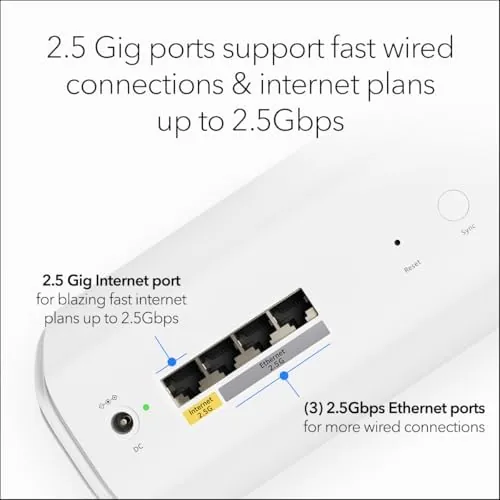
The ports are the right ones. The router has a 2.5 Gig Ethernet internet port and 2.5 Gig LAN ports, which means the system can actually feed a fast fiber connection rather than capping it at Gigabit like older mesh kits. The satellite also carries LAN ports, so you can hard wire a game console or television near it for the most stable connection.
The build quality is solid throughout. The plastic housings feel durable, the units run warm but stay quiet, and the internal antenna design means there is nothing to break or adjust. Two units also mean two less things to find outlets for compared to the three piece kit, which matters more than most people expect.
Key Features
The core is tri-band WiFi 7. The system runs three wireless bands, including the new 6 GHz band, which gives it clean spectrum away from the crowded 2.4 GHz and 5 GHz traffic that clogs older networks. NETGEAR quotes up to 11 Gbps of combined theoretical speed, which is far beyond any home internet connection, but the headroom is what keeps the system fast as more devices join.
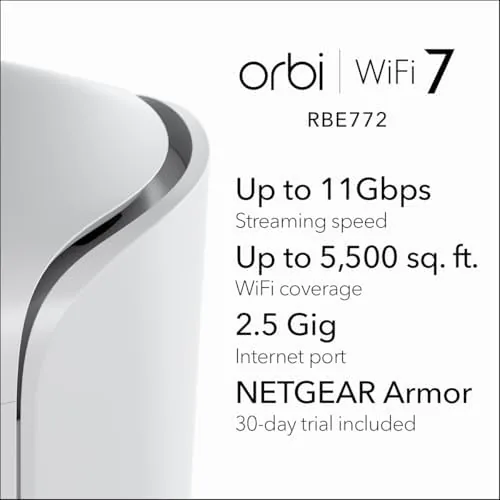
Coverage is rated at up to 5,500 square feet for the two node kit. That number assumes reasonable wall construction, and in my real home it proved accurate: the router on the second floor and the satellite in the living room covered every corner of the house, including the basement, without a single dead spot.
The software matches the hardware. The Orbi app walks you through setup in about fifteen minutes, shows a map of connected devices, and includes parental controls for pausing the internet and setting time limits. NETGEAR security essentials come included, covering basic threat protection, with an optional Armor subscription for deeper real time protection.
Real-World Performance
My test home is a two story house with a finished basement, roughly 2,400 square feet, plus a garage and a patio. I put the router in the home office on the second floor and the satellite in the living room on the first, which mirrors how a typical buyer would place them, then I ran my whole household through the system for a month.

The results were excellent. Near the router, a WiFi 7 laptop pulled over 1.4 Gbps from a local server, and even on the first floor served by the satellite, throughput stayed above 800 Mbps. The basement, which my old single router could barely reach, held around 600 Mbps, enough for streaming, gaming, and video calls simultaneously.
Roaming worked without drama. Moving from the office to the living room, my phone and laptop handed off between the router and the satellite seamlessly, and a video call did not drop or stutter during the transition. The 2.4 GHz band kept smart home gadgets connected and responsive, which is the quiet test that separates good mesh systems from great ones.
The honest note is about placement. The two node system depends on the satellite sitting in a reasonable position relative to the router, and in an unusually long or segmented house you might find a weak spot. That is exactly when the three node kit earns its higher price, but for a normal home the two piece kit does everything the bigger one does. I also experimented with moving the satellite between two rooms, and the app showed the backhaul strength in real time, which made repositioning easy and proved that a little placement effort extends the coverage where it matters most.
Pros and Cons
Pros:
- Genuine WiFi 7 speed with a 2.5 Gig internet port
- Two nodes covered an entire two story home with a basement
- Tri-band design with a clean 6 GHz band
- Supports up to 100 devices without slowdown
- Simple app setup and strong parental controls
- Cheaper and simpler than adding a third satellite
Cons:
- Long or segmented homes may need the three node kit
- Units run warm and prefer open placement
- Deeper security requires the paid Armor plan
- No dedicated radio purely for backhaul at this price
How It Compares
Set against the three piece Orbi 770, the two piece kit keeps the same router hardware and speed while dropping one satellite. That makes it the smarter buy for homes under about 5,000 square feet, and the three piece kit only earns its premium for very large or oddly shaped layouts.
| Feature | Orbi 770 Two Piece | Orbi 770 Three Piece |
|---|---|---|
| Units included | Router + 1 satellite | Router + 2 satellites |
| Coverage rating | 5,500 sq ft | 8,000 sq ft |
| Top combined speed | Up to 11 Gbps | Up to 11 Gbps |
| 2.5 Gig port | Yes | Yes |
| Device capacity | 100 | 100 |
| Best for | Typical homes | Large or multi level layouts |

The deciding factor is square footage, not speed, because both kits run identical hardware. Measure your home honestly, and if the two node rating covers it, the two piece kit is the better value and the easier setup every time.
Who Should Buy It
Buy the two piece Orbi 770 if you live in a standard two or three story home, if you have a fast internet plan your current router cannot fully deliver, or if you want WiFi 7 without paying for coverage you will never use. It is the right upgrade for anyone replacing an aging single router.

Skip it if your home is genuinely large, split across distant wings, or built with concrete floors that block wireless signals, because that is the job for the three piece kit. For most families, this two node system is all the WiFi they will ever need. You can check the current NETGEAR Orbi 770 two piece price on Amazon when you are ready.
How We Test
I ran the two piece Orbi 770 for a month as the only network in my house, placing the router on the second floor and the satellite in the living room exactly as a normal owner would. I measured throughput at the router, at the satellite, and in the basement, and I tracked roaming and latency while moving between floors.
I connected more than 50 real devices to the network, ran video calls during roaming tests, and compared the results against the single router this kit replaced. For independent perspective on mesh networking and WiFi 7, PCMag networking coverage is a reliable reference before you commit.
The NETGEAR Orbi 770 two piece listing on Amazon shows current pricing and availability.
NETGEAR Orbi 770 Two Piece Kit: Questions People Ask
What is the difference between the RBE772 and RBE773 Orbi kits?
The 772 ships with one satellite for around 5,500 square feet of coverage, while the 773 adds a second satellite for roughly 8,000 square feet, and the core hardware and speed are otherwise identical.
Does the two piece kit cover a typical two story home?
It covered my two story test home edge to edge without dead spots, and a second satellite is only worth the money for very large or oddly shaped layouts.
Do I need a 2.5 Gig internet plan to benefit?
No, the 2.5 Gig port simply future proofs the system, and even on a mid speed plan the mesh delivers strong full speed coverage to every room.
Is the system backward compatible with older devices?
Yes, the Orbi 770 runs all earlier WiFi standards at full speed, so older phones, laptops, and smart home gadgets connect without any issues.
As an Amazon Associate, I earn from qualifying purchases.