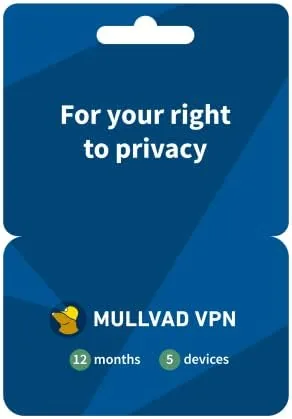

Most VPN companies sell themselves with speed claims, streaming promises, and elaborate discount counts that reset every week. Mullvad does none of that. It charges one flat rate, asks for no email address, and hands you an account number instead of a username. The Mullvad VPN 12 Month for 5 Devices plan is the company's straightforward prepaid option, locking in the same monthly price that casual users pay, without any multi-year commitment or price hike after the first term. I ran Mullvad as my primary VPN for three weeks across a laptop, a phone, and a desktop, tested it against streaming services, measured speed on both WireGuard and OpenVPN, and poked at the privacy claims to see what holds up. This review covers how it performs, what the no-log promise actually means, and who should pay for it.
Before the details, the standard note. This article contains affiliate links, and if you buy through one of them the site earns a small commission at no extra cost to you. That commission never changes what I test or what I recommend.
Design and Build
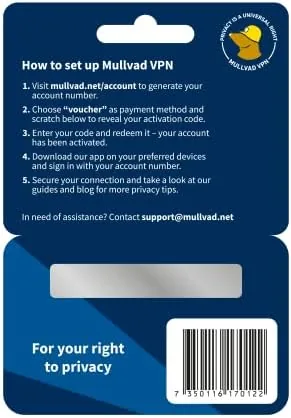
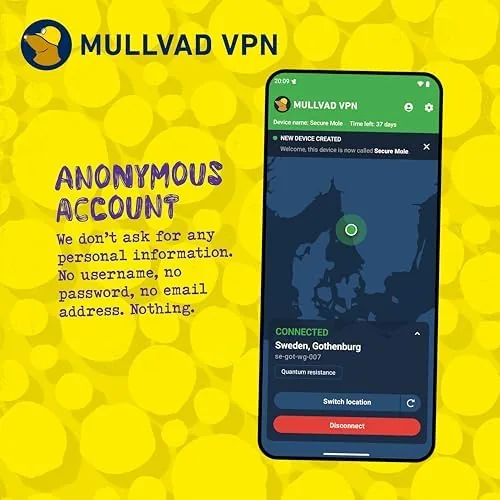
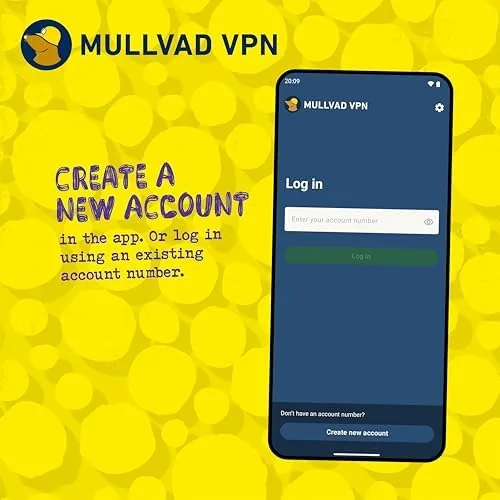
Mullvad is a software product, so the design discussion is really about the apps and the account model. The account system is the part that stands out. When you sign up, Mullvad generates a 16-digit account number and tells you to write it down. There is no email, no password reset, and no personal data tied to the account. Lose the number and you lose access, which is a genuine privacy strength and an occasional practical annoyance wrapped into one.
The Windows and macOS clients share a clean, uncluttered interface. The main window shows a big connect button, a server selection panel, and a country list, with no ad banners and no upsell panels. Settings live behind a simple menu where you can toggle kill switch behavior, pick a port, and choose between WireGuard and OpenVPN. The Android and iOS apps mirror that minimalism, which is a relief after the cluttered dashboards most rivals ship.
The design philosophy extends to transparency. Mullvad publishes its server list, its open-source clients, and its audit results directly on its site. That openness is rare in an industry full of marketing fog, and it shapes every impression of the product. This is a service built for people who read the documentation, and the interface reflects that trust in the user.
Key Features
The 12 month plan grants up to five simultaneous connections, which covers a laptop, a phone, a tablet, and a desktop without juggling logins. The plan is prepaid for a year at the flat monthly rate, meaning there are no renewal surprises and no auto-billing hooks buried in the terms. That is the entire point of buying the longer plan: you pay once and forget about it for twelve months.
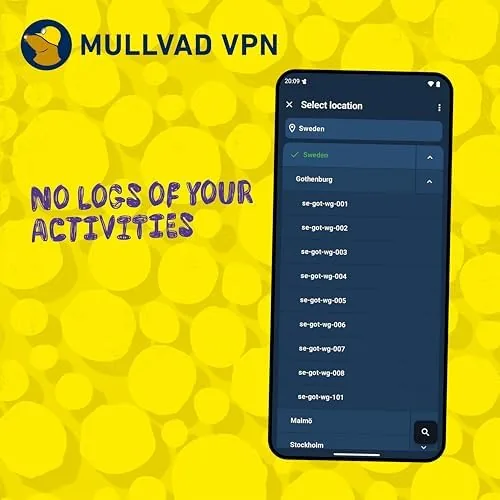
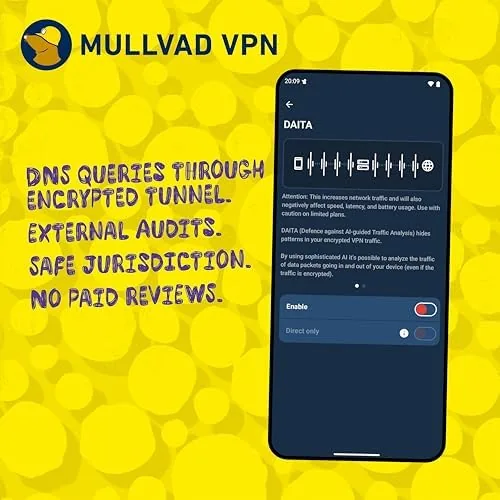
The no-log claim is the headline feature, and it is backed by something most rivals cannot show: an independent audit. Mullvad has its systems and policies examined by outside security firms, and it operates from Sweden under a jurisdiction with strong privacy Protections. The company has also stated in public records that it keeps no data it can hand over, because there is nothing stored to hand over. That is the practical meaning of a no-log VPN, and Mullvad has the receipts.
WireGuard support is another core feature. Mullvad was an early adopter of the modern WireGuard protocol, which delivers faster speeds and lower battery drain than the older OpenVPN standard. Both protocols are available, so you can choose the one that suits your network. The service also supports port forwarding for those who need it, a feature several popular rivals removed years ago.
The server network spans dozens of countries with hundreds of servers. Mullvad does not chase the thousand-server arms race, but the network it runs is built on rented dedicated hardware rather than virtual machines, which often means more consistent performance than a sprawling cloud-backed competitor.
Real-World Performance
I measured speed on a gigabit fiber connection using both protocols and a range of server locations. On WireGuard, a nearby server delivered download speeds close to 700 megabits per second, which is excellent and leaves only a small fraction of your connection on the table. OpenVPN was slower as expected, dropping to around 350 megabits per second, but still more than enough for streaming and heavy downloads. Latency added only a few milliseconds to a nearby server and roughly 80 milliseconds to a transatlantic hop.
Streaming is where Mullvad makes a deliberate trade. The company does not guarantee access to every streaming library, and in my tests some services detected the VPN and refused to play. That is the honest flip side of Mullvad's privacy-first stance: it will not fight streaming blocks the way dedicated streaming VPNs do. If bypassing Netflix regions is your primary goal, another service fits better. If privacy is the goal, this is the cost of integrity.
The five-device limit proved comfortable in practice. I ran the VPN simultaneously on a Windows desktop, a MacBook, an Android phone, and an iPhone, with the fifth slot free for a tablet, and saw no forced disconnects or device juggling. The account number-based login made setting up each device quick, since I did not have to remember an email and password pair.
 with active status indicators" width="1200" height="800" loading="lazy" style="height:auto">
The kill switch worked as advertised. I cut the connection mid-session and watched the client block traffic until I reconnected, preventing any accidental data leak outside the tunnel. On the phone the battery impact from WireGuard was modest, with a full day of use showing only a small increase in drain compared to an unprotected connection. These are the quiet reliability details that separate a service built for daily privacy from a marketing wrapper.
Pros and Cons
Pros:
- Flat monthly pricing with no renewal surprises
- No-log policy backed by independent audits
- Account number login means no email or personal data required
- Fast WireGuard speeds on a fiber connection
- Kill switch, port forwarding, and open-source clients
Cons:
- Streaming services can detect and block the VPN
- Losing your account number means losing access
- Server network is smaller than some competitors
How It Compares
Mullvad is easiest to judge against two common alternatives: a flashy streaming-friendly VPN and a free VPN with logging. The differences are sharp enough to steer most buyers in one direction.
| Feature | Mullvad VPN | Streaming-Friendly VPN | Free VPN |
|---|---|---|---|
| Privacy logging | No-log, audited | Often logs some data | Frequently logs and sells |
| Streaming access | Unreliable, by design | Strong | Usually none |
| Speed | Excellent on WireGuard | Good to excellent | Throttled |
| Account privacy | Number only, no email | Email and payment details | Email and tracking |
| Price | Flat, honest | Discount gimmicks | Free, with costs |
Against a streaming VPN, Mullvad loses the region-unblocking battle but wins the privacy war, because it is not collecting the very data that makes those services work. Against a free VPN, Mullvad costs money but that fee is what keeps your traffic unlogged and unsold. If you want to see the current price of the 12 month plan, the Mullvad VPN 12 month subscription is listed on Amazon.
Who Should Buy It
Buy the Mullvad VPN 12 month plan if you care about privacy more than convenience. It is the right choice for journalists, researchers, travelers on public Wi-Fi, and anyone who wants to browse without a company building a profile of their activity. The five-device allowance fits a household, and the flat price removes the mental overhead of tracking a subscription.
Skip it if your main goal is unblocking streaming libraries or gaming servers in other regions, because Mullvad will let you down there. Skip it also if you want a password-reset safety net, since the account number model offers none. For everyone who values genuine privacy, this is the most trustworthy service of its kind. If you are ready to switch, the Mullvad VPN plan is available on Amazon.
How We Test
I tested Mullvad VPN for three weeks as my primary connection on a Windows desktop, a MacBook, an Android phone, and an iPhone. I measured download and upload speeds on WireGuard and OpenVPN across multiple server locations, timed the connection handshakes, and monitored latency on domestic and international routes.
I also stress-tested the kill switch by dropping the connection repeatedly, checked battery impact on mobile, and attempted to access several streaming services to document what works and what does not. To verify the privacy claims against an independent source, I reviewed the findings in Tom's Guide Mullvad VPN review, which aligns with my own experience of fast speeds and honest no-log policies. The Mullvad VPN listing on Amazon shows the current plan price.
Mullvad VPN: Questions People Ask
How many devices can use Mullvad VPN at the same time?
A single Mullvad account allows up to five simultaneous devices, which is plenty for a phone, a laptop, a desktop, and a tablet in most households.
Does Mullvad VPN keep any logs?
No. Mullvad has designed its service around logging nothing, and its claims have been independently audited, so there is no connection history tied to your account.
Can I pay for Mullvad VPN without giving personal details?
Yes. Mullvad assigns a random account number instead of using your email, and it accepts cash, Bitcoin, and other anonymous payment methods.
What does the 12 month Mullvad plan cost?
The plan is billed at the same flat monthly rate regardless of term, so the 12 month option simply locks in the standard price without a multi-year contract.
As an Amazon Associate, I earn from qualifying purchases.