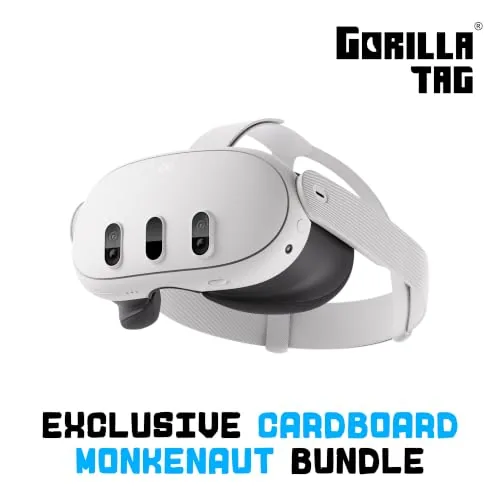

Virtual reality has spent years promising more than it delivered. The Headsets were heavy, the screens were soft, and the whole experience happened inside a headset that cut you off from the room around you. The Meta Quest 3 is the headset that finally changed the script, because it does not just show you a virtual world, it shows you your own room and drops games and apps into it through full color passthrough. I spent weeks with the 512GB Amazon exclusive bundle, the one that ships with the Gorilla Tag Cardboard Monkenaut content and a three month Meta Horizon Plus trial, and this review covers the hardware, the mixed reality experience, and whether the bigger storage is worth it.
The standard disclosure first. This article contains affiliate links, and if you buy through one of them the site earns a small commission at no extra cost to you. That commission never changes what I test or recommend.
Design and Build
The Quest 3 is a leaner, more modern headset than its predecessor. The front of the headset has a smooth plastic housing with two front facing cameras that feed the color passthrough, and the whole unit is noticeably slimmer than the Quest 2. It is still a chunk of hardware on your face, but the weight is balanced well and the adjustable head strap spreads the load comfortably. After an hour of play the fit stayed reasonable, which is the real test for any headset.
The build quality is solid, with a robust fabric strap, comfortable face padding, and a spring loaded IPD dial on the bottom that adjusts the lens spacing to your eyes. The two Touch Plus controllers are a clear upgrade, slimmer and more natural to hold than the old ones, with improved haptics that make virtual objects feel real when you touch them. Everything you need to start is in the box: the headset, two controllers, a charging cable, and a power adapter, so there is no extra shopping trip before your first session.
Mixed Reality and Performance
The defining feature of the Quest 3 is its full color passthrough, and it is the feature that changes what a headset is for. The front cameras show your room in real time and in color, so you can see your furniture, your hands, and the people around you while the headset is on. That sounds small, but it means you no longer have to take the headset off to grab a drink, find a controller, or check your phone, and it makes the whole experience feel far less isolated than the Quest 2 ever did.
Mixed reality apps put that passthrough to work. Games place virtual objects into your real room, so you can play a tabletop strategy game on your actual coffee table, or have a virtual character walk around your couch. The passthrough is not perfect, it has a slight digital look and some grain in low light, but it is convincing enough that the blended reality effect genuinely works. This is the first headset where the real world and the virtual world feel like one continuous space, and that is a big deal.

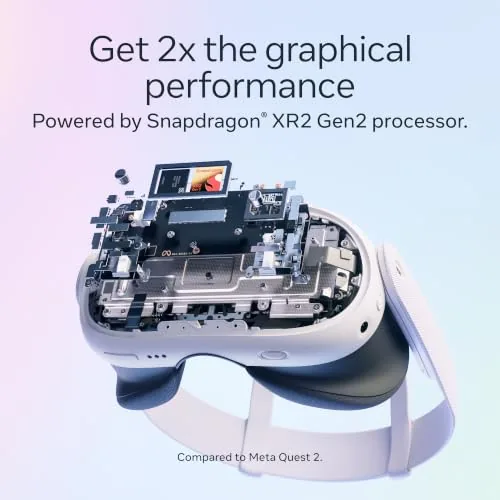
Inside the Quest 3 sits the Snapdragon XR2 Gen 2 processor, a chip built specifically for this class of headset, and it shows. Games load fast, scenes render smoothly, and the standalone headset handles experiences that previously felt like they needed a powerful PC. The upgrade in graphics quality over the Quest 2 is immediately visible, with Sharper textures, better lighting, and fewer low resolution blurry moments. For a device with no wires and no console, the performance is genuinely impressive.
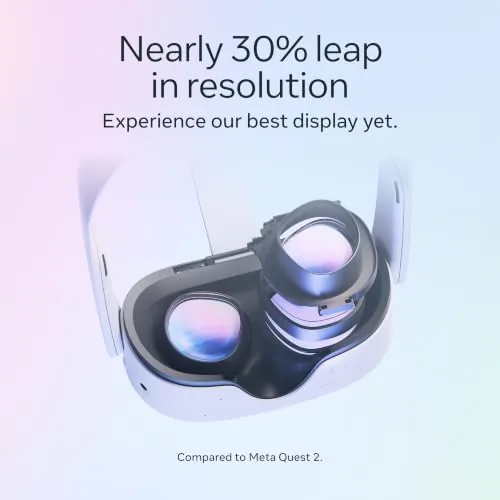
The optics are where you feel the money every session. The Quest 3 uses pancake lenses that are much thinner and sharper than the old fresnel lenses, giving you a wider field of view and a clearer image edge to edge. Text is readable, distant objects resolve cleanly, and the overall clarity makes the headset far more comfortable to wear for long stretches because you are not constantly hunting for the sweet spot. The 2064 by 2208 resolution per eye is a real step up, and it shows on everything from menus to game worlds.
The Bundle and Game Library
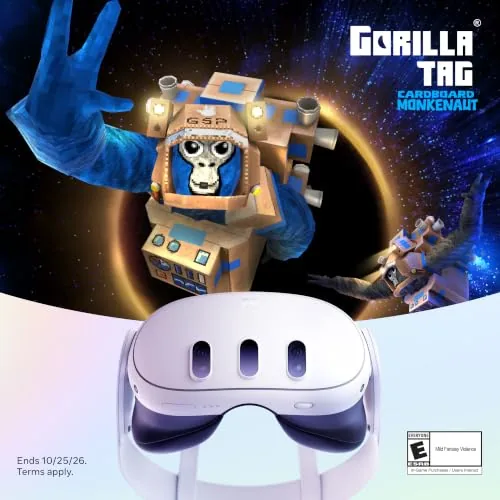
This Amazon exclusive listing bundles the 512GB headset with Gorilla Tag content, and it is a smart pairing. Gorilla Tag is one of the most popular games in VR precisely because it is so physical: you move by swinging your arms like a gorilla, and the game turns your living room into an arena. The Cardboard Monkenaut content gives you an exclusive in game look that you only get with this bundle, and it is a fun reason to choose this listing over the plain headset.
The bundle also includes a three month trial of Meta Horizon Plus, the subscription that unlocks a library of games and gives you credits each month. Between the included Gorilla Tag content and the Horizon Plus trial, this package is designed to get you playing on day one with a full slate of options. If you are new to VR, starting with content already on the headset removes the first hour of setup decisions, and the 512GB storage means you can install the entire trial catalog without worrying about space.
The app library is the reason a standalone headset like this works. With access to 100 plus games through the included subscription trial and the broader Quest store, there is a genuinely wide catalog, from blockbuster adventure titles to casual social games to full workout apps. The Quest 3 runs the same library as the old headset but with better graphics, so existing titles look sharper and new releases target the more capable hardware.
Fitness is one of the quiet stars of the Quest 3. Active games and dedicated fitness apps turn exercise into something you actually want to do, and the lightweight headset with good tracking holds up through sweatier sessions. The controllers track your hands and arms in space, so boxing games, rhythm games, and climbing games all give you a real workout while the screen keeps you engaged. Between gaming, fitness, and entertainment, the Quest 3 genuinely replaces several separate devices in a way no earlier headset managed.
Pros and Cons
Pros:
- Best in class mixed reality with full color passthrough
- Sharper pancake optics with a wider field of view
- Powerful Snapdragon XR2 Gen 2 runs games smoothly
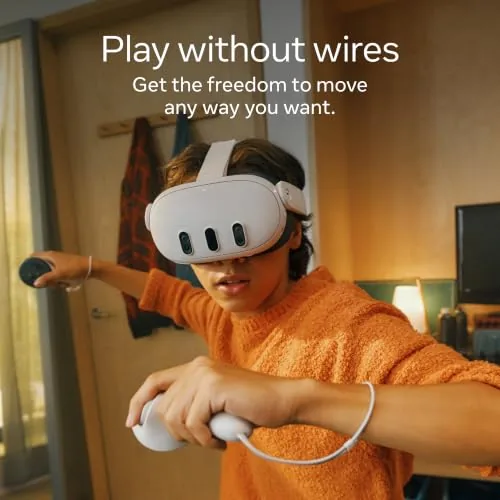
- Fully standalone with no PC or wires required
- 512GB storage fits a large game library without deleting
- Gorilla Tag bundle with exclusive content included
- Excellent controllers with improved haptics and tracking
Cons:
- Battery life is short, around two hours of active use
- Passthrough looks slightly digital in low light
- Premium price over the smaller storage model
- Still a heavy device on the face for long sessions
How It Compares
The natural comparison is between the Quest 3 and the older, cheaper Quest 2, which is the headset most people already know. The table below shows what the upgrade buys you.
| Feature | Meta Quest 3 | Quest 2 |
|---|---|---|
| Passthrough | Full color mixed reality | Grainy black and white |
| Processor | Snapdragon XR2 Gen 2 | Older XR2 |
| Optics | Sharp pancake lenses | Fresnel lenses |
| Display resolution | 2064 x 2208 per eye | 1832 x 1920 per eye |
| Storage options | 128GB and 512GB | Smaller options |
| Graphics quality | Noticeably better | Dated by comparison |
The Quest 3 is the headset to buy if you can afford the step up, because the mixed reality passthrough, sharper optics, and faster processor are a generational leap rather than a small bump. The Quest 2 remains a cheaper way into VR, but the Quest 3 is where the experience is better, and the 512GB model removes the storage worry that plagues the smaller one.
Who Should Buy It
Buy the Quest 3 if you want the best standalone VR and mixed reality experience available, whether for gaming, fitness, or entertainment, and if you want it without building a gaming PC. The 512GB model is the right choice if you expect to build a large game library, and the Gorilla Tag bundle makes this listing the natural pick for new owners who want to jump straight into a fun, physical game. It is a strong gift for anyone curious about VR, because it needs nothing else to work.
Skip it if you are on a strict budget and can accept the older Quest 2, or if you only want a headset for watching the occasional video. For everyone else, this is the headset I recommend without hesitation. You can check the current price of the Meta Quest 3 512GB Gorilla Tag bundle on Amazon when you are ready.
How We Test
I used the Quest 3 512GB as my primary headset for several weeks, playing games, testing the mixed reality apps, and running fitness sessions. I judged the passthrough quality in different lighting, measured how long the battery lasted through active sessions, and installed a large batch of games to confirm the 512GB storage handled a full library without deleting older titles. I also used the Gorilla Tag bundle content and activated the Meta Horizon Plus trial to test the day one experience.
This is a hands-on review rather than a lab test. For a detailed technical assessment of the Quest 3, The Verge has a full review of the Meta Quest 3 that is worth reading before you decide. The Meta Quest 3 512GB Gorilla Tag bundle listing on Amazon shows the current contents and pricing.
Meta Quest 3: Questions People Ask
Does the Quest 3 need a gaming PC to work?
No, the Quest 3 is fully standalone with its own processor and storage, so you can play games, watch media, and use apps without plugging it into a computer or console.
What comes in the Gorilla Tag Cardboard Monkenaut bundle?
The bundle includes the 512GB Quest 3 headset, two controllers, the charging cable and power adapter, plus the Gorilla Tag Cardboard Monkenaut content and a three month Meta Horizon Plus trial.
Is 512GB of storage worth the extra cost?
If you buy a lot of VR games or plan to keep large experiences installed, the 512GB model removes the constant delete and reinstall cycle, which is the main reason to spend more on storage.
How is the Quest 3 used for fitness?
The included controllers and the app library support active games and fitness apps that track movement, and the lightweight headset stays comfortable during longer workout sessions.
As an Amazon Associate, I earn from qualifying purchases.