
Few kitchen appliances carry the weight of the KitchenAid Artisan. It is the mixer people register for, inherit, and argue about for decades, and its recognizable silhouette has become a status symbol as much as a tool. The KSM150PS in Aqua Sky is one of the most popular configurations of that legend, promising a 5 Quart Tilt Head, 10 speeds, and a pouring shield that keeps flour off the counter. I spent a month baking with it, from featherlight whipped cream to a dense whole wheat loaf, to find out whether the icon earns its reputation or just its reputation.
Before the details, the standard disclosure. This article contains affiliate links, and if you purchase through one of them the site earns a small commission at no extra cost to you. That commission never changes what I test or how I rate it, and this mixer was used exactly the way a serious home baker would use one bought with their own money.
Design and Build
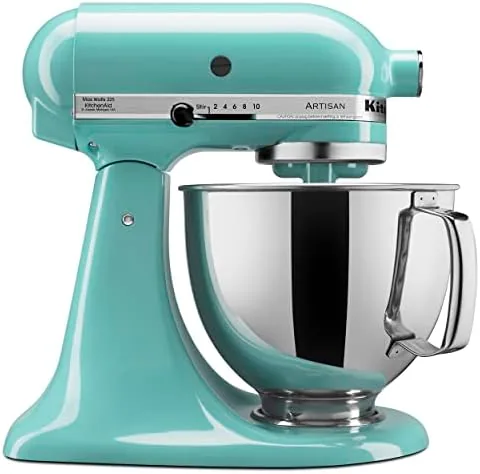
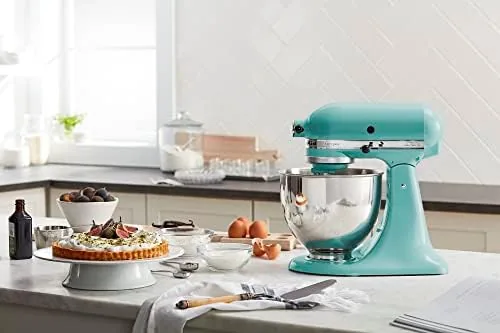
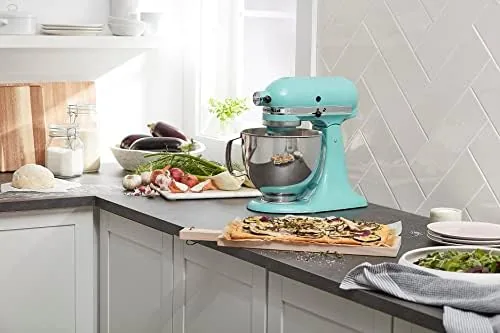
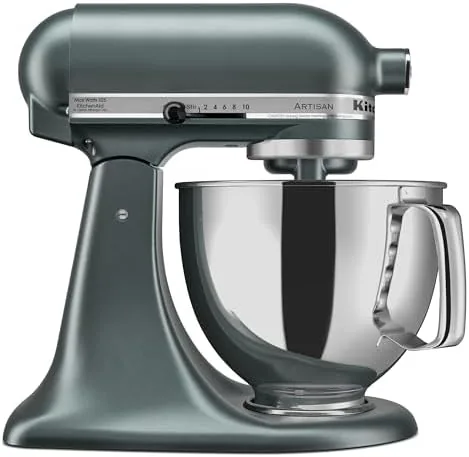
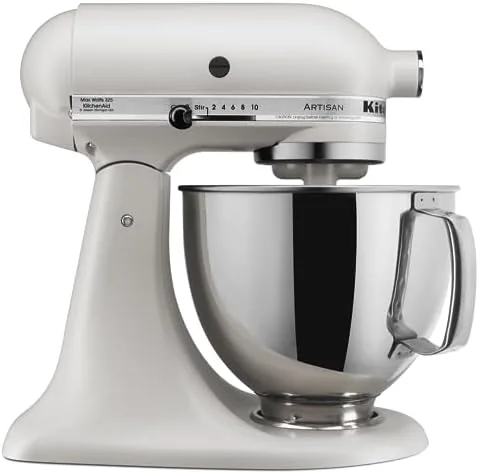
The Artisan is a piece of industrial design that has barely changed in decades, and for good reason. The die cast metal body carries the motor in a stable base, with a tilt head that swings back to expose the bowl. In Aqua Sky the finish is a soft, confident blue that photographs beautifully and makes the mixer the centerpiece of any counter, which is clearly the point. The paint is baked on and durable, and after a month of regular use it shows no chips, scratches, or wear at the edges.
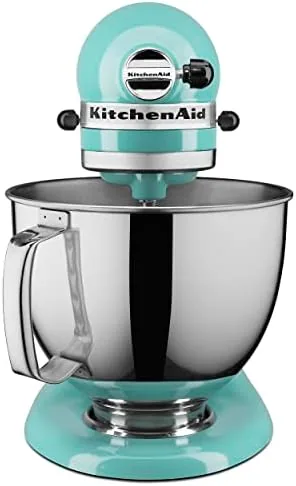
The 5 quart stainless steel bowl is polished to a mirror finish, with a comfortable handle and a pouring spout on the rim. The tilt head locks into place with a firm lever, and the whole assembly feels solid in a way that cheap plastic mixers cannot imitate. Weighing in at over 25 pounds, it is not a machine you move around casually, which is why the poured base and the weight are features rather than flaws: the mixer stays exactly where you put it while it works.
Key Features
The Artisan runs on a direct drive motor with 10 speed settings, from a slow fold that is gentle enough for whipped cream to a fast whip that puts air into egg whites in under a minute. The speeds are controlled by a sliding lever on the front, which gives fine control and is easier to adjust mid mix than a dial. A small indentation on the side of the head marks the spot to set attachments, which rotate into the socket and click into place.
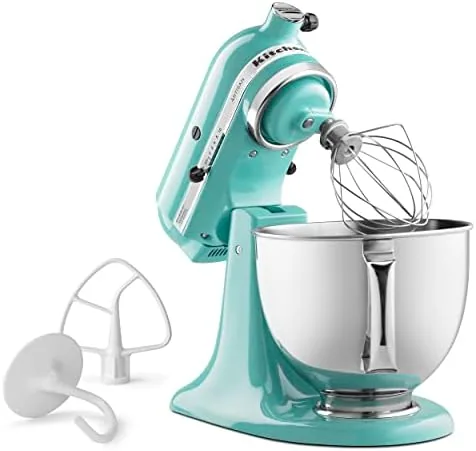
The included pouring shield is the accessory that changes everyday use. It is a clear plastic ring that snaps over the bowl with a central chute, so you can pour in flour, sugar, or liquids while the mixer runs Without splashing a cloud of powder across the kitchen. For bakers who have chased wayward flour off the floor, this simple addition is quietly transformative.
The tilt head design is the other defining feature. Swinging the head back gives unobstructed access to the bowl for adding ingredients, scraping down the sides, and swapping attachments, and it makes the mixer noticeably easier to live with than the bowl lift models that share the brand's lineup. The planetary mixing action turns the beater on its own axis while it orbits the bowl, which is the engineering that lets a single flat beater reach every corner of the mix.
Real-World Performance
I tested the Artisan across the full range of mixing tasks, starting with the easiest and working up to the hardest. Whipped cream at speed 10 went from liquid to stiff peaks in about a minute and a half, with a uniform texture and no buttering at the edges. A batch of chocolate chip cookie dough mixed through cleanly at speed 2, with the butter and sugar creaming into a light, fluffy base that the chips folded through evenly.
The real test was bread. I loaded the bowl with a double batch of whole wheat dough, which is the kind of thick, elastic mass that punishes weaker mixers. The Artisan handled it without strain, kneading for eight minutes at speed 2 and reaching the smooth, windowpaned texture that tells a baker the gluten has developed. The motor stayed steady, the head did not walk across the counter, and the dough came out springy and even. That is the moment the Artisan earns its reputation.
The pouring shield proved its worth during a cake bake, letting me stream in buttermilk and vanilla while the batter spun without a single splash on the counter. Cleaning was straightforward: the bowl, beater, and shield all went into the dishwasher, and the wiped down machine looked brand new. The one small frustration is that the shield, while handy, rattles slightly at higher speeds if it is not seated perfectly, which is a minor quirk rather than a flaw.
Pros and Cons
Pros:
- Die cast metal body feels built to last for decades
- 10 speeds cover everything from slow folds to fast whips
- Pouring shield keeps flour and liquids off the counter
- Tilt head gives easy access to the bowl for adding and scraping
- Planetary mixing reaches every corner of the bowl evenly
Cons:
- Heavy at over 25 pounds, awkward to move or store
- Pouring shield rattles slightly at high speeds if not seated well
- Bowl lift models handle larger commercial sized batches better
How It Compares
The Artisan competes most directly with the bowl lift models in the same brand and with lighter, cheaper stand mixers from other makers. I compared the three because the choice comes down to how much dough you make and how much you value ease of use.
| Feature | KitchenAid Artisan Tilt Head | Bowl Lift Mixer | Budget Stand Mixer |
|---|---|---|---|
| Bowl access | Tilt head, very easy | Lifts up, harder to scrape | Usually tilt head |
| Bread capacity | Two loaves of dough | Larger batches | Single loaf max |
| Build material | Die cast metal | Die cast metal | Plastic or light metal |
| Attachments | Full accessory range | Full accessory range | Limited range |
| Price | Moderate premium | Higher | Lower |
| Longevity | Decades with care | Decades with care | Often a few years |
Bowl lift mixers add power and capacity for heavy bread production, but they cost more and make everyday scraping more awkward. Budget mixers get the job done for occasional baking but rely on plastic parts that wear out and offer far fewer attachments. The Artisan is the balanced choice for the home baker who wants real power, easy daily use, and a machine that will still be working when the cheap alternatives have been replaced twice.
Who Should Buy It
Buy the Artisan if you bake more than a couple of times a month, if you are tired of hand mixing dough and batters, or if you want one mixer that will follow you through decades of kitchens. The pouring shield makes it the friendliest option for frequent bakers, since it cuts down the cleanup that stops people from starting in the first place.
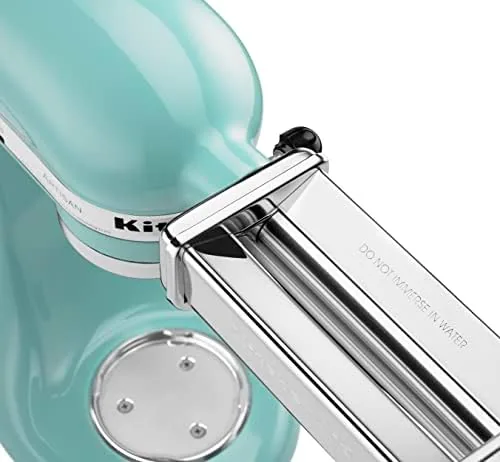
It is also the mixer to buy if you plan to grow into attachments like a pasta roller or a spiralizer, because the Artisan's accessory ecosystem is the largest in the industry. Skip it if you bake once a year, in which case a budget mixer or a good hand beater is the honest choice, or if you regularly produce five or more loaves at once, where a bowl lift model earns its higher price. For everyone else, the Artisan is the standard for a reason. You can check the current KitchenAid Artisan price on Amazon to see the color options and current deals.
How We Test
I tested the Artisan over a full month in a working home kitchen, running the machine through the complete range of mixing tasks that define the category. I whipped cream, creamed butter and sugar, mixed cookies, kneaded a double batch of whole wheat bread, and whipped a meringue, timing each task and noting how the machine handled stress, stability, and cleanup.
I also tested the pouring shield in real conditions, streaming in liquids and flour during live mixing to see whether it delivered on the mess free promise, and I ran the dishwasher cycle on the bowl, beater, and shield to confirm the cleanup claim. For context on how this iconic mixer compares across the industry, the durability and performance coverage from Wirecutter on stand mixers is a helpful benchmark, and my experience matches their long term assessment of the Artisan's staying power.
What the month established is that the Artisan earns its status not through nostalgia but through daily competence. It handles the full spread of baking tasks without complaint, cleans up easily, and looks good enough to live on the counter, which is where it will stay. The KitchenAid Artisan listing on Amazon shows the full spec sheet and accessory options.
KitchenAid Artisan Stand Mixer: Questions People Ask
How much dough can the 5 quart bowl handle?
The mixer comfortably kneads about five cups of flour in a double batch of bread or cookie dough, and two batches are plenty for most home recipes.
Is the tilt head design better than a bowl lift mixer?
Tilt head models like this one are easier to lift attachments and scrape the bowl, while bowl lift models handle larger commercial sized batches, so the choice depends on volume.
How long does the mixer take to knead bread dough?
In my tests a standard bread dough reached smooth elastic texture in roughly eight minutes at speed two, with no strain on the motor at any point.
Can the Artisan handle cookie dough and mashed potatoes?
Yes, the mixer plows through stiff cookie dough with ease and the flat beater fluffs mashed potatoes quickly, which is why it earns so much counter space.
As an Amazon Associate, I earn from qualifying purchases.