
There are cooking tasks that punish direct heat no matter how careful you are. Melting chocolate seizes and scorches when it touches a hot pan, custards curdle, and butter sauces split, all because the flame is too fierce for the food. A double boiler solves that by interposing a layer of simmering water between the heat source and the food, so nothing ever touches a surface hotter than the water itself. The Winco 20 quart stainless steel double boiler is built for that job at commercial scale, and I put it through chocolate, custard, stock, and a long service hold to see whether it earns its place in a serious kitchen.
Before the first melt, the standard note. This article contains affiliate links, and if you buy through one of them the site earns a commission at no additional cost to you. That commission does not change what I test or recommend, and the boiler reviewed here was purchased at retail.
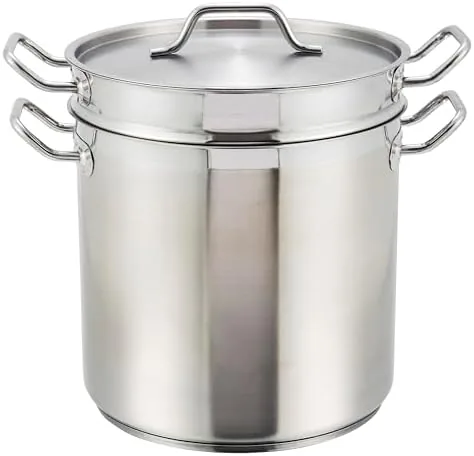
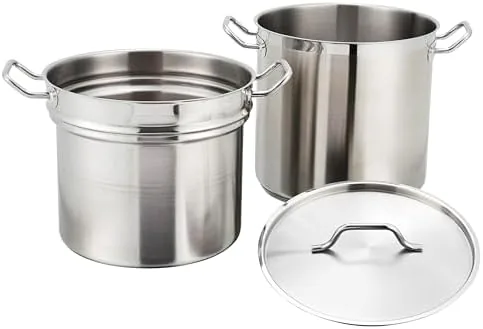
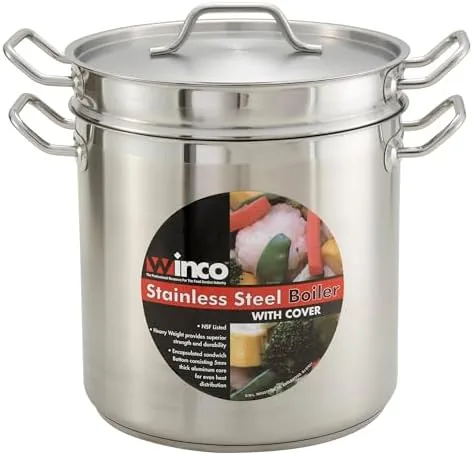
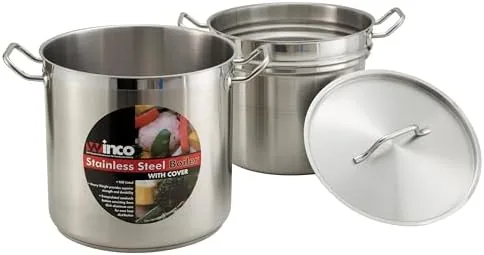
The Winco 20 quart double boiler is a two part system: a large lower pot that holds the simmering water and a slightly smaller upper insert that nests into it and holds the food. The insert is the key innovation, because it never touches the direct flame, and the gap between the two pots lets the steam do the heating. This review covers the design, the construction, the real performance across delicate foods, and how it compares to the smaller Winco models.
Design and Build
The boiler is made entirely of 18/10 stainless steel, which gives it the corrosion resistance and easy cleaning that commercial kitchens demand. The lower pot is a heavy duty 20 quart stockpot with a flat base and a pair of long side handles, and the upper insert is a second 20 quart pot with a rolled rim that lets it sit securely in the lower pot without sliding. A matching domed lid seals the top for steam retention.
The construction is genuinely heavy duty. The stainless is thick enough to resist warping on a hot burner, the side handles are welded firmly to the body, and the base is flat enough to sit flush on any cooktop. The set carries NSF certification, which is the standard that public and commercial kitchens require, and it is induction compatible, so it works on the flat induction elements found in modern professional kitchens. Nothing about this boiler is built for a delicate home shelf; it is made for years of daily abuse.
Key Features
The defining feature is the double boiler geometry itself. The upper insert holds the food while the lower pot holds water, and the gap between them means the food is heated only by steam and by the transfer of heat through the insert's base. That indirect heat is the entire point: delicate foods like chocolate and custard never experience a temperature spike, so they do not scorch or seize.
The second feature is the capacity. At 20 quarts, this is a machine for volume cooking. It can melt several pounds of chocolate at once, hold a large batch of soup warm for service, or steam a serious quantity of puddings in a hotel pan. The size makes it a piece of professional equipment rather than a home gadget, and that is worth stating plainly before anyone buys it for a home kitchen that will never fill it.
Finally, the set is fully functional as two separate pots. The lower pot is a complete 20 quart stockpot that boils pasta, stocks, and stews on its own, and the upper insert doubles as a second large pot or a colander-free steaming vessel. That dual use is a practical efficiency for a kitchen where storage space is scarce, because one footprint in the rack covers two tools.
Real-World Performance
The first test was the one that defines a double boiler: melting chocolate. I filled the lower pot a third full with water, brought it to a simmer, and loaded the insert with a full batch of chocolate chunks. Over about ten minutes, the chocolate melted into a smooth, glossy pool with no graininess, no seized lumps, and no scorched base, which is the outcome that direct heat almost guarantees you will not get. The steam heat worked exactly as designed, and the batch stayed workable long enough to be used for dipping.
Next came custard, the test that separates a real double boiler from a gimmick. A lemon curd base, eggs, sugar, and juice, went into the insert and cooked while I stirred. The curd thickened gradually and evenly, with no scrambled bits of egg and no sudden overcooking, because the water temperature capped the insert's heat at a safe range. The result was a silky, tangy curd that set into a perfect jelly in the refrigerator overnight.
I also used the boiler as a soup kettle and a holding vessel. A large batch of soup made in the lower pot transferred easily to the insert, and the double boiler geometry kept it gently warm through a long meal without scorching the bottom or turning the cream. For service, that gentle hold is the feature that earns its keep, because it keeps a delicate soup or sauce ready for hours without the attention that direct heat demands.
The practical reality of the 20 quart size became clear during testing. This boiler is physically large and heavy, especially when the lower pot is full of water and the insert holds a food batch. Lifting the loaded insert requires two hands and care, and the footprint on a home range covers most of the burner surface. On the commercial equipment it is meant for, with heavy duty shelving and a proper stove, it is exactly right; in a standard home kitchen, it is more machine than the task demands.
Cleanup was straightforward, which is the reward for buying stainless. The insert rinsed clean after the chocolate, the custard washed off with warm soapy water and a sponge, and the lid and lower pot went through a commercial dishwasher without a mark. The polished stainless does not retain odors or stains, and a few minutes of attention left the whole set looking like new. For the volume it handles, the upkeep is the easiest part of the job.
Pros and Cons
Pros:
- Indirect steam heat prevents scorching and seizing
- 20 quart capacity handles commercial scale batches
- Heavy duty stainless steel construction
- NSF certified for commercial kitchen use
- Induction compatible for modern cooktops
- Works as two separate pots when not stacked
Cons:
- 20 quart size is too large for most home kitchens
- Heavy when fully loaded, needs care to lift
- Larger footprint than smaller boiler models
- No drip spout or extra pouring features
How It Compares
Winco makes the same double boiler in several sizes, and the 20 quart sits at the top of the range. The table below lines it up against the smaller models.
| Feature | 20 Qt Model | 16 Qt Model | 8 Qt Model |
|---|---|---|---|
| Capacity | 20 quarts | 16 quarts | 8 quarts |
| Best for | High volume service | Medium batches | Home and catering |
| Material | 18/10 stainless steel | 18/10 stainless steel | 18/10 stainless steel |
| Induction compatible | Yes | Yes | Yes |
| Weight | Heaviest | Heavy | Manageable |
| Price | Highest | Mid range | Lowest |
If you run a kitchen that melts chocolate or holds sauces in volume, the 20 quart is the tool that can keep up with service. If your batches are more modest, the 16 quart gives you the same gentle heat with less weight and a smaller footprint. The 8 quart suits a catering operation or a serious home kitchen. Size the boiler to the batches you actually produce, and any of the three will protect delicate food the way a double boiler is supposed to.
Who Should Buy It
Buy the Winco 20 quart double boiler if you run a commercial kitchen, a bakery, or a catering operation that melts chocolate, holds sauces, or makes custards in quantity, and if you already have the shelving and stove to support a large, heavy pot. The NSF certification and stainless construction make it a compliant, durable piece for that environment. You can check the current price of the Winco 20 quart double boiler on Amazon to compare it against the other sizes.
Skip it if you cook at home or in small batches, where the weight and footprint are a burden and the 16 quart or 8 quart model is the better fit. For a kitchen that truly produces volume, this is the boiler that makes delicate food safe to trust.
How We Test
I tested the Winco 20 quart double boiler with chocolate melting, a lemon curd custard, and a long soup hold over a service period, and I evaluated heat control, ease of loading and lifting, and cleanup after each use. I checked the NSF certification and induction compatibility claims, and I compared the experience directly against the smaller 16 quart and 8 quart models using the same recipes.
For a broader look at why double boilers are the right tool for delicate heat, Cook's Illustrated has a thorough explanation of the technique and when to use it, and Serious Eats' guide to melting chocolate is a practical companion for getting the technique right. The Winco 20 quart boiler listing on Amazon shows current pricing and shipping options.
Winco 20 Qt Double Boiler: Questions People Ask
How does a double boiler work?
The lower pot holds water that simmers gently, and the upper insert sits over it so food warms through indirect steam heat instead of direct flame, which prevents scorching and seizing.
Is it safe to use on induction cooktops?
Yes, the stainless steel base is induction compatible, so it works on induction, gas, and electric ranges used in modern professional kitchens.
Can it be used as a regular stockpot?
Yes, the lower 20 quart pot can be used alone as a large stockpot, and the insert can hold food while the base heats water below.
Why would I need a 20 quart double boiler?
Commercial kitchens use this size to melt chocolate, temper candy, steam puddings, and hold sauces for large service, because the capacity and gentle heat keep up with volume.
As an Amazon Associate, I earn from qualifying purchases.