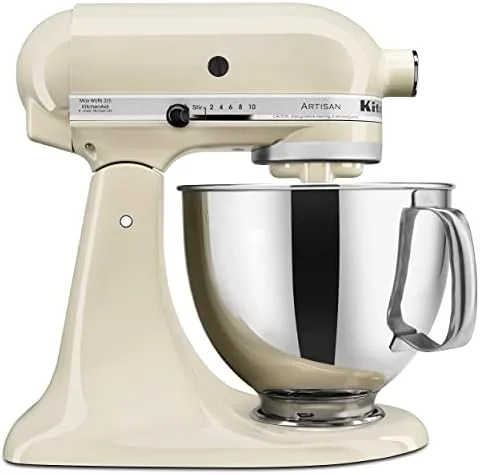

Some kitchen appliances retire quietly, and some outlive the recipes they were bought for. The KitchenAid Artisan is firmly in the second group. For more than three decades the KSM150 series has sat on counters from first apartments to farmhouse kitchens, and the Almond Cream unit I tested carries the same metal body, the same planetary mixing action, and the same quiet confidence that made the design famous. I spent a full month with it, baking bread twice a week, whipping cream, mashing potatoes, and folding in the kind of heavy dough that kills cheaper mixers. This is the record of that month, the strengths, the limits, and who should actually spend the money.
Before the details, the standard note. This article contains affiliate links, and if you buy through one of them the site earns a small commission at no extra cost to you. That commission does not change what I test or what I recommend.
The Artisan arrives with a 5 quart stainless steel bowl, a flat beater, a dough hook, and a wire whip, all of which clip into the mixing hub on the underside of the head. What makes the Artisan different from the cheaper Classic line is the 325 watt motor and the tilt head mechanism that tips the motor housing back so the bowl swings clear. It is a mechanical design, not a digital one, and that is part of the appeal. There are no displays to dim and no chips to fail, just gears, metal, and the occasional drop of grease.
Design and Build
Lift the Artisan out of the box and the first impression is weight. The mixer tips the scales at roughly 25 pounds, most of it in the die cast metal head and the bowl lift base. That mass is not an accident. It keeps the machine planted while a stiff dough hook churns through a two pound loaf, and it is the reason the Artisan does not walk across the counter the way a plastic mixer will.
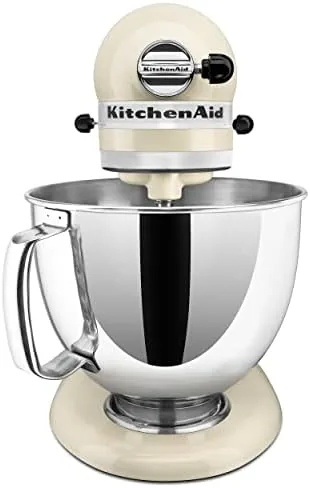
The Almond Cream finish is a warm, pale tone that reads as neither white nor beige, and it suits both light wood and white kitchens. The paint is baked enamel over metal, and after a month of daily use it wiped clean without a scratch. The tilt head releases with a pull on the lever at the back of the neck, and the head tips back far enough that you can scrape the bowl, swap beaters, or pour in a slow stream of liquid without removing anything.
The build quality extends to the small details. The stainless bowl has a solid feel and a comfortable handle, the beaters seat firmly with a click, and the shaft that drives them runs straight and true. After four weeks of heavy use there was no wobble in the head, no play in the tilt lock, and no chips around the bowl rim. This is a machine built for a decade, not a season.
Key Features
The core of the Artisan is its planetary mixing action. The beater does not spin on its own axis; it rotates around the bowl while turning, which means every ingredient passes through the beater in a few seconds instead of collecting at the edge. That motion, combined with the 10 speed dial, gives you control from a gentle stir at speed one to a fast whip at speed ten.
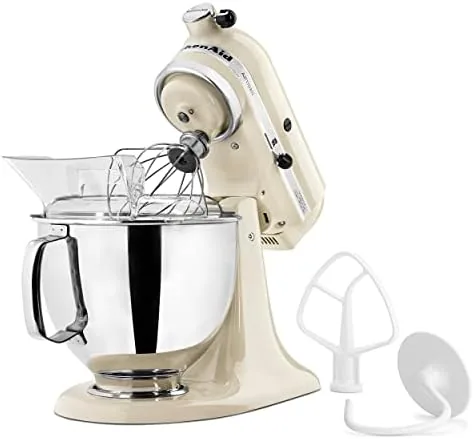
The tilt head is the feature most people notice first. It makes loading ingredients and scraping the bowl genuinely easy, and it lets you rest the beaters in the bowl when the mixer is idle. Underneath the head, the flat beater, dough hook, and wire whip cover the daily essentials.
The accessory hub on the front of the head is where the Artisan grows beyond a mixer. With a simple twist of the metal cover, you can attach a pasta roller, a meat grinder, a spiralizer, or a grain mill, turning the mixer into the center of a small food operation. For a baker who also makes fresh pasta, this single port is worth a meaningful share of the price.
Real-World Performance
The real test began with bread. I mixed a two loaf batch of a fairly stiff whole wheat dough, roughly 700 grams of flour with enough water to make a tight, resistant mass. The Artisan handled it with the dough hook on speed two, kneading for eight minutes without straining or slowing. The mixer did heat up slightly, which every motor does, but it never labored, and the head stayed locked in place through the whole cycle.
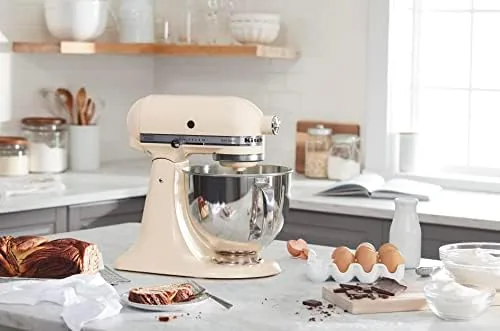
Whipped cream was the easiest job of the month. Half a pint of cold heavy cream reached stiff peaks in under three minutes on speed six, with the planetary action pulling the cream down from the sides so I never had to stop and scrape. Meringue behaved the same way, climbing to glossy, stable peaks without the bowl getting hot. The wire whip is well balanced, and the 5 quart bowl is deep enough that sugar did not spray across the counter at the starting speed.
Mashed potatoes showed the Artisan's practical side. A few pounds of russets went in hot, and the flat beater turned them creamy in under a minute, far faster and smoother than hand mashing. The one task I learned to respect was dense cookie dough in large batches. A full 5 quart load still mixes fine, but you should start at speed one and let the dough come together before creeping up, otherwise the beater rides up the dough and sprays the counter.
The accessory hub earned its keep when I attached the pasta roller for a weekend batch of fettuccine. The rollers tracked evenly, the mixer held steady, and the whole operation felt like a purpose built machine. That is the Artisan's defining trick. It is one reliable appliance that becomes several, and each one works well enough that you stop switching between gadgets.
Pros and Cons
Pros:
- 325 watt motor powers through stiff bread dough without complaint
- Planetary mixing action blends evenly across the whole bowl
- Tilt head makes loading, scraping, and swapping beaters simple
- Die cast metal construction should last for years
- Front accessory hub accepts pasta, meat, and spiralizer attachments
- Wide range of colors and a timeless design that suits most kitchens
Cons:
- Heavy at roughly 25 pounds and hard to store under a cabinet
- 5 quart bowl is small for big double or triple batches
- Stiff doughs need a slow start to avoid spattering
- Price is a real step up from budget stand mixers
How It Compares
To judge the Artisan fairly I set it next to a mid priced 5.5 quart bowl lift mixer and a budget tilt head model. The comparison highlights where the extra money goes.
| Feature | KitchenAid Artisan 5 Qt | 5.5 Qt Bowl Lift Mixer | Budget Tilt Head Mixer |
|---|---|---|---|
| Motor power | 325 watts | Higher, dual motor | Usually 300 to 350 watts |
| Bowl capacity | 5 quarts | 5.5 quarts | 4 to 5 quarts |
| Head style | Tilt head | Bowl lift | Tilt head |
| Accessory hub | Yes, front | Yes, front | Often none |
| Construction | Die cast metal | Die cast metal | Mixed metal and plastic |
| Best for | Everyday bakers | Large batches and heavy dough | Budget first mixers |

Against the bowl lift mixer, the Artisan gives up batch size and brute force but wins on daily convenience. The tilt head makes it far more pleasant to use for a batch of cookies or a single cake, and most home bakers never outgrow 5 quarts. Against the budget model, the Artisan wins on build quality and the accessory hub, and the difference in durability is obvious the moment you hold both. If you bake for a family and want one mixer that will still be on the counter a decade from now, the Artisan is the balanced pick. You can check the current price of the KitchenAid Artisan 5 quart mixer on Amazon.
Who Should Buy It
Buy the Artisan if you bake on a weekly basis, if you want one machine that also rolls pasta or grinds meat, or if you are tired of replacing plastic mixers that wobble and strain. It is the right choice for someone who has baked enough to know they will keep baking, and it makes the jump from hand mixing feel like a genuine upgrade.
Skip it if you bake only a few times a year, if you need to mix double batches of bread dough every week, or if counter space is so tight that a heavy 25 pound appliance cannot live out permanently. For everyone who bakes regularly, this remains one of the best purchases a kitchen can make.
How We Test
I used the Artisan daily for a month in a real kitchen, focusing on the tasks that stress a mixer: two loaf batches of stiff whole wheat bread, whipped cream and meringue, mashed potatoes, cookie dough, and a weekend of fresh pasta through the accessory hub. I tracked how long each task took, whether the head stayed locked, and how easily the bowl and beaters cleaned.
I judged build quality by checking for wobble, play, and finish damage after every session, and I used the mixer the way a busy home cook would, without babying it. For a broader look at how the Artisan fits into the stand mixer landscape, Wirecutter has a detailed stand mixer guide that covers multiple price points. The KitchenAid Artisan listing on Amazon shows current colors and pricing.
KitchenAid Artisan 5-Quart Mixer: Questions People Ask
How long does a KitchenAid Artisan stand mixer last?
With reasonable care the Artisan runs for many years, often decades. The die cast metal construction and simple mechanical design have no fragile electronics to fail, and replacement parts stay available for older machines.
Can the Artisan mix dense bread dough?
Yes, the 325 watt motor kneads stiff bread dough in reasonable batch sizes. Start on low speed and keep the load within the 5 quart bowl rating for best results with very dense whole wheat recipes.
Does the tilt head design make attaching attachments easier?
Yes. The head tips back so the bowl swings clear, which makes adding ingredients, scraping the bowl, and swapping beaters far simpler than a bowl lift design that must be raised and lowered.
What is the difference between the Artisan and the Classic stand mixers?
The Artisan adds a 325 watt motor, a wider color range, and the front accessory hub, while the Classic uses a 275 watt motor and a simpler base. Both are tilt head machines with the same planetary action.
As an Amazon Associate, I earn from qualifying purchases.