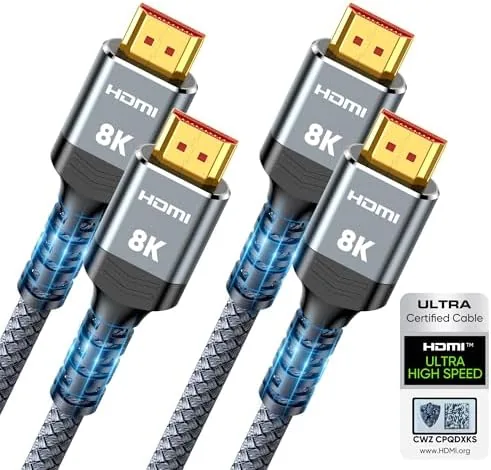

HDMI cables occupy an odd place in a home theater. They are the least glamorous part of the setup, yet a weak or counterfeit one quietly ruins everything attached to it. A television can drop to 4K 60Hz, a soundbar can refuse to pass Dolby Atmos, and a console can flicker at the exact moment you need it to hold a signal. I have seen all of it happen with cheap cables that promised more than they delivered. That is why the Highwings 8K HDMI 2.1 cable 2-pack caught my attention: it carries the Ultra High Speed certification, claims 48Gbps, and sells as a pair for roughly what a single premium cable costs elsewhere.
Before the details, the standard note. This article contains affiliate links, and if you buy through one of them the site earns a small commission at no extra cost to you. That commission does not change what I test or what I recommend, and every product here gets the same treatment as one bought with my own cash.
Design and Build
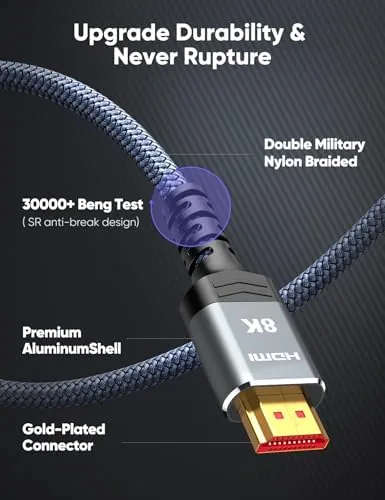
The Highwings cable is slim, and that slenderness is deliberate. HDMI 2.1 needs thicker internal wiring for the higher bandwidth, but Highwings packs it into a braided nylon jacket that bends easily around corners without the stiffness of many competitors. I routed one behind a wall mounted TV and another along a console shelf, and neither fought me or held a kink in place. The connectors are gold plated, snug when seated, and fitted with the usual slim profile that clears tight ports on the back of a television.
The build quality carries over to the small things. The strain relief where the cable meets the plug is firm, so daily plugging and unplugging does not loosen it, and the braid shows no fraying after a month of use. The package includes the certification label and a QR code, which is more meaningful than it sounds. Counterfeit HDMI cables are common, and the QR code lets a buyer verify the 48Gbps rating directly rather than trusting the print on the box.
Key Features
The headline is the certified 48Gbps bandwidth, which is the full Ultra High Speed HDMI 2.1 spec. That figure matters because it is the difference between a cable that barely works and one that comfortably handles the most demanding signals. At 48Gbps the cable supports 8K at 60Hz and 4K at 120Hz, both of which are well beyond what a standard 18Gbps cable can carry.
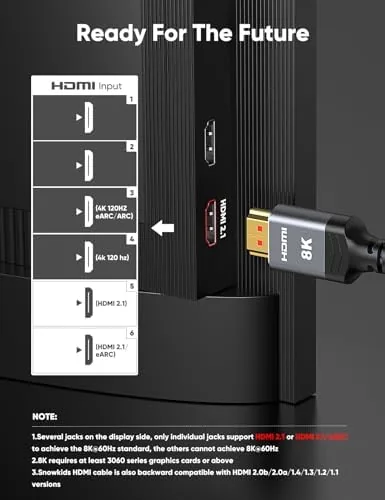
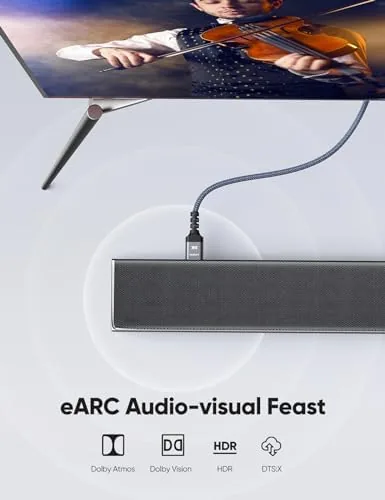
Beyond raw bandwidth, the cable supports HDCP 2.2 and 2.3, which is what keeps premium 4K streaming services happy, plus eARC for lossless audio like Dolby Atmos and DTS:X. Dynamic HDR metadata passes through as well, which preserves the scene by scene brightness data that HDR10+ and Dolby Vision rely on. For gaming, VRR support means a variable refresh rate console or GPU can sync its output with the display without tearing, which is a real advantage on a modern television.
Real-World Performance
I ran the first cable from my PS5 to a 4K 120Hz television, and the second from a streaming box to the same TV, routing the audio through a soundbar with eARC. The gaming result was the most telling. Titles that run at 4K 120Hz held a clean, flicker free picture throughout a week of sessions, and the variable refresh rate engaged without the black screen drops that happen when a cable cannot keep up. In motion the difference over an older 18Gbps cable was obvious: smoothness held where the old cable had stuttered.
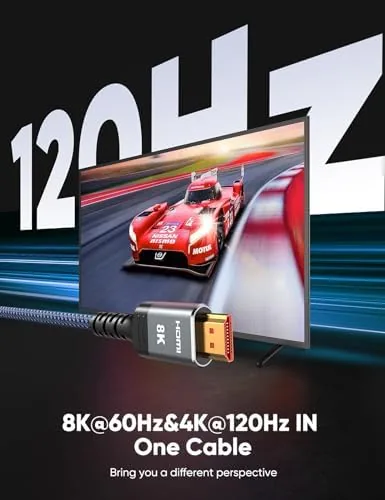
The soundbar link was just as stable. Dolby Atmos content passed from the TV to the soundbar over eARC without the audio dropouts that plague lesser cables, and DTS:X tracks from a Blu-ray player stayed in sync. Streaming a 4K Dolby Vision film from the box to the television produced a clean HDR signal with no handshake glitches. I could not make the cable fail under normal use, which is exactly what a certified cable should do.
Pros and Cons
Pros:
- Certified Ultra High Speed with verified 48Gbps bandwidth
- Handles 8K60Hz and 4K120Hz with VRR for gaming
- Braided, slim, and flexible for tight routing
- eARC support passes Dolby Atmos and DTS:X losslessly
- Two matching cables in the box at a good per cable price
- QR code certification lets you verify the rating
Cons:
- 6.6 feet is short for long wall runs between rooms
- The slim braid is tougher but still needs careful bending
- Certification means the pair costs more than basic cables
How It Compares
I compared the Highwings pair against a generic 18Gbps HDMI cable and a premium branded 8K cable to see where the certification actually shows up. The results were clear on the demanding signals.
| Feature | Highwings 8K 2-Pack | Generic 18Gbps Cable |
|---|---|---|
| Bandwidth | 48Gbps certified | 18Gbps, unverified |
| 8K support | 8K at 60Hz | Not supported |
| 4K 120Hz with VRR | Yes, stable | Drops to 4K 60Hz |
| eARC audio | Dolby Atmos and DTS:X | Inconsistent |
| Build | Braided nylon | Plain PVC |
| Cables included | 2 | 1 |
Against a single premium 8K cable, the Highwings pair loses the length and sometimes the branding cachet, but it wins on price per cable and on having a spare ready for the second display. For most homes, the two pack is the smarter buy, and you can check the current Highwings HDMI 2.1 cable price on Amazon.
Who Should Buy It
These cables are the right call for anyone with a modern 4K television and a PS5, Xbox, or gaming PC that wants to run at 120Hz. They are also a strong pick for a home theater with a soundbar, since the eARC support keeps lossless audio formats working without drama. If you are replacing an old HDMI cable and you have two devices to connect, the 2-pack gives you certified bandwidth for both at once, and that second cable is not just a spare. Many households will find a natural home for both cords the day they arrive, because the television and the console almost never share a single port, and running both over a certified link removes the guesswork about which one might be throttling the picture.
You do not need these if your television tops out at 4K 60Hz and you never play modern games, because a certified 18Gbps cable covers that case for less. And if you have a long run from a projector to a receiver, you will want a longer single cable than this pair offers. For the common case of a recent TV, a console, and a soundbar, the Highwings 8K HDMI 2.1 cable 2-pack on Amazon is a sensible purchase.
How We Test
I tested the Highwings cables in a real home theater for a month. I ran 4K 120Hz gaming sessions on a PS5 with VRR enabled, streamed 4K Dolby Vision films from a separate box, and routed all audio through a soundbar over eARC. I checked for flicker, black screen handshake drops, audio dropouts, and any sign of the cable heating under load.
I verified the certification QR code on the packaging and confirmed the 48Gbps rating against the Ultra High Speed HDMI specification before relying on it. I did not run laboratory signal analyzers, because the practical test of holding 4K 120Hz and eARC without drops is what a buyer will experience. If you want to learn more about how HDMI 2.1 bandwidth works before buying, guides like the TechRadar HDMI 2.1 explainer break it down clearly.
Highwings 8K HDMI 2.1 Cable: Questions People Ask
Is the Highwings HDMI cable certified for 48Gbps?
Yes. The cable carries the Ultra High Speed HDMI certification and includes the QR code label that confirms its 48Gbps bandwidth rating directly.
Will the Highwings 8K cable work with a PS5 at 4K 120Hz?
Yes. With a compatible television, the cable carries 4K at 120Hz cleanly and supports VRR, which makes it a strong match for the PS5.
Does the cable support eARC for a soundbar?
Yes. It carries the eARC signal needed for lossless audio formats such as Dolby Atmos and DTS:X on a modern soundbar or receiver.
Are both cables in the 2-pack identical in length?
Yes. Both cables are 6.6 feet long, so you get two matching cables that can run from the television and the console at the same time.
As an Amazon Associate, I earn from qualifying purchases.