
The smart speaker market has settled into a familiar bargain. Most models deliver clear voice assistant sound at a friendly price, and that is where the story ends. The Amazon Echo Studio is the outlier, the speaker Amazon built for people who want the assistant and the sound system in one device. The newest model, reviewed here in Graphite, is designed around Alexa Plus and throws in spatial audio with Dolby Atmos, a built in smart home Hub, and a driver layout that would not look out of place in a dedicated music speaker. I spent a month living with it, testing it as a music source, a home theater speaker, and the center of a smart home.
Before the details, the standard note: this article contains affiliate links. If you buy through one of them, the site earns a small commission at no extra cost to you, and that commission never changes what I test or recommend.
Design and Build
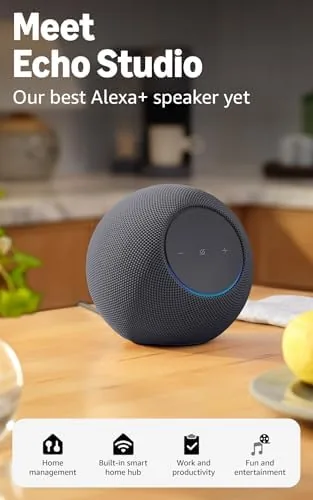
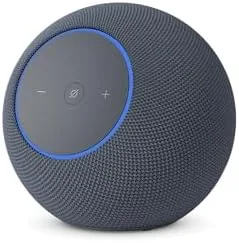
The Echo Studio keeps the fabric wrapped sphere that has defined the line since the first model, and the Graphite finish gives it a quiet, furniture friendly presence. It is a heavy, substantial speaker, with the weight that serious drivers demand, and it sits on a wide base that keeps it steady even at high volume. The fabric wrap feels durable, and the rounded shape makes it easy to place on a shelf, a sideboard, or a floor stand without shouting for attention.
On top sit the controls: a volume ring, an action button, a mute button, and a small status light. The layout is unchanged from earlier Studios and is easy to learn, though most people will rarely touch it, because voice control handles the heavy lifting. Around the back you will find the power jack, a 3.5 millimeter audio line input, and the USB port, which gives you ways to connect a turntable, a computer, or a phone that the basic Echo models simply do not offer.
Key Features
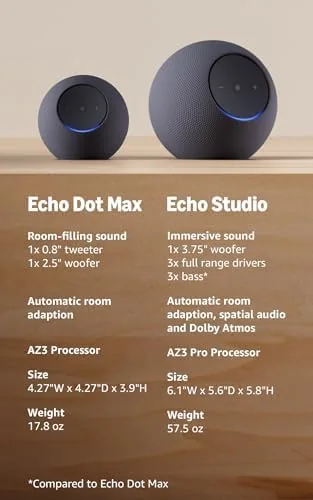
Inside, the Studio packs a 5.5 inch downward firing woofer, three two inch midrange drivers arranged around the body, and a one inch tweeter, all driven by a five channel amplifier. That layout is the foundation of the spatial audio story: because the midrange drivers fire in multiple directions, the speaker can place sound around the room instead of pushing everything from a single point. When you play a Dolby Atmos track, instruments and effects appear to hover in space around you rather than staying glued to the speaker.
The smart home hub is a second headline feature. The Studio includes a built in Zigbee radio and supports the Matter standard, which means it can pair directly with Zigbee bulbs, plugs, and sensors, as well as Matter devices, without a separate hub. For many homes it removes a piece of hardware entirely, and it gives Alexa a direct, low latency channel to your lights and locks.
The newest model is designed around Alexa Plus, Amazon's upgraded assistant tier. In practice that means more natural, conversational responses, better handling of follow up questions, and access to richer answers than the classic Alexa gave. The Studio also supports lossless audio playback and adaptive room tuning, which measures your room with the built in microphone and adjusts the output to suit the space.

Real-World Performance
As a music speaker, the Studio is a genuine surprise. It is the only smart speaker I have tested that plays loud, full, and balanced enough to serve as a primary music source in a living room. Bass is deep and physical without muddying the mids, voices stay clear, and even at high volume there is no audible strain. The room tuning works: moving the speaker from a small shelf to a large open room produced audibly different, better adjusted output after each calibration.
Dolby Atmos music is where the Studio justifies its design. A spatial track places vocals in the center, drums to the sides, and effects above and behind you, and the effect is genuinely convincing from a single box. It is not the same as a full surround system, but it is far closer than any single speaker has a right to be. Standard stereo tracks sound excellent too, which matters because not all of your library will be spatial.
The smart home side performed without drama. The built in hub paired directly with a Zigbee smart bulb and a Matter plug, and commands like turning lights on and off responded quickly and consistently. Voice pickup is strong: the Studio hears commands across a medium sized living room even while music plays, thanks to the multi mic array and beamforming.
The honest limitations are about the ecosystem. The best spatial audio experience is inside Amazon Music, and the deepest assistant features come with Alexa Plus. If you stream from services you already use and prefer a neutral speaker, you will still get excellent sound, but you will leave some of the special sauce on the table. Pairing a Studio with a Fire TV for home theater sound adds real value, and a second Studio creates a stereo pair that widens the image further.
Pros and Cons
Pros:
- Genuine Dolby Atmos spatial audio from a single speaker
- Deep, physical bass with clear, balanced mids and highs
- Built in Zigbee and Matter hub removes the need for a separate hub
- Room tuning adapts the sound to the space automatically
- Line input and USB give flexibility for non streaming sources
- Strong far field voice pickup during music playback
Cons:
- Best spatial audio experience requires the Amazon ecosystem
- Alexa Plus extras sit behind a subscription tier
- Large and heavy compared with compact smart speakers
- No battery means it stays tied to a wall outlet
How It Compares
The Echo Studio is usually weighed against the Apple HomePod and the Sonos Era 300. The table below shows where the three diverge.
| Feature | Echo Studio | Apple HomePod | Sonos Era 300 |
|---|---|---|---|
| Spatial audio | Dolby Atmos | Dolby Atmos | Dolby Atmos |
| Assistant | Alexa with Plus | Siri | Alexa or Sonos |
| Smart home hub | Zigbee and Matter | Matter and Thread | Matter ready |
| Line input | 3.5 mm and USB | None | Optional adapter |
| Typical price | Lower | Higher | Higher |
The HomePod is a superb speaker with a tighter, more refined sound and seamless Apple integration, but it is locked to Apple devices. The Era 300 offers excellent spatial audio with more streaming service neutrality, yet it costs more and its smart home hub support is thinner. The Echo Studio is the value pick that also happens to be the most complete smart home device of the three. For independent coverage of smart speakers, The Verge regularly reviews this category: The Verge audio coverage.
Who Should Buy It
Buy the Echo Studio if you want a single speaker that handles both serious music and your smart home, if you are building a Fire TV home theater setup, or if your home already leans on Alexa. It is the smart speaker to choose when sound quality is the first requirement.
You can check the current Echo Studio price on Amazon. Skip it if you are firmly invested in another assistant ecosystem, if you need a portable speaker, or if a basic Echo would cover your needs and your music listening happens elsewhere.
How We Test
I used the Echo Studio as my primary living room speaker for a month, playing spatial audio, lossless tracks, and everyday playlists across multiple streaming services. I ran the room tuning in two different rooms, paired it with a Fire TV for movies, and created a stereo pair with a second unit.
On the smart home side, I connected Zigbee and Matter devices directly to the hub, tested voice pickup while music played at high volume, and left the speaker playing for hours to check thermal behavior and stability. I also compared its sound against reference smart speakers at the same price tier.

Amazon Echo Studio: Questions People Ask
Does the Echo Studio support Dolby Atmos?
Yes. The speaker supports Dolby Atmos spatial audio, and compatible tracks place instruments and effects around the room instead of at a single point.
Can the Echo Studio control smart home devices?
Yes. It includes a built in Zigbee radio and supports Matter, so it pairs directly with bulbs, plugs, sensors, and locks without a separate hub.
Do I need a Fire TV to get spatial audio?
No. The Studio produces spatial audio from music and supported apps on its own, and pairing it with a Fire TV is an optional extra for home theater sound.
What is new in the newest Echo Studio model?
The newest model is designed around Alexa Plus, adds improved spatial audio processing and lossless playback, and keeps the fabric covered spherical design in Graphite and other finishes.
The Echo Studio listing on Amazon shows the current price and available colors.
As an Amazon Associate, I earn from qualifying purchases.