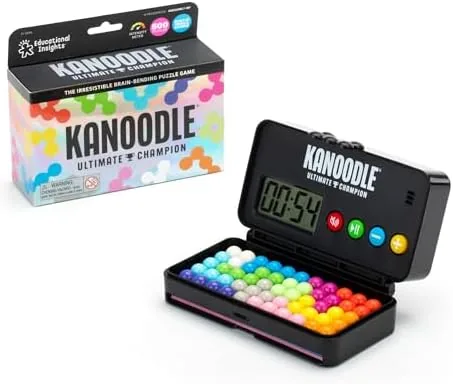

Most puzzle games fall into one of two camps. Either they are quick distractions you solve once and forget, or they are endurance tests that demand a desk and a long attention span. The Educational Insights Kanoodle Ultimate Champion sits somewhere better. It is a single player brain teaser small enough to carry in a jacket pocket, yet deep enough to keep a puzzle obsessed household occupied for an entire weekend. Twelve chunky pieces lock into a compact board, and a challenge book asks you to build 2D patterns and 3D pyramids from them. I spent two weeks with the game, worked through more than forty challenges, timed my fastest solutions, and handed it to children and adults alike. This is the honest account of how it performed.
A quick note before the details. This article contains affiliate links, and if you buy through one of them the site earns a small commission at no extra cost to you. That commission never influences what I test or what I recommend.
Design and Build
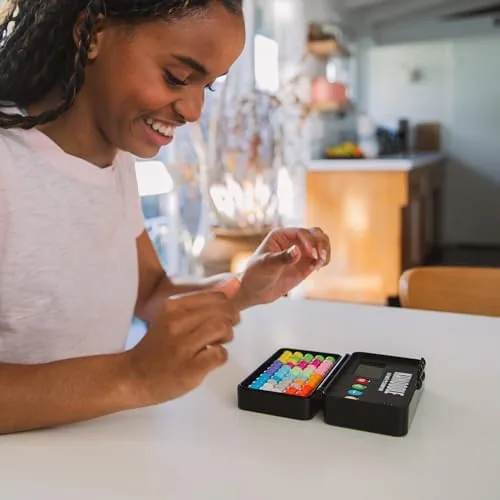
The Kanoodle Ultimate Champion is deliberately uncomplicated. The board is a flat plastic tray with a grid of raised pegs that the pieces click over, and the twelve pieces are rounded, chunky shapes in bright colors. Each piece is made from a small chain of spheres joined in straight lines and right angles, which gives them a friendly, toy like look while keeping the geometry precise. They feel sturdy in the hand, with no sharp edges, which matters when a child is gripping and twisting a piece through a difficult puzzle.
The lid is the quiet star of the design. It snaps onto the board to seal the pieces inside, which means you can tip the whole game into a backpack without losing a single piece. That is a genuinely useful detail, because puzzle games lose their charm the moment a piece rolls under the couch. The challenge book fits into a molded slot on the lid, so the booklet, the board, and the pieces all travel together as one tidy unit.
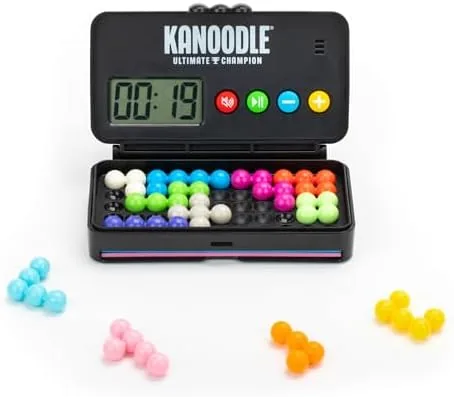
The build quality is what I expect from Educational Insights, a company with decades of classroom tested games behind it. The plastic is rigid but not brittle, the pegs align cleanly with the pieces, and nothing felt loose after a week of repeated use. There are no batteries, no screens, and no delicate parts waiting to bend or break, which makes it an unusually low maintenance toy for a family.
Key Features
The core feature is the puzzle system itself. The challenge book presents a series of target shapes, some drawn as flat 2D patterns and some as 3D pyramids built in layers. You pick the pieces a puzzle requires, then arrange them so they match the target shape exactly, with every sphere accounted for. The difficulty does not come from complicated rules. It comes from the fact that several arrangements look almost right before you discover a piece will not fit, which forces you to rethink the entire structure.
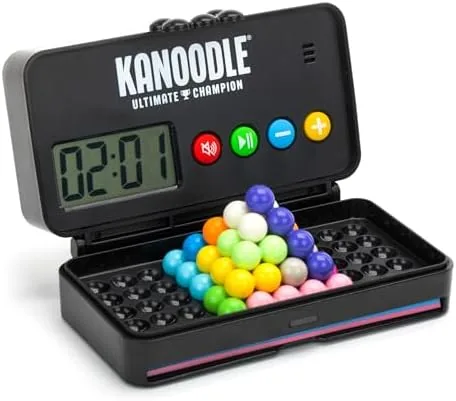
The difficulty rises in steps rather than leaps. Early challenges teach you how the pieces connect, middle challenges start to twist your thinking, and the later 3D challenges are genuinely hard even for adults. That progression keeps the game fair for everyone. A young child can solve the opening puzzles without help, while the closing ones remain a rewarding stretch. The single player format means there is no scorekeeping and no timer pressure, which is exactly why it works so well as a wind down activity at the end of the day.
Portability is a feature in its own right. The whole game is roughly the size of a thick paperback, so it disappears into a carry on bag or a glove box. I took it on a short trip and it filled idle time at an airport without any setup at all. For a look at the current price and the exact challenge count in this edition, the Amazon listing for the Kanoodle Ultimate Champion is a useful reference.
Real-World Performance
My first session was the moment the game won me over. I opened the book to the opening 2D challenges and solved the first several in a few minutes each, which built confidence quickly. Then came a middle 2D puzzle where two pieces looked interchangeable, and I placed them the wrong way three times before the mistake finally clicked. That is the satisfying core of the game. The failure is clear, the correction is immediate, and the victory is earned rather than given away.
The 3D challenges are where the game shows its teeth. Building a pyramid in layers means you have to hold a mental picture of how the bottom level supports the top, and several puzzles forced me to dismantle a half built structure and start over. It is a genuine spatial reasoning workout, the kind of thinking that researchers link to mental rotation and structural problem solving. My fastest 3D solve was just over four minutes, and my slowest took close to twenty, which shows how wide the difficulty spread really is.
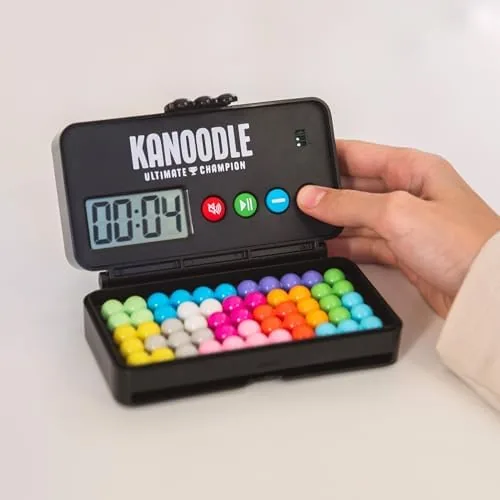
I also tested the game with a nine year old and a teenager. The nine year old sailed through the opening challenges and needed a gentle hint or two on her first 3D build. The teenager attacked the hardest puzzles with real focus and finished one of the advanced pyramids that had taken me close to twenty minutes. Watching the two of them made clear that the age range on the box is honest, and that adults get just as much from the game as children do.
The only real criticism is that the 2D puzzles feel lighter than the 3D ones. After you have solved a dozen 2D challenges, several of them start to blend together, and the book leans on the pyramid builds for its most memorable moments. It is a minor imbalance rather than a flaw, because the 3D side carries the game comfortably.
Pros and Cons
Pros:
- Genuinely challenging 3D puzzles that exercise spatial reasoning
- Twelve durable pieces with a satisfying click into place
- Compact board with a lid that keeps every piece contained
- No batteries, no screen, and no setup required
- Difficulty ramps smoothly for both kids and adults
- Challenge book travels inside the lid as one tidy unit
Cons:
- Later 2D challenges start to feel repetitive
- Single player only, so there is no head to head mode
- Pieces can feel small for very young hands
- The hardest puzzles may frustrate younger children
How It Compares
Single player logic games come in many forms, and the comparison that matters is between stacking games, marble run towers, and classic twist puzzles. I set the Kanoodle Ultimate Champion against the ThinkFun Gravity Maze and a classic twist puzzle to see where each one earns its keep.
| Feature | Kanoodle Ultimate Champion | ThinkFun Gravity Maze | Classic Twist Puzzle |
|---|---|---|---|
| Play style | Build shapes with pieces | Build marble run towers | Align colored faces |
| Spatial thinking | High, 2D and 3D | High, 3D towers | Moderate |
| Portability | Excellent, pocket size | Bulkier with marble parts | Excellent |
| Setup time | None | Medium | None |
| Age range | Kids to adults | Kids to adults | Mostly adults |
| Price | Mid range | Mid range | Low to mid |
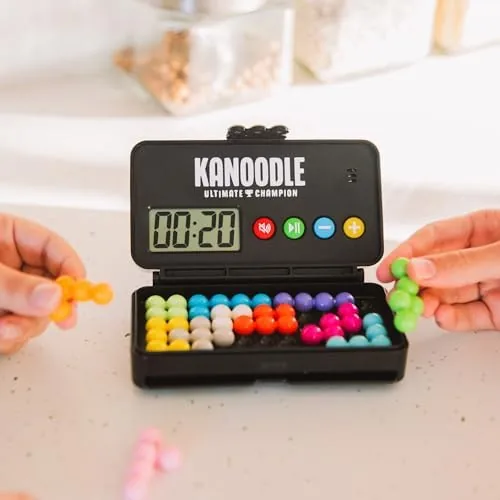
Gravity Maze is a wonderful game, but it needs a flat table and a spread of parts, so it lives in a drawer rather than a backpack. A classic twist puzzle is more portable but demands algorithm memorization, which is a different skill entirely and a real barrier for younger players. The Kanoodle wins for me because it combines the immediacy of a twist puzzle with the spatial depth of a stacking game, and because it works just as well on a train as on a kitchen table. If you want a single player logic game that travels, this is the strongest of the three.
Who Should Buy It
Buy the Kanoodle Ultimate Champion if you want a screen free puzzle that a child can learn in minutes and an adult can still find genuinely hard. It suits families, classrooms, and anyone who likes a mental warm up that fits in a pocket. It is also an excellent travel gift, because it takes up almost no space and requires nothing more than a flat surface and a few spare minutes.
Skip it if you are looking for a party game or a social multiplayer experience, or if you want puzzles that focus on vocabulary or numbers rather than shapes. For everyone else, this is an affordable and genuinely rewarding pick. You can check the current price for the Kanoodle Ultimate Champion on Amazon when you are ready to solve.
How We Test
I tested the Kanoodle Ultimate Champion over two weeks with more than forty challenges spread across the difficulty tiers. I timed each 3D solve with a stopwatch, noted where I had to restart, and deliberately left the game assembled between sessions to check that the pieces stayed secure and the board showed no wear. I also ran sessions with a nine year old and a teenager to confirm the age range on the box holds up in real use, and I dropped the sealed board onto a hard floor twice to make sure the lid stayed shut.
For broader perspective on why logic and reasoning games matter, independent editorial coverage such as Wirecutter's guide to the best board games puts the value of this kind of play into context. The Kanoodle Ultimate Champion listing on Amazon shows the current price and available editions.
Kanoodle Ultimate Champion: Questions People Ask
How many puzzles does the Kanoodle Ultimate Champion include?
The challenge book offers a large set of puzzles organized into difficulty tiers, covering both 2D flat layouts and 3D pyramid builds, with the hardest challenges designed to stretch experienced players.
What age range is the Kanoodle Ultimate Champion suitable for?
The game suits children roughly six years old and up, but adults find the later 3D challenges genuinely demanding, so it works as a family game rather than a children only toy.
Is the Kanoodle Ultimate Champion good for travel?
Yes. The board, the twelve pieces, and the challenge book all fit together under a snap shut lid, so the entire game travels as a compact unit that fits in a bag.
Does the game need batteries or a screen?
No. It is a completely mechanical puzzle game with no power source and no display, which is one of its main advantages for screen free play.
As an Amazon Associate, I earn from qualifying purchases.