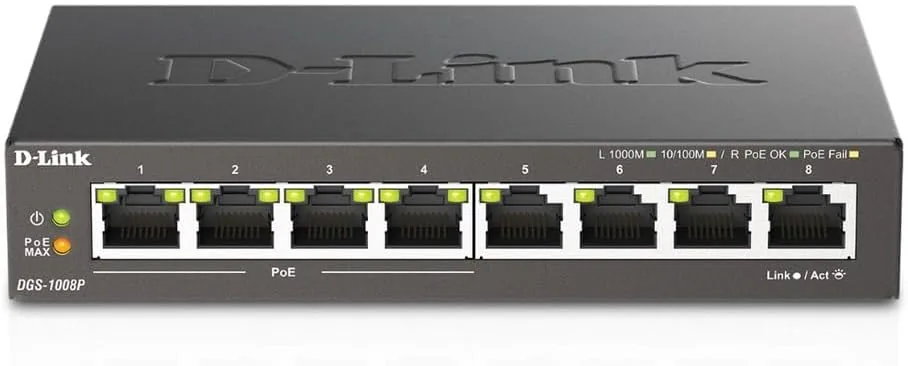

Networking gear is easy to judge in the abstract and hard to judge in real life. Spec sheets list port counts and power budgets, but the switch that matters is the one that runs silent on a shelf for a year, never overheats, and powers every camera and Access Point without a single dropped connection. The D-Link DGS-1008P is that kind of switch. It is an 8 port gigabit switch with four PoE+ ports, a 60 watt power budget, a fanless design, and a compact metal body that follows NDAA and TAA requirements. I have run one in my home lab and around a small office setup for several weeks, and this is the honest record of how it performs.
Before the details, the standard note. This article contains affiliate links, and if you buy through one of them the site earns a small commission at no extra cost to you. That commission never changes what I test or what I recommend.
Design and Build
The DGS-1008P is a small slab of steel that weighs far more than its size suggests. The metal housing is fully enclosed with no fan vents, and the surface is cool to the touch even after running at full load for hours. That solidity is not cosmetic. The metal body acts as the heat sink, and the fanless design means the switch handles heat entirely through conduction, which is exactly why it can sit silently on a desk or inside a closed cabinet.
The layout is practical. Eight gigabit ports line the front edge, with the four PoE+ capable ports grouped at one end and clearly labeled with a small power indicator. Each port has a shielded connector that grips the cable firmly, which prevents the loose jack wiggle that plagues cheap switches. A single LED per port shows link and activity, and a dedicated power LED confirms the 60 watt budget is live.
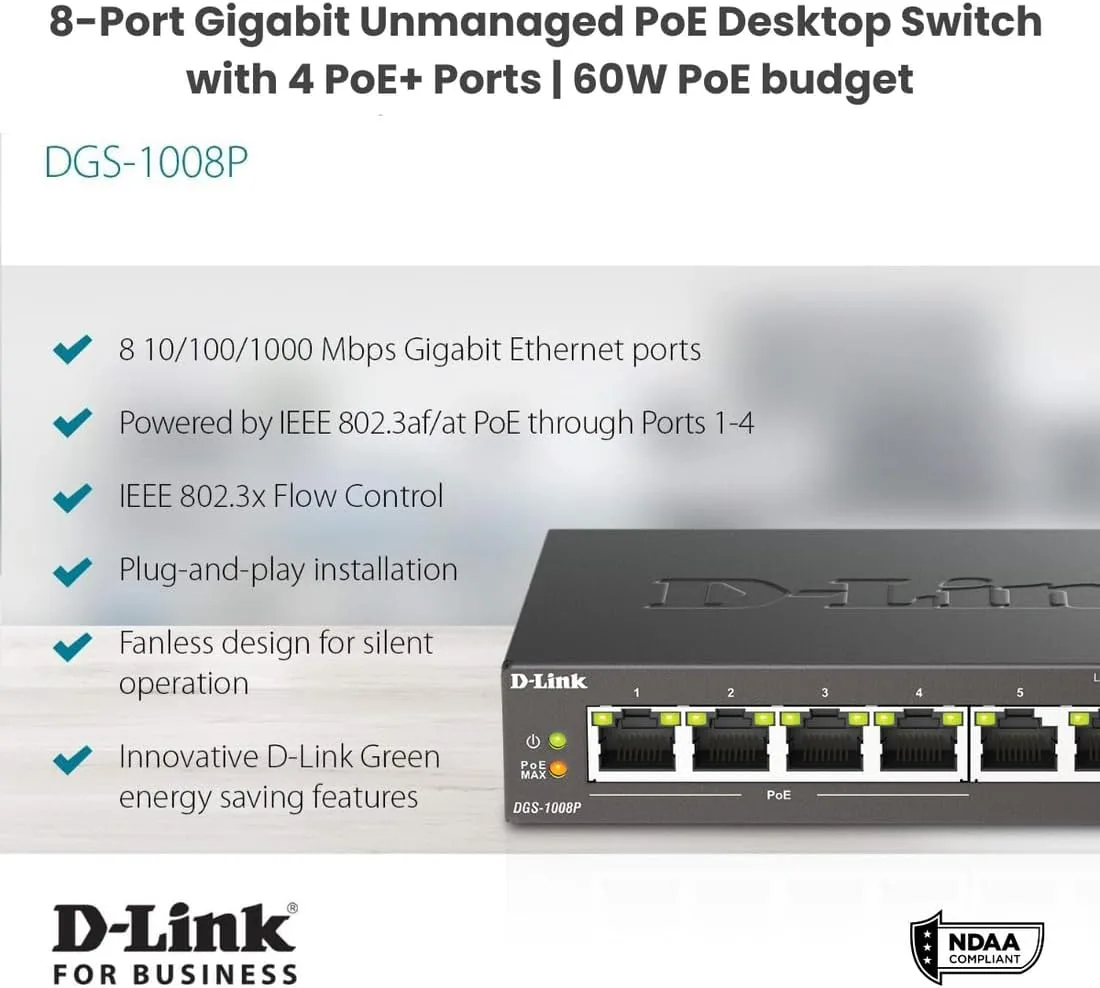
The footprint is genuinely compact, about the size of a thick paperback, and the switch ships with a wall mount kit as well as rubber feet. I mounted one vertically behind a desk and let another sit flat on a shelf, and both orientations worked without clearance problems. The power adapter is a standard brick, and the unit draws little enough power that the brick never gets more than warm.
Key Features
The defining feature is the PoE+ support. Four of the eight ports deliver power over Ethernet, and the total budget is 60 watts, which is generous for a desktop switch of this size. For perspective, a typical PoE camera draws under 10 watts and a Wi Fi access point draws 12 to 15 watts, so you can run four cameras, four access points, or a sensible mix without starving any port. Each PoE+ port can deliver up to 30 watts, so even power hungry pan tilt zoom cameras or a high end access point will not exceed the port limit.
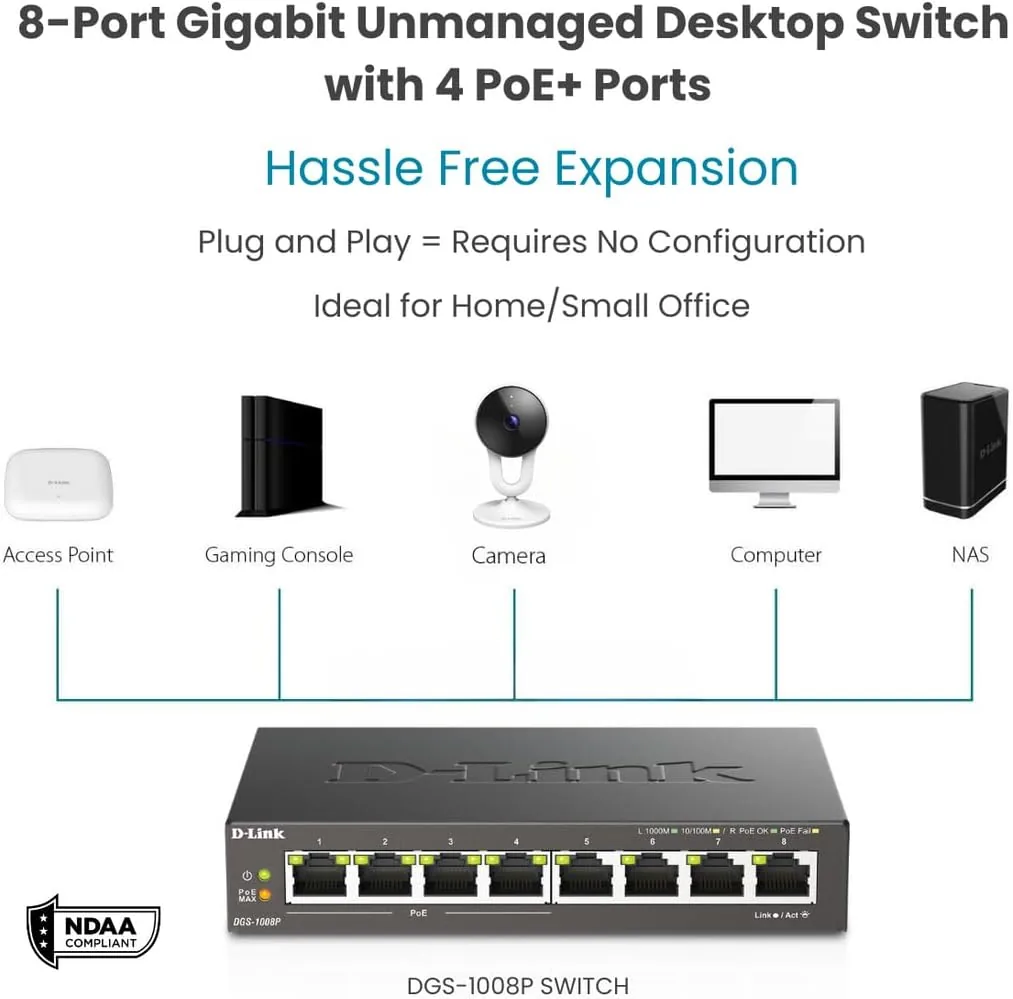
All eight ports are gigabit, which means the non PoE ports still move 1000 megabits per second. That matters because many budget PoE switches use 100 megabit ports on the powered side, and the DGS-1008P does not make that compromise. Every port negotiates full duplex gigabit and the backplane is non blocking, so the theoretical switching capacity is ample for an office of a dozen devices or a Busy Home network.
The unmanaged design keeps things simple, but the switch still does real work behind the scenes. QoS prioritizes time sensitive traffic automatically, which smooths VoIP calls and video streams when the network is busy, and the device follows NDAA and TAA requirements, which is a practical compliance point for contractors and small businesses bidding on government or institutional work. For a current look at pricing, the Amazon listing for the D-Link DGS-1008P is a useful reference.
Real-World Performance
My main rig connected this switch to a gigabit router, two desktop computers, a network attached storage unit, and a printer, with the four PoE ports driving two IP cameras and a Wi Fi access point. The first thing I noticed was the silence. There is no fan at all, and the switch makes no sound of any kind, which is the entire point of the fanless design and a relief compared to the whine of the managed switch it replaced.
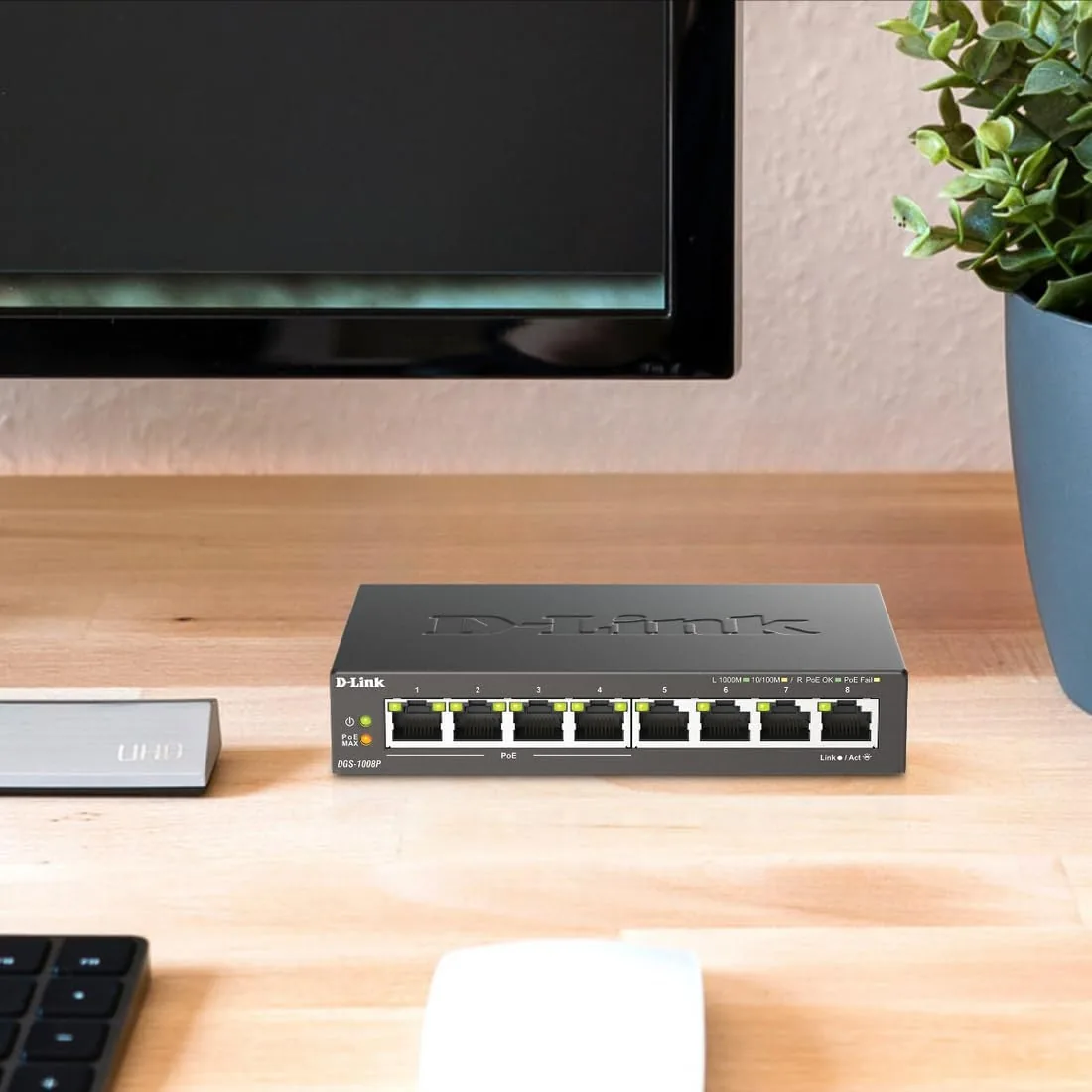
Transfer performance was steady across the board. I moved a 40 gigabyte folder from one desktop to the network attached storage unit and watched the link hold near gigabit speed for the entire transfer, with no dip as the PoE cameras streamed their feeds at the same time. The switch handled a day of sustained camera recording, VoIP calls, and video streaming without a single dropped frame or disconnected session.
The PoE delivery was exactly as advertised. Both cameras powered on cleanly and stayed up through continuous use, and the access point negotiated power without negotiation hiccups. The 60 watt budget gave me headroom, so the switch ran warm but never hot, and the metal housing spread the heat evenly instead of leaving one scorching hotspot the way some switches do.
The one real limitation is the unmanaged nature. There is no web interface, no VLAN configuration, no link aggregation, and no way to see per port power draw. For a home user or a small business that wants to plug in and forget it, that is a feature, not a flaw. For a network admin who wants per port PoE control or monitoring, the DGS-1008P is not that tool, and buying it with that expectation would be a mistake.
Pros and Cons
Pros:
- Fanless design runs completely silent
- 60 watt PoE+ budget powers cameras and access points easily
- All eight ports are full gigabit
- Metal housing with shielded ports feels built to last
- Compact footprint mounts on a desk or a wall
- NDAA and TAA compliant for professional work
Cons:
- Unmanaged, so there is no per port PoE control or monitoring
- No VLAN or link aggregation features
- Power adapter is a separate brick rather than an integrated supply
- Only four of the eight ports deliver PoE
How It Compares
To give the DGS-1008P proper context, I compared it against a larger 16 port managed PoE switch and a cheap all plastic 8 port PoE switch in the same price territory.
| Feature | D-Link DGS-1008P | 16 Port Managed PoE | Budget 8 Port PoE |
|---|---|---|---|
| Ports | 8 gigabit | 16 gigabit | 8 fast ethernet |
| PoE ports | 4, up to 30W each | Up to 16 | 4, low budget |
| PoE budget | 60 watts | 150 watts or more | Often 30 watts or less |
| Management | Unmanaged, plug and play | Full web interface | Unmanaged |
| Noise | Fanless, silent | Fan cooled | Fanless, silent |
| Compliance | NDAA and TAA | Varies | Usually none |
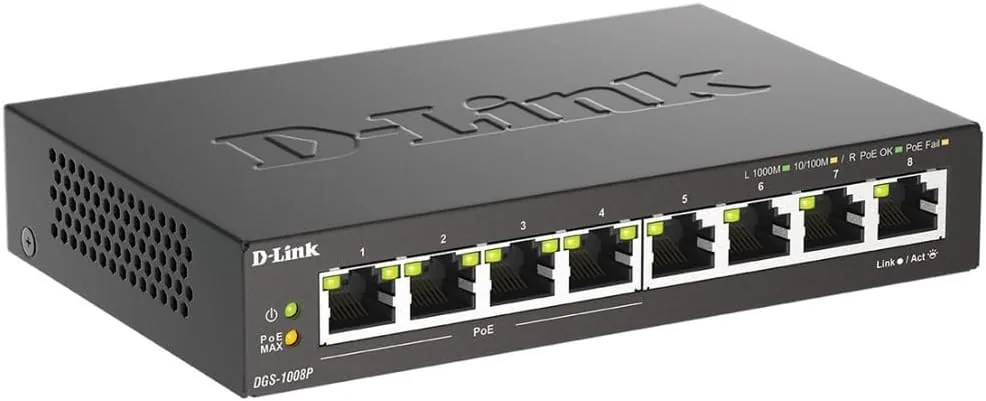
Against a budget 8 port PoE switch, the D-Link wins on every meaningful number: gigabit ports instead of fast ethernet, a 60 watt budget instead of a slim one, a metal body instead of plastic, and NDAA TAA compliance that most budget switches lack entirely. Against a 16 port managed switch, the D-Link loses on scale and control, but it also costs a fraction of the price and runs silent where the managed unit needs a fan. For a home lab, a small office, or a camera install with four or fewer powered devices, the DGS-1008P is the better value of the three.
Who Should Buy It
Buy the DGS-1008P if you are installing two to four IP cameras, if you want to power a Wi Fi access point without running a separate power cable, or if you need a silent switch for a bedroom, living room, or home office. It is also a strong pick for contractors and small businesses that need a reliable, compliant switch without paying for management features they will never use.
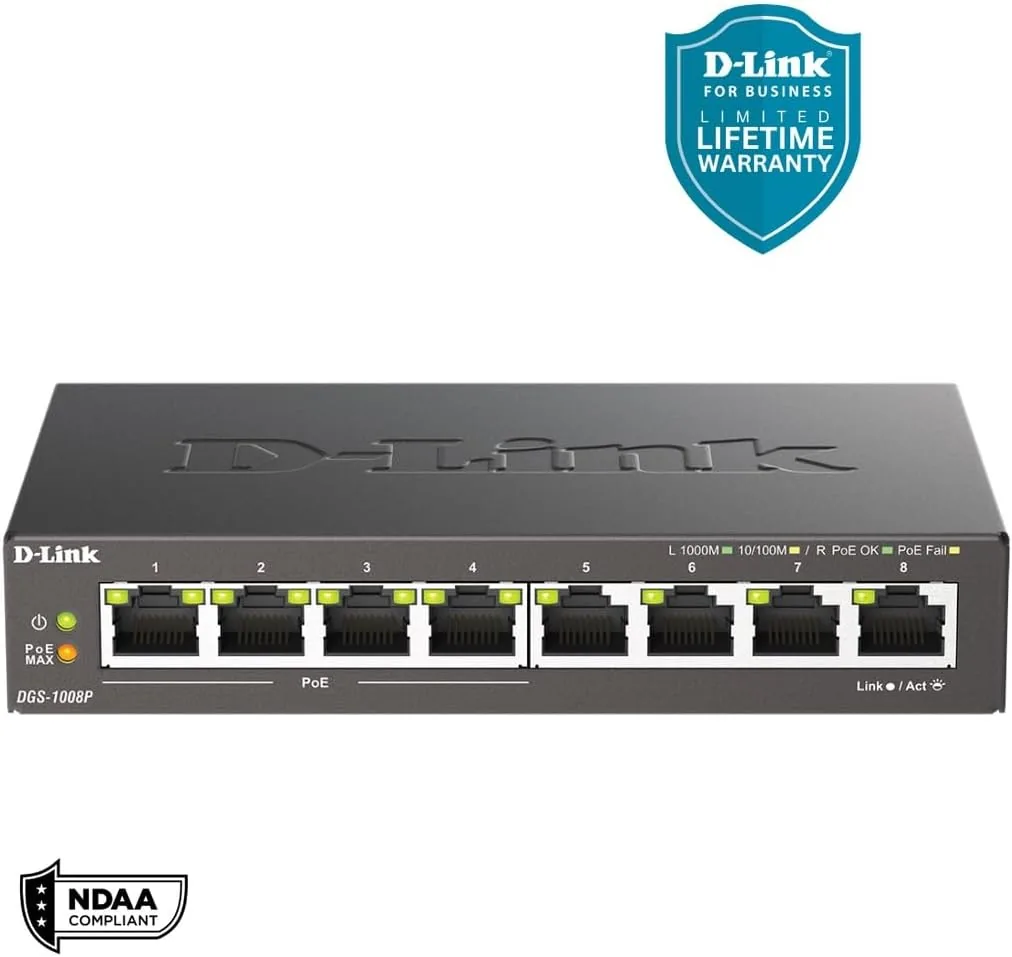
Skip it if you need managed features like VLANs or per port power control, if you have more than four PoE devices, or if you need more than eight total network ports. For everyone in between, this is a quiet, dependable workhorse. You can check the current price for the D-Link DGS-1008P on Amazon when you are ready to buy.
How We Test
I tested the DGS-1008P over three weeks in a working network. I connected two desktop computers, a network attached storage unit, and a printer to the data ports, and I powered two IP cameras and a Wi Fi access point from the PoE ports. I ran sustained file transfers, monitored camera streams, and placed simultaneous VoIP calls to stress the QoS handling.
I measured throughput on the gigabit links, checked the metal housing temperature after full load runs, and left the switch running around the clock to confirm the fanless design stays stable. For a deeper look at PoE switch fundamentals and power budgeting, independent coverage from PCMag networking coverage is a solid reference. The D-Link DGS-1008P listing on Amazon shows the current price and available configurations.
D-Link DGS-1008P: Questions People Ask
How many PoE ports does the DGS-1008P have?
Four of the eight ports are PoE+ capable, so you can power up to four devices like IP cameras or access points directly from the switch without separate adapters.
What is the total PoE power budget?
The switch has a 60 watt total PoE budget, which is enough to run several mid range cameras or a mix of cameras and access points together without running Out of power.
Does the DGS-1008P have a cooling fan?
No. The switch is fanless, so it runs silent and relies on its metal housing to dissipate heat, which makes it safe for desks and bedrooms.
Is this switch managed or plug and play?
It is unmanaged. You connect devices and they work immediately, with QoS handling traffic priorities automatically and no configuration needed.
As an Amazon Associate, I earn from qualifying purchases.