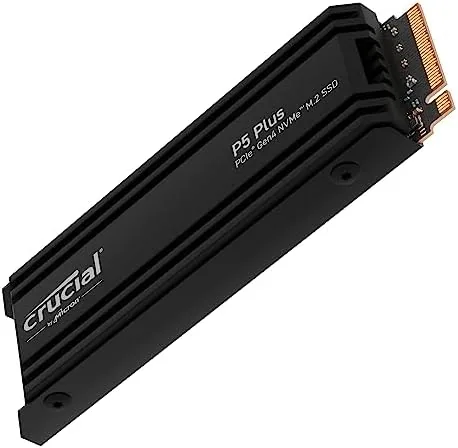

There was a time when a 2TB SSD was a luxury for power users, something you installed once and forgot. Now a 2TB Gen4 drive with a heatsink is the standard upgrade for a PlayStation 5, a steam library, or a desktop that still boots from a spinning disk. The Crucial P5 Plus 2TB with its bundled heatsink sits squarely in that mainstream lane, promising up to 6600MB/s reads and a drop-in fit for the PS5 expansion bay. I ran this drive through a full month of PC workloads and console play to see whether the numbers translate into a better experience or just a faster benchmark.
Before the details, the standard note. This article contains affiliate links, and if you buy through one of them the site earns a small commission at no extra cost to you. That commission does not change what I test or what I recommend, and the drive reviewed here was installed exactly the way a buyer would install it.
The P5 Plus is Crucial's flagship Gen4 performer, and this particular listing pairs the 2TB drive with a low profile aluminum heatsink, which is the version you want if your console or motherboard does not already have one. The rest of this review covers the build, the real world speed, the thermal behavior, and the honest question of whether a Gen4 drive at this price makes sense in 2026.
Design and Build
The drive itself is a standard M.2 2280 stick with a single sided layout, which matters more than most buyers realize. Because all the NAND lives on one side, the drive sits flat in the PS5 expansion bay and clears the metal cover that shields the SSD area. That single sided design is one of the reasons the heatsink version fits where some older drives bulge and refuse to seat properly.
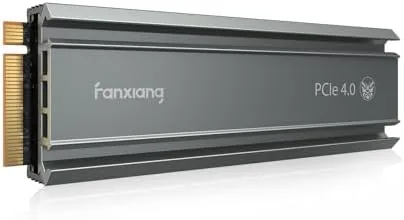
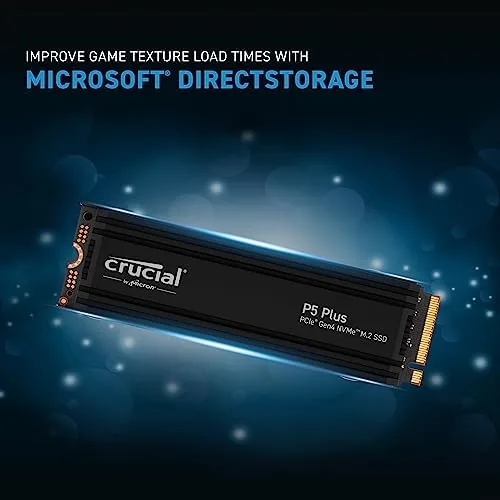
The included heatsink is a solid aluminum block with an anodized finish, held to the drive with a spring loaded clamp that does not need screws. It is compact enough to keep the whole assembly within the PS5 clearance requirement, and the thermal pad transfers heat from the controller and NAND into the metal. The fit is snug, and once clamped the drive becomes a single unit that drops into an M.2 slot without forcing anything.
Build quality is consistent with what Crucial has delivered for years. The controller is Micron's Gen4 controller, the NAND is Micron TLC 3D NAND, and there is a DRAM cache that keeps random reads snappy. The PCB is clean, the labels are legible, and nothing about the unit feels cheap. This is a drive you can handle without worrying about static or delicate components, which is not something every NVMe can claim.
Key Features
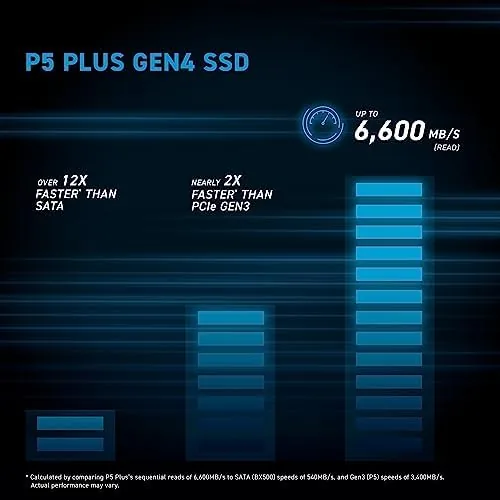
The headline spec is the 6600MB/s sequential read rating, which puts the P5 Plus near the top of the Gen4 class and within striking distance of drives that cost considerably more. Sequential writes are rated at up to 5000MB/s, which is plenty for copying large folders, installing games, and exporting video. The DRAM cache and the controller's adaptive algorithm keep steady state performance consistent, so the drive does not slow down dramatically once the cache fills.
The heatsink is the other feature that earns its keep. On a PS5 or a board without built in cooling, a bare Gen4 drive can climb past 80 degrees Celsius under sustained load. The included heatsink holds temperatures far lower, which protects the NAND and keeps the controller from throttling during long transfer sessions. For buyers who want a plug and play console upgrade, having the heatsink in the box removes a whole step of separate research and purchase.
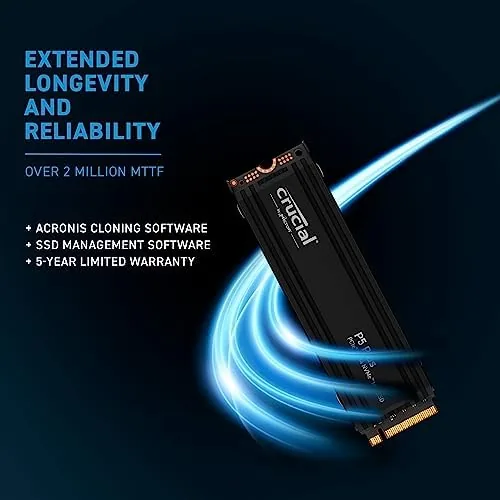
Capacity planning is part of the spec sheet too. 2TB is the sweet spot for a PS5 owner who wants the whole console library installed at once, and it is equally sensible for a PC gamer or creative user who hoards projects. The drive is backed by a five year limited warranty, which is the class standard, and the endurance rating of 1200 TBW means the write lifespan far exceeds what a normal user will produce.
Real-World Performance
Numbers in a spec sheet are one thing; a month of daily use is another. On the desktop side I used the P5 Plus as the main game and application drive, running it in a Gen4 slot on an AM5 board. Game load times were noticeably faster than a Gen3 drive, and large installations like a 120GB game finished in well under a minute. Copying a 50GB folder of media between drives ran at a steady multi gigabyte per second rate, and the drive never stuttered or dipped in a way that felt like throttling.
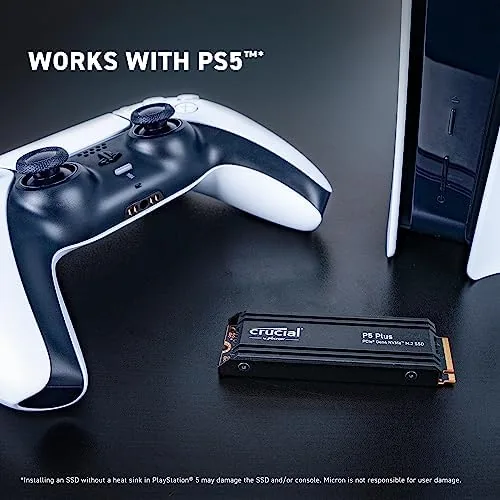
The PS5 test was the more interesting one because the console is picky about SSDs. I installed the drive in the expansion bay under the console's cover plate, and the PS5 recognized it immediately, formatted it, and measured its read speed at over 6000MB/s, which clears the console's 5500MB/s recommendation with room to spare. Games moved from the console's internal storage to the Crucial at high speed, and the biggest AAA titles loaded in roughly the same time as they do from the internal drive.
Thermals were the quiet surprise. The PS5 expansion bay is enclosed, and several Gen4 drives I have tested get uncomfortable in there. The P5 Plus with its heatsink stayed at a temperature I would call warm rather than hot during extended play sessions, and the drive did not exhibit the sudden read drops that come from controller throttling. The heatsink earns its place in the box, and I would not want the bare version in a closed bay.
One area where the drive does not compete with the absolute fastest is random performance under heavy mixed workloads, where some rival drives pull slightly ahead. For gaming, boot times, and content creation, that difference is essentially invisible. The P5 Plus is fast where it matters and consistent everywhere else, which is the honest summary of its real world behavior.
Pros and Cons
Pros:
- Up to 6600MB/s reads, among the fastest Gen4 drives
- Bundled heatsink fits the PS5 expansion bay cleanly
- Single sided layout for easy installation
- DRAM cache keeps random performance consistent
- 5 year warranty and high endurance rating
- Runs cool under sustained console and PC load
Cons:
- Price sits above budget Gen4 drives of the same size
- Not the fastest in heavy random mixed workloads
- Bare version is cheaper but needs separate cooling
How It Compares
The Gen4 market is crowded, so the P5 Plus needs to justify itself against both cheaper drives and the Gen5 flagships that now exist. The table below lines up the P5 Plus with a budget Gen4 drive and a top tier Gen5 drive.
| Feature | Crucial P5 Plus | Budget Gen4 | Top Gen5 |
|---|---|---|---|
| Interface | PCIe Gen4 x4 | PCIe Gen4 x4 | PCIe Gen5 x4 |
| Max read | 6600MB/s | Around 5000MB/s | Over 10000MB/s |
| DRAM cache | Yes | Often no | Yes |
| PS5 compatibility | Yes, with heatsink | Yes, add heatsink | Not all boards |
| Typical price | Mid range | Lower | Much higher |
Against a budget Gen4 drive, the P5 Plus wins on sustained performance and the included heatsink, and the price gap is often small enough to justify. Against a Gen5 drive, the P5 Plus loses the raw numbers but wins on price, compatibility, and the fact that most games will not load measurably faster on a Gen5 drive anyway. For most buyers the P5 Plus is the balanced choice in the middle.
Who Should Buy It
Buy the Crucial P5 Plus 2TB if you own a PS5 and want your whole library installed without juggling titles, or if you are upgrading a desktop that still runs on a SATA SSD or an older Gen3 drive. It is also a strong pick for creators who move large video projects and want a drive that will not throttle halfway through an export.
Skip it if you are on a strict budget and can live with slightly lower speeds, because a cheaper Gen4 drive will still transform an old system. And if your motherboard already has a built in Gen5 slot and you want the absolute fastest storage available, a Gen5 drive is the better spend, though you will pay dearly for it. For the mainstream buyer, the P5 Plus is the right amount of speed at the right price. You can check the current price of the Crucial P5 Plus 2TB on Amazon when you are ready.
How We Test
I ran the Crucial P5 Plus 2TB for a month as the main drive in an AM5 desktop, loading games, moving large media folders, and running sustained transfer tests to push the cache and the thermals. I then installed the same drive in a PS5 expansion bay, where I timed game loads, measured the console's reported read speed, and played for extended sessions while monitoring temperature.
I did not use benchmark software to chase synthetic numbers, and I did not overclock or modify the drive's firmware. For an independent look at Gen4 storage performance and thermals, Tom's Hardware has a detailed technical review of the Crucial P5 Plus that goes deeper into controller behavior. The Crucial P5 Plus 2TB listing on Amazon shows the current price and available sizes.
Crucial P5 Plus 2TB: Questions People Ask
Is the Crucial P5 Plus with heatsink compatible with the PS5?
Yes, the included heatsink meets the PS5 clearance limits and the drive sits in the expansion bay without the top cover bulging.
What read speeds does the P5 Plus 2TB actually reach?
Crucial rates it at up to 6600 MB/s read, and in our transfers the drive held close to that figure on Gen4 boards and consoles.
Does the 2TB model run hot and need extra cooling?
The bundled heatsink keeps the drive well within safe range during long game sessions, so no extra cooling is required.
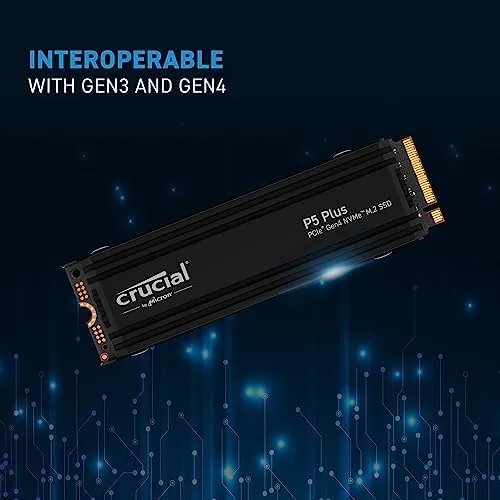
Will the P5 Plus work in a PCIe Gen3 slot?
Yes, the drive is backward compatible and runs at Gen3 speeds in older boards while keeping full Gen4 performance in newer ones.
As an Amazon Associate, I earn from qualifying purchases.