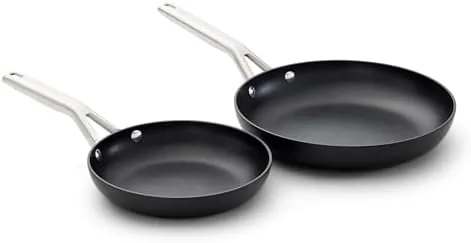

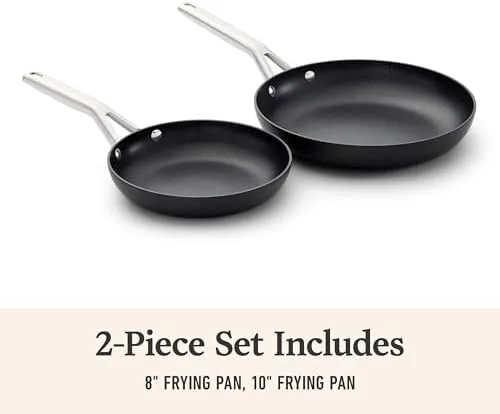
A nonstick pan reveals its character within the first few breakfasts. The coating either holds up to a daily rotation of eggs, fish, and pancakes, or it starts showing scratches and stickiness within a month. The Calphalon hard-anodized nonstick set, which pairs an 8 inch and a 10 inch skillet, is built around the idea that a durable coating and even heat can survive ordinary kitchen abuse. Both pans share a hard-anodized aluminum body and a PFOA free nonstick surface, and I ran them through three weeks of real cooking to see whether the promises hold up on a busy stovetop.
Before the details, the standard disclosure. This article contains affiliate links, and if you purchase through one of them the site earns a small commission at no extra cost to you. That commission does not influence what I test or what I recommend.
Design and Build
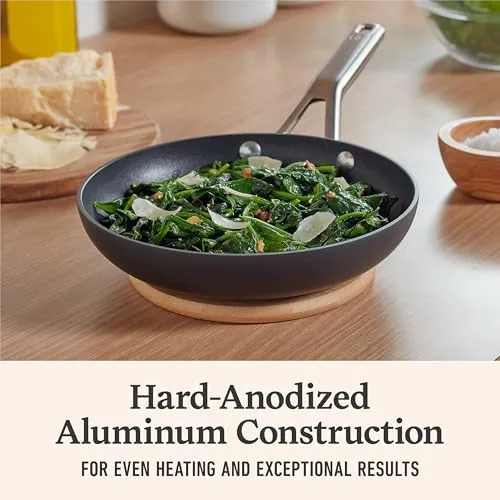
Both pans share the same construction philosophy. The body is a hard-anodized aluminum shell, a process that hardens the aluminum surface so it resists scratches, warping, and the pitting that plagues soft metal cookware. The result is a pan with a dark, matte exterior and a smooth nonstick interior that feels dense and well balanced in the hand. The 8 inch pan suits single servings and modest sides, while the 10 inch version gives real room for two omelets or a full portion of fish.
The handles are riveted and stay relatively cool during normal cooking, though they warm noticeably over long sessions. The exterior finish is attractive and looks good hanging or stacked, and the pans nest with enough care to avoid scraping the interior coating. The overall weight is substantial without being unmanageable, which gives the pans a reassuring sense of quality compared with featherweight budget skillets.
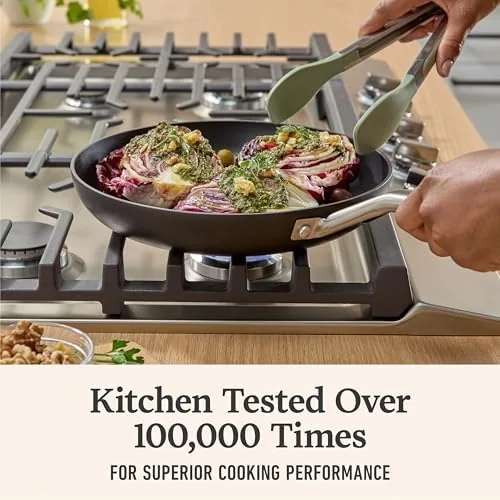
I noticed no hot spots on either pan during testing, which reflects the thermal characteristics of anodized aluminum. The pans heat quickly and hold that heat during cooking, a trait that makes them forgiving for home cooks who do not want to monitor the flame constantly.
Key Features
The central feature is the nonstick coating itself. It is PFOA free, which means it avoids the older perfluorinated compounds that raised health concerns, and it delivers the easy release that makes everyday cooking pleasant. Eggs slide off without sticking, fish fillets turn without tearing, and cleanup becomes a quick wipe with a sponge rather than a scrubbing session.
The hard-anodized body is the second defining feature. Anodizing creates a surface harder than stainless steel, which protects the pans from the everyday scrapes and scuffs that ruin ordinary nonstick cookware. The body also distributes heat evenly across the cooking surface, which prevents the brown spotting and uneven cooking you get from thin budget pans. Both features work together: the durable base protects the slick coating, and the coating makes the durable base easy to live with.
The set is sized for daily use. The 8 inch pan handles a quick egg, a single burger, or a small portion of vegetables, while the 10 inch pan covers pancakes, crepes, and full entree portions. For a current look at the price and available sizes, the Amazon listing for the Calphalon nonstick frying pan set is a useful reference.
Real-World Performance
I started with the classic nonstick test: a runny egg in a lightly buttered pan over medium heat. Both pans released the egg cleanly with no sticking and no tearing of the yolk, and the finished egg slid onto the plate without needing a spatula. This is the experience that justifies choosing nonstick cookware, and the Calphalon pans delivered it consistently across the testing period.
Next I cooked flaky white fish fillets, which normally cling to mediocre nonstick surfaces. The fillets released cleanly with a gentle nudge, and the coating showed no discoloration after a month of repeated use. I also tested pancakes, which browned evenly without the pale centers that indicate uneven heat, and the pans required far less butter than a standard stainless skillet.
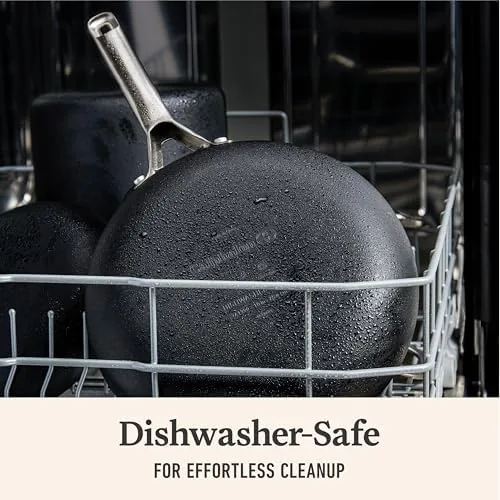
Cleanup was consistently easy. A warm pan and a soft sponge cleared most residues in seconds, and even stubborn cheese or caramelized sugar lifted with light effort. The pans are labeled dishwasher safe, and although they survived a dishwasher cycle without visible damage, hand washing kept the coating noticeably slicker, so I recommend the gentler approach for anyone who wants years of service.
The one real limitation appeared with induction cooktops. Hard-anodized aluminum does not have a magnetic base, so the pans do not work on induction burners. On gas and electric stovetops they perform beautifully, but induction households need to look elsewhere or add an induction interface plate.
Pros and Cons
Pros:
- PFOA free nonstick coating releases eggs and fish cleanly
- Hard-anodized aluminum body resists scratches and warping
- Even heat distribution prevents hot spots and uneven browning
- Two practical sizes cover single servings and full meals
- Fast cleanup with a soft sponge
- Substantial, balanced build quality
Cons:
- Not compatible with induction cooktops
- Coating needs gentle care and non-metal utensils
- Handles warm up during long cooking sessions
- Dishwasher use can dull the coating over time
How It Compares
Everyday frying pans split into three broad camps: standard stainless steel, cast iron, and nonstick. I compared the Calphalon set against a stainless skillet and a seasoned cast iron pan to map out the trade offs.
| Feature | Calphalon Nonstick Set | Stainless Steel Pan | Cast Iron Pan |
|---|---|---|---|
| Food release | Excellent, no oil needed | Poor, needs oil or butter | Good when seasoned |
| Even heating | Excellent | Good | Moderate, hot spots |
| Maintenance | Gentle hand wash | Easy, heavy duty | Seasoning required |
| Induction ready | No | Usually yes | Yes |
| Weight | Medium | Medium | Heavy |
| Durability | Coating wears over years | Near permanent | Near permanent |
Against stainless steel, the Calphalon set wins decisively on ease of use. A stainless pan demands preheating, generous oil, and careful technique to avoid sticking, while the nonstick surface delivers the same results with less effort and less fat. Stainless still wins for high-heat searing and for cooks who want a pan that outlasts a decade. Against cast iron, the Calphalon pans win on weight, immediate nonstick performance, and easy cleanup, while cast iron wins for durability and induction compatibility. For most home cooks who cook eggs and fish several times a week, the nonstick set is the most practical everyday choice.
Who Should Buy It
Buy the Calphalon set if you cook eggs, pancakes, fish, or delicate vegetables regularly and want food to release cleanly without a puddle of oil. It is also a strong fit for newer cooks who want forgiving cookware, and for anyone replacing cheap nonstick pans that lost their coating within months.
Skip it if your kitchen runs on induction, if you prefer the durability and searing power of stainless or cast iron, or if you routinely use metal spatulas and dishwasher cycles on your pans. For everyone else, this is a reliable, well built set that handles the daily cooking grind. You can check the current price for the Calphalon frying pan set on Amazon when you are ready to buy.
How We Test
I tested both pans over three weeks with a rotating menu of eggs, omelets, pancakes, flaky white fish, chicken breasts, and caramelized vegetables. I monitored sticking behavior, checked for even browning, and deliberately cooked sticky ingredients like cheese and sugar to stress the coating. I also ran the pans through a dishwasher cycle to confirm the cleaning promise and compared the results with hand washed sessions.
I used the pans on a gas burner and a flat electric coil, and I did not test them on induction because the product is not designed for it. To understand how nonstick coatings compare across brands, independent reviews such as CNET's guide to the best nonstick skillets provide useful background on what separates quality coatings from budget ones. The Calphalon pan set listing on Amazon shows the current price and available sizes.
Calphalon Hard-Anodized Nonstick Frying Pan Set: Questions People Ask
Is the Calphalon hard-anodized nonstick coating safe for food?
Yes. The coating is PFOA free, so it does not use the older chemical compounds linked to health concerns, and it stays stable at the normal cooking temperatures used for frying and sauteing.
Can these pans go in the dishwasher?
The pans are labeled dishwasher safe, but hand washing with a soft sponge preserves the nonstick surface and keeps the finish looking newer for longer. A dishwasher cycle works in a pinch without visible damage.
Are the Calphalon 8 and 10 inch pans compatible with induction cooktops?
No. Hard-anodized aluminum does not have a magnetic base, so these pans work on gas, electric, and glass stovetops but not on induction burners without a separate interface plate.
Do these pans work with metal utensils?
Calphalon recommends non-metal utensils such as silicone, wood, or nylon. Scraping with metal can scratch and degrade the nonstick coating over time, so a silicone spatula is the safer daily choice.
As an Amazon Associate, I earn from qualifying purchases.