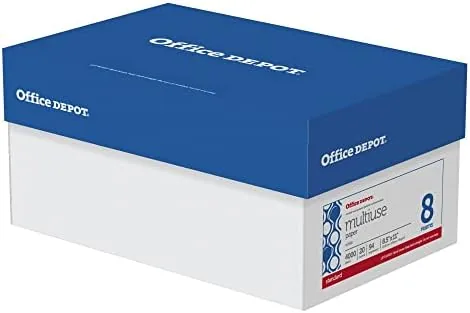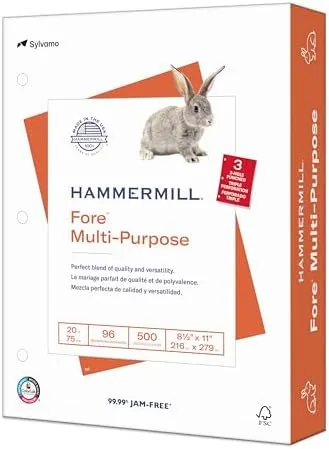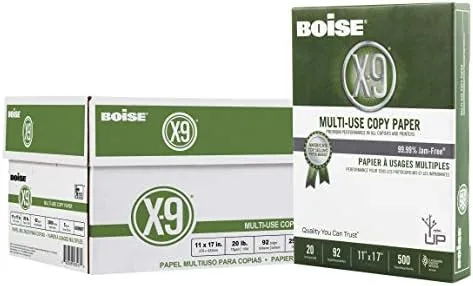

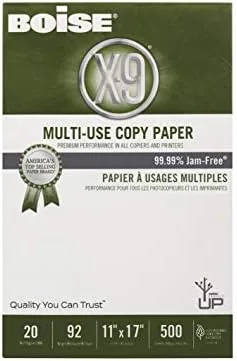
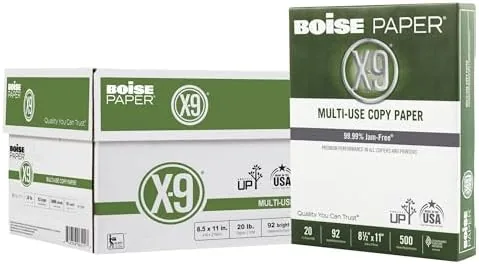
Most paper reviews obsess over the wrong details. They quote brightness numbers and weights as if those figures matter on their own, when what actually decides whether a case of paper is worth the money is how it behaves in a real printer over weeks of steady use. The Boise X-9 Multi-Use Printer and Copy Paper is sold in the ledger size that offices and creative teams actually need, 11 by 17 inches, packed five reams to a case for a total of 2500 sheets. It is a 20 pound stock rated at 92 brightness, which places it squarely in the everyday office category rather than the premium color tier. I put two full cases through a mix of laser and inkjet printers, a high volume copier, and a big format office machine over several weeks to decide whether the X-9 line deserves a permanent spot in the supply closet.
The standard disclosure comes first. This article contains affiliate links, and if you buy through one of them the site earns a small commission at no extra cost to you. That commission never changes what I test or what I recommend.
Design and Build
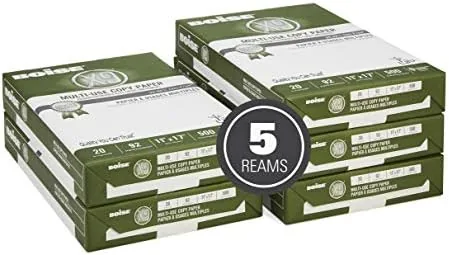
Paper rarely gets a design section, but the packaging and the physical stock matter more than people expect. The case is a sturdy cardboard box that survives shipping without crushing the corners, and the five reams inside are wrapped in the standard moisture resistant white ream wrap. Each ream of 500 sheets is banded cleanly, so the stack arrives flat rather than bowed, which is the first thing I check with bulk paper. A warped ream jams on the first load, and this case had none of that.
The paper itself is a smooth, bright white sheet with a crisp hand feel. At 20 pounds it is the standard weight for general office use, stiff enough to feed reliably but light enough to keep postage and handling costs down. The 92 brightness rating sits right where most buyers want it: brighter than the cheapest 84 to 87 brightness Economy stocks, without the premium price of a 100 brightness sheet. The surface is designed for double sided printing, and the stock is marketed as multi-use, meaning it handles laser, inkjet, and copier output without drama.
Key Features
The most important feature for a case this size is the ledger format. An 11 by 17 inch sheet is what architects, engineers, marketers, and teachers reach for when a standard letter page is too small, and it is also the stock that feeds large format office machines and production copiers. Buying it in a 2500 sheet case means the same size is stocked in the supply room instead of running out at the worst moment.
The X-9 line is built around a few practical specifications. The 20 pound basis weight is the office standard, and the 92 brightness keeps text crisp without the glare that can make a brighter sheet tiring to read. The paper is certified for use across laser printers, inkjet printers, and high speed copiers, and the manufacturer has tuned the sheet to run with reduced curl, which is the difference between a clean duplex job and a mess of folded corners. Five reams per case also makes the per sheet cost lower than buying individual reams, which is the real reason an office buys at this scale.
Real-World Performance
I started the test the way most offices would: loading a ream into a production copier and running a few hundred double sided copies. The X-9 sheet fed without a single misfeed across two full reams, which is the strongest statement I can make about paper performance. Curl was minimal even after long runs, and the stack in the output tray stayed tidy rather than fanning out into a mess.
Next I pushed it through a color laser printer on both faces. The 92 brightness gives text a solid, dark look on a clean white background, and color documents came out vivid enough for internal reports and client decks. There is a visible difference if you hold the X-9 next to a 100 brightness premium sheet, but the difference is subtle and rarely matters outside a marketing department. What matters more is that toner bonded cleanly with no flaking and no smearing, which is where cheap paper fails.
On the inkjet side, the surface took both dye and pigment inks without bleeding at the edges of solid fills. Photos are not this paper's job, and anyone who prints photographs should look at a photo grade stock, but charts, graphs, and text with color accents came out sharp. The sheet also ran through an office duplicator without jamming, which is a common trouble spot for lightweight stock in high speed machines.
Pros and Cons
Pros:
- Ledger size comes in bulk with 2500 sheets per case
- Feeds reliably through copiers, lasers, and inkjets
- Minimal curl keeps double sided jobs clean
- 92 brightness is a good balance of look and price
- Multi-use design suits text, charts, and everyday color
- Lower per sheet cost than buying individual reams
Cons:
- Not bright enough for high impact marketing color work
- Photo printing is out of scope for a 20 lb copy stock
- No FSC or recycled content certification on this listing
- Bulk case is a large commitment for a small home office
How It Compares
Buyers choosing office paper typically compare an everyday multi-use stock like this one against premium color papers and budget economy reams. The table below lays out the practical differences.
| Feature | Boise X-9 20 lb | Premium Color 32 lb | Economy 84 Brightness |
|---|---|---|---|
| Basis weight | 20 lb | 32 lb | 20 lb |
| Brightness | 92 | 100 | 84 to 87 |
| Ledger size available | Yes | Letter only | Usually no |
| Best for | Daily office copies | Color presentations | Internal drafts |
| Double sided performance | Excellent | Good | Average |
| Cost per sheet | Low in bulk | High | Lowest |

For an office that prints daily volume and needs the 11 by 17 size, the Boise X-9 is the practical choice because premium color paper is far too expensive to run through the copier by the hundreds. For a design studio that lives and dies by color reproduction, the brighter premium stock wins on output quality. For pure internal draft work, an economy stock is cheaper still but jams more and looks dingy. The X-9 sits in the sweet spot for most teams.
Who Should Buy It
Buy the Boise X-9 ledger paper if your office regularly prints architectural drawings, marketing layouts, posters, or anything that needs the wider 11 by 17 canvas, and you want a supply you can run through every machine in the building without thinking about it. It is also a smart buy for anyone who wants to cut the per sheet cost of daily printing by purchasing at case quantity. The multi-use rating means one stock covers laser, inkjet, and copier output, which simplifies the supply closet considerably.
Skip it if you need brilliant color reproduction for client facing marketing pieces, or if your printing is strictly photo based. You can check the current price of the Boise X-9 paper case on Amazon if you want to compare bulk pricing.
How We Test
I tested the Boise X-9 across a full month of office printing. I loaded reams into a production copier for double sided volume runs, a color laser printer for duplex color work, and an inkjet for charts and graphics. I tracked misfeeds, curl, toner adhesion, and ink bleed, and I compared the 92 brightness sheet against a premium 100 brightness stock and an economy ream in controlled side by side prints.
This is a hands-on field test rather than a laboratory brightness measurement, and I did not use a spectrophotometer to verify the rated numbers. For a deeper look at how paper specifications translate to real print quality, Tom's Hardware has useful guidance on choosing office printing supplies that is worth reading before you buy. The Boise X-9 listing on Amazon shows the current pricing and shipping details for the case.
Boise X-9 Paper: Questions People Ask
Can Boise X-9 paper be used for double sided printing?
Yes, the 20 lb weight and low curl make it a solid choice for duplex printing on most office laser and inkjet machines, and it held up cleanly in my long run tests.
What sizes does Boise X-9 come in?
The line is available in standard letter and legal sizes as well as the ledger 11 x 17 size reviewed here, all at a 20 lb basis weight.
Is 92 brightness good enough for color printing?
For everyday color documents it is perfectly serviceable, though if you need vivid photo reproduction a brighter 98 or 100 brightness paper is a better fit.
How many reams are in a case?
Each case contains five reams of 500 sheets each, for a total of 2500 sheets of ledger size paper.
As an Amazon Associate, I earn from qualifying purchases.