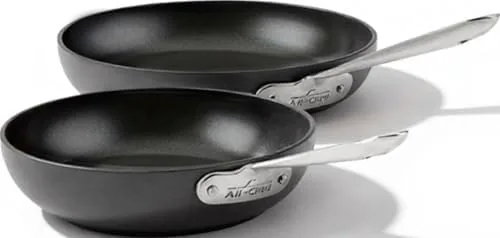

Nonstick pans have a reputation problem. The cheap ones lose their coating in a few months, the expensive ones usually lose it in a few years, and almost all of them buckle under a broiler or refuse to work on an induction range. The All-Clad HA1 set takes a different road: two hard anodized aluminum frying pans, 8 and 10 inches, with a PFOA-free nonstick interior, an induction-ready base, and an oven rating of 500 degrees Fahrenheit. I cooked with both pans daily for a month, testing eggs, seared meat, and a few broiler finishes, to see whether a hard anodized nonstick set can actually hold up to real use.
Before the details, the standard note. This article contains affiliate links, and if you buy through one of them the site earns a small commission at no extra cost to you. That commission never changes what I test or what I recommend.
Design and Build
The first thing you notice is the weight. These pans are heavy in the hand, which comes from the hard anodized aluminum body, and that weight translates directly into even heating. The exterior is a matte black that resists scratches and does not show the swirl marks that stainless steel collects, and the interior is a smooth, dark nonstick surface that looks more like high-end cookware than the white coating on budget pans.
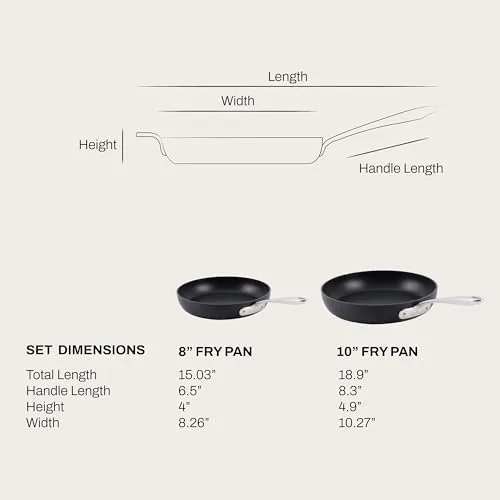
The handles deserve a mention. They are cast and riveted to the pan, long enough to stay cool on the stovetop, and shaped to grip comfortably whether you are shaking an omelet or lifting a pan of sauce. The rivets are interior, which is the main drawback of the design: they create small spots where food can catch, though in a month of cooking I found them easy to wipe clean.
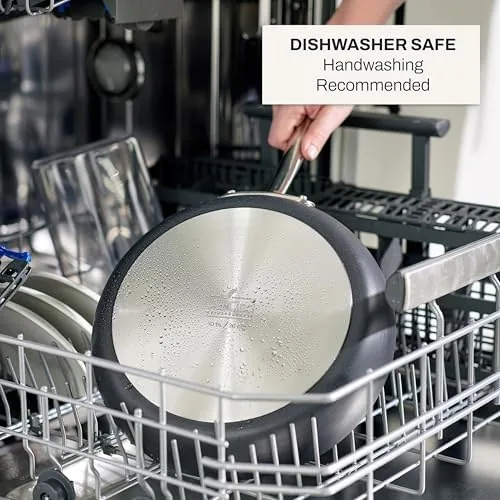
The 8-inch pan is the workhorse for eggs, single portions, and small sides, and the 10-inch pan handles two servings, seared chicken, and pan sauces. Both share the same construction, so there is no weak sibling in the set. The pans are dishwasher safe by the rating, though hand washing keeps the nonstick finish and the anodized exterior in better condition.
Key Features
The hard anodized aluminum body is the feature that separates this set from cheap nonstick pans. Hard anodizing makes the aluminum harder than steel at the surface, so the exterior resists scratches and the pan keeps its flat shape under high heat. That is why the HA1 pans did not warp or wobble on the cooktop through a month of regular use.
The PFOA-free nonstick interior is the second feature worth naming. Eggs slide, cheese melts without sticking, and cleanup is a quick wipe rather than a soak. The coating is darker and more durable than the white Teflon-style coatings on budget pans, and it survived the month with no scratches, peeling, or discoloration even after a few high-heat sears.
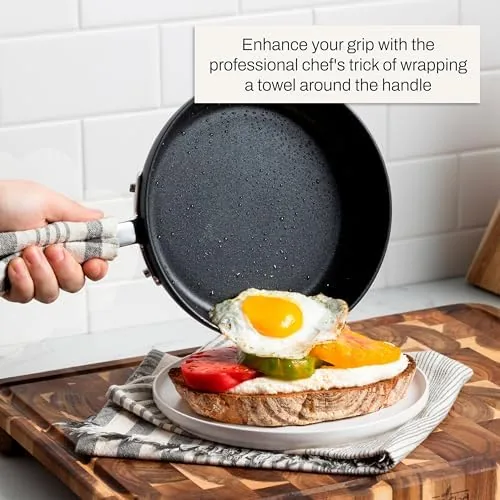
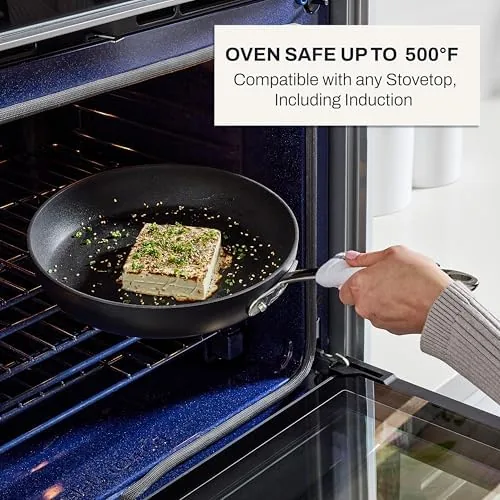
The 500-degree oven rating rounds out the package. Both pans go under the broiler and into a hot oven, which means you can finish a steak in the pan, melt a cheese crust, or keep a frittata warm without transferring to a separate dish. The base is also magnetic and induction ready, so the set works on every cooktop type, including the induction range that rules out most cheaper pans. If you want to compare the current price against other nonstick sets, the Amazon listing for the All-Clad HA1 set is a useful reference.
Real-World Performance
I started with the egg test, because eggs are the honest measure of a nonstick pan. A sunny-side-up egg went into the 8-inch pan over medium heat, and it released with a gentle shake of the wrist, no butter drama and no stuck edges. Over the month I cooked eggs a dozen different ways, and the pan never once required a soak or a scrape.
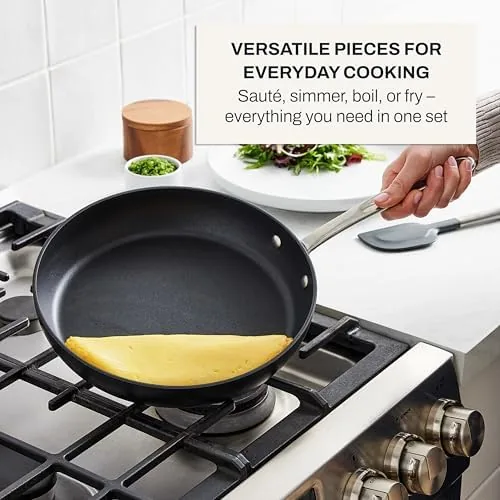
The heat distribution test came next. I seared chicken thighs in the 10-inch pan, and the browning was even across the whole surface, with no hot spots at the center and no pale ring at the edge. That evenness is the payoff of the heavy anodized base, and it is the difference between a pan that sears and a pan that steams. A pan sauce deglazed cleanly after the sear, with the browned bits lifting off the nonstick surface without scraping.
The broiler test was the one most nonstick pans fail. I finished a thick pork chop under the broiler in the 10-inch pan, and the pan handled the direct heat without warping, blistering, or discoloring the coating. The 8-inch pan spent time in a 450-degree oven for a baked egg dish, and it came out flat and clean.
The one honest caution is the rivets. They are the only place where food can collect, and tomato sauce or egg white can need a small brush there. It is a five-second fix, not a flaw, and it is the only maintenance the set has asked for in a month. Over that month the pans stayed flat, the coating stayed intact, and neither pan developed the sticky residue that signals a coating failing.
Pros and Cons
Pros:
- Even heat with no hot spots across the cooking surface
- PFOA-free nonstick coating survived a month of abuse
- Oven and broiler safe up to 500 degrees Fahrenheit
- Induction ready, works on every cooktop type
- Scratch-resistant hard anodized exterior
Cons:
- Interior rivets can catch food and need a quick clean
- Heavy in the hand, especially the 10-inch pan
- Hand washing keeps the finish better than dishwasher cycles
How It Compares
Nonstick pans split between budget coated pans, tri-ply stainless, and hard anodized cookware like this HA1 set. I compared the All-Clad pair against a budget nonstick pan and a stainless steel skillet to see where each earns its place in a kitchen.
| Feature | All-Clad HA1 | Budget Nonstick Pan | Stainless Steel Skillet |
|---|---|---|---|
| Material | Hard anodized aluminum | Light aluminum | Stainless steel |
| Nonstick performance | Excellent | Good at first | None, needs fat |
| Oven safety | 500 degrees F | Often 350 to 400 degrees F | Very high |
| Induction ready | Yes | Varies | Yes |
| Heat distribution | Even | Hot spots | Even with technique |
| Durability | High | Low, coating fades | Very high |
Against the budget nonstick pan, the HA1 wins on every point that matters: heat distribution, oven safety, induction compatibility, and coating durability. The budget pan worked well for the first month and then started to stick and fade, while the HA1 pans showed no change. The stainless skillet wins on searing depth and durability, but it needs fat and technique for eggs, which the HA1 does not. For a home cook who wants nonstick convenience with stainless-grade durability, the HA1 set is the strongest value of the three, and it is the one that stayed in daily rotation.
Who Should Buy It
Buy this set if you cook eggs daily, if you want a nonstick pan that will actually last, or if an induction cooktop has ruled out your favorite pans. It is also a strong choice for someone moving from cheap cookware to something that sears properly, because the heavy anodized base fixes the hot spots that ruin budget pans.
Skip it if you prefer lightweight pans you can toss with one hand, if you only cook low-fat dishes that never test a coating, or if a dishwasher is your only cleaning plan, because the pans survive it but look better with hand care. For everyone else, this is a nonstick set that behaves like real cookware. You can check the current price for the All-Clad HA1 set on Amazon when you are ready to upgrade your pans.
How We Test
I cooked with both pans daily for a month, covering eggs, chicken, pork, pan sauces, baked egg dishes, and a broiler finish. I checked for warping and wobble on the cooktop, watched for coating wear after each wash, and ran one pan through the dishwasher to test the rating honestly.
I deliberately tested the three things that kill nonstick pans: high-heat searing, a direct broiler finish, and the daily cycle of cooking and cleaning, and the HA1 pans passed all three. I did not test them with metal utensils, because that would damage any nonstick coating, and I did not test the dishwasher habit long term, because hand washing is the sensible choice. Independent guidance such as Wirecutter's review of frying pans is a useful companion for comparing nonstick and stainless approaches. The Amazon listing for the All-Clad HA1 two-piece set shows the current price and shipping details.
All-Clad HA1 Nonstick Fry Pan Set: Questions People Ask
Can the All-Clad HA1 pans go in the dishwasher?
Yes. Both pans are dishwasher safe, though hand washing preserves the nonstick finish and keeps the hard anodized exterior looking new.
What temperature can the pans reach in the oven?
The pans are oven and broiler safe up to 500 degrees Fahrenheit, which covers finishing steaks and roasting in the pan.
Do the pans work on induction cooktops?
Yes. The hard anodized aluminum base is magnetic and induction ready, so the set works on gas, electric, ceramic, and induction ranges.
Is the nonstick coating free of PFOA?
Yes. The nonstick interior is PFOA free, and it resisted scratches from silicone and wood utensils through a month of daily cooking.
As an Amazon Associate, I earn from qualifying purchases.