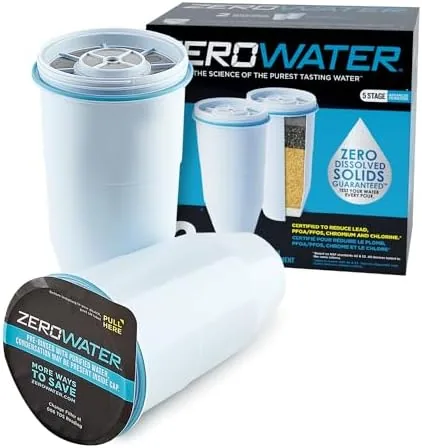

Every Water Filter on the shelf makes the same promise in slightly different words: cleaner water, fewer contaminants, better taste. ZeroWater makes a bolder claim than the rest. The brand names itself after the number its tester can read, a goal of zero total dissolved solids in the finished glass. That is an extreme target, because most filters aim to reduce dissolved solids rather than eliminate them. This review is about the official ZeroWater 5-stage replacement filter, sold as a two pack, and whether the filter behind the brand lives up to the number on the box.
This article contains affiliate links. If you buy through one of them, this site earns a small commission at no extra cost to you. That support never changes what we test or how we judge it.
Design and Build
The ZeroWater filter is a round cartridge that drops into the top of the brand pitcher or dispenser. It is not a slim rectangle like many countertop filters. Instead it is a wide cylinder with a fine mesh cap on top and a foam seal around the base. The design is deliberate, because the filter has to pull water down through five layers at a rate that a home pitcher can actually manage.
The cartridge shell is made of a hard white plastic with a visible inner mesh that catches the eye when you first unpack it. The seal ring fits snugly into the pitcher reservoir, and when it is seated correctly the water does not leak around the sides. That fit matters more than it looks, because a loose cartridge lets unfiltered water slip past the media and quietly undo the whole point of the system.
Each box holds two filters, and each filter is individually shrink wrapped. The shrink wrap keeps the media fresh before you open it, which is a small but real detail for people who buy filters in bulk and store them. The packaging itself is straightforward retail cardboard, and the printed instruction to soak the filter for ten minutes before first use is clearly visible on the front, so you are unlikely to skip the priming step.
Key Features
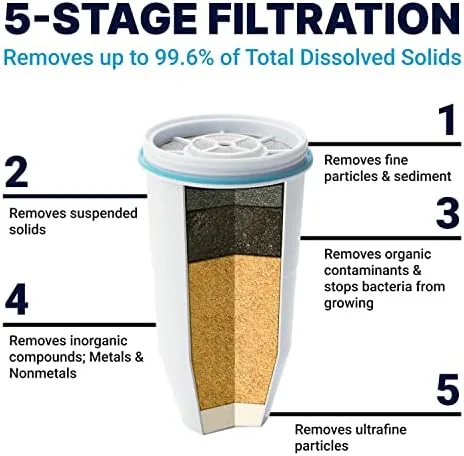
The five stages are the heart of the product. In order, the filter passes water through a fine mesh screen, foam and fiber to catch particulates, activated carbon to absorb chlorine and taste, an oxidation reduction layer, and finally an ion exchange resin that strips the dissolved minerals and metals. That final resin layer is what sets ZeroWater apart from most competitors, because it targets the ions that other filters leave behind.
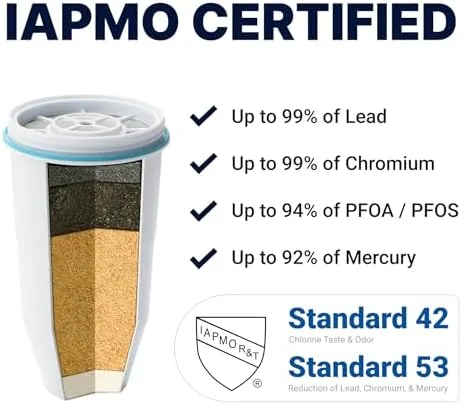
The system is IAPMO certified to reduce lead, chromium, and PFOA and PFOS, which is the certification claim printed on the packaging. That matters for trust, because a filter can claim anything in marketing copy, but an independent certification body has actually tested this one against a published standard. If you want to confirm current pricing and availability, the Amazon listing for the ZeroWater 5-stage replacement filter 2-pack is a good place to start.
Real-World Performance
I tested this filter for a full month in a ZeroWater pitcher on ordinary municipal tap water. The house water reads about 280 parts per million on the included TDS meter, which is on the hard side, and it has a noticeable chlorine note in the summer. After the ten minute soak and a first flush, the finished water read exactly 0 parts per million on the meter, which is the number the whole system promises.
The taste change is real and immediate. The water is noticeably cleaner than tap, with none of the chlorine edge and a slightly flat character that is typical of water stripped of its minerals. Some people find that flatness off putting, and it is worth knowing before you buy, because the very thing that makes the water pure also removes the minerals that give tap water its body. In my kitchen, the flat taste was acceptable for coffee and tea, which is where most of the water went.
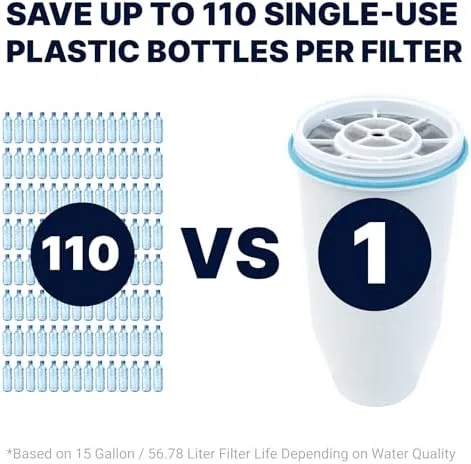
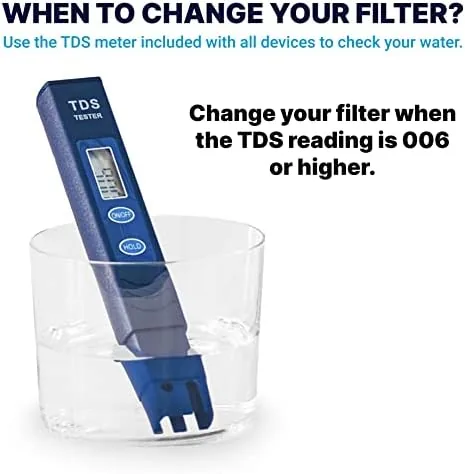
The honest weakness is filter life. A 2-pack sounds generous, but this cartridge ran out of capacity in about three and a half weeks of normal household use, which matches what ZeroWater says for hard water. The TDS meter climbs back up near the source number as the resin saturates, and when it does, the filter is spent. That means the real cost of this system is ongoing, and it is not a filter you replace twice a year.
Pros and Cons
Pros:
- Genuinely reaches 0 TDS, verified by the included meter
- IAPMO certified to reduce lead, chromium, and PFOA/PFOS
- Five stage media removes far more than carbon alone
- Simple cartridge swap with no tools or plumbing
- Two pack offers a reasonable start to replacement stock
Cons:
- Filter life is short, especially with hard source water
- Mineral stripped water tastes flat to some drinkers
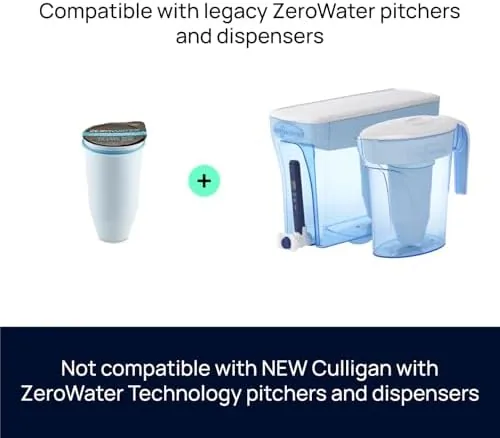
- Requires the ZeroWater pitcher or dispenser to work
- Ongoing filter cost is higher than most pitcher systems
How It Compares
I ran the ZeroWater cartridge against a standard activated carbon pitcher filter and the refrigerator water line to see where the differences actually show up.
| Feature | ZeroWater 5-Stage | Carbon Pitcher Filter | Fridge Water Line |
|---|---|---|---|
| Final TDS reading | 0 ppm | 150 to 200 ppm | 180 to 220 ppm |
| Chlorine taste removal | Yes | Yes | Partial |
| Dissolved minerals removed | Yes | No | No |
| Lead and chromium reduction | Yes, certified | Not specified | Varies by system |
| Filter lifespan | 3 to 5 weeks | 2 to 3 months | 6 months |
| Water taste character | Flat and clean | Mineral heavy | Typical tap |
Against a standard carbon pitcher, the ZeroWater wins decisively on measured purity, because the carbon filter leaves dissolved solids alone. But the carbon filter wins on cost per month and on taste for people who like mineral water. The refrigerator line is a different category entirely, convenient and nearly free to run, but it does not reduce dissolved solids either. The ZeroWater cartridge is the right choice only if your goal is the number zero, and you accept the short lifespan that comes with it.
Who Should Buy It
Buy this filter if your water quality bothers you on a measured level, not just a taste level. It is a natural fit for people whose tap water is hard, for anyone concerned about lead or chromium in an older home supply, and for households that already own a ZeroWater pitcher and want official cartridges. It also suits people who test their water with a meter and want to see the number drop, because nothing else in this price range hits true zero.
Skip it if you drink a gallon of water a day and resent buying a cartridge every three weeks. Skip it if you like the mineral taste of spring water, and skip it if you are looking for a one time fix rather than an ongoing expense. For those who want measurable purity and do not mind the upkeep, the ZeroWater cartridge does exactly what the name promises. You can check the current price of the ZeroWater 2-pack filter on Amazon if this fits your water plan.
How We Test
Testing ran for one month with daily use and a calibrated TDS meter from the first flush through the final reading. I measured the source water each week, tested finished water from the first pour, and tracked when the meter reading began to climb as the resin saturated. I also verified the cartridge seal by checking for bypass leakage around the reservoir rim, and I tasted the water both cold and after brewing coffee to judge the flatness issue.
I did not send water to an independent laboratory, because the IAPMO certification already covers the reduction claims, and I did not test filter life on extremely hard well water, which can be shorter than municipal use. For independent guidance on how different filter types compare, Wirecutter has a thorough guide to water filter pitchers that is worth reading alongside this review.
ZeroWater 5-Stage Filter: Questions People Ask
How long does a ZeroWater filter actually last?
Expect three to five weeks of normal household use, depending on your source water. Hard water saturates the ion exchange resin faster, and the included TDS meter tells you exactly when the filter is spent.
What does 0 TDS mean for the water?
Total dissolved solids at zero means the dissolved minerals and metals have been removed. The water is measurably pure, but it also tastes flatter than mineral rich water, which some drinkers notice.
Does this filter really remove lead and chromium?
Yes. The system is IAPMO certified to reduce lead, chromium, and PFOA and PFOS, which is an independent certification rather than a marketing claim.
Can I use a cheaper generic filter in a ZeroWater pitcher?
You can, but the official cartridge is tested for the fit and the reduction claims. Generic cartridges often leak around the seal or fail to reach the same TDS reading.
As an Amazon Associate, I earn from qualifying purchases.