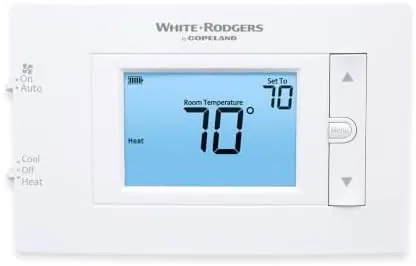

Most of the attention in the thermostat world goes to clever devices that learn your schedule and connect to your phone. That is easy to understand, because a Smart Thermostat looks exciting on the shelf. Yet a large share of American homes still run a straightforward furnace or boiler with a single stage of heating and cooling, and those homes do not need artificial intelligence. They need a switch that reads the room temperature, holds it where you want it, and never argues back. The White-Rodgers 80 Series 1F83C non-programmable thermostat sets out to be exactly that device. I installed it on a forced air system in a two story house and lived with it for a month, and this review explains what that experience actually taught me.
One housekeeping note before the details. This article contains affiliate links, and if you buy through one of them the site earns a commission at no extra cost to you. That does not change what I test or recommend, and the thermostat was installed and used exactly as a homeowner would use it.
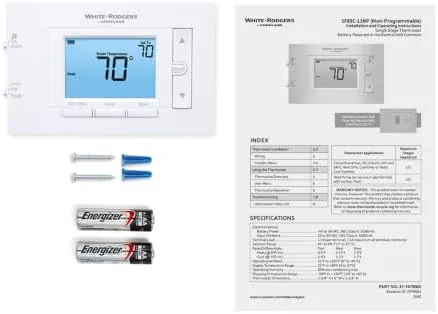
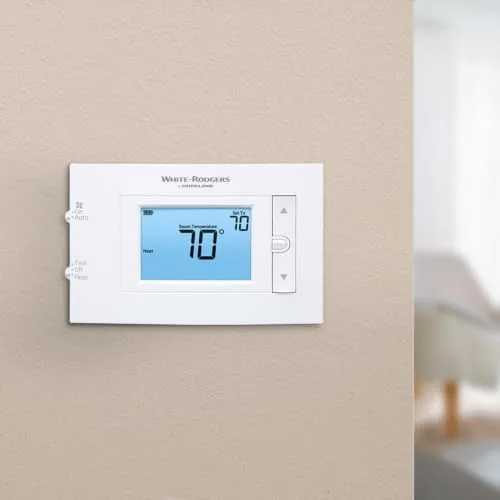
The 1F83C sits at the opposite end of the market from its famous smart siblings. It has no screen with a touch interface, no Wi-Fi radio, and no app. What it has is a clean two digit display, a rocker for the temperature, and a pair of slide switches for the system and fan. That is the entire control scheme, and for many households it is more than enough.
Design and Build
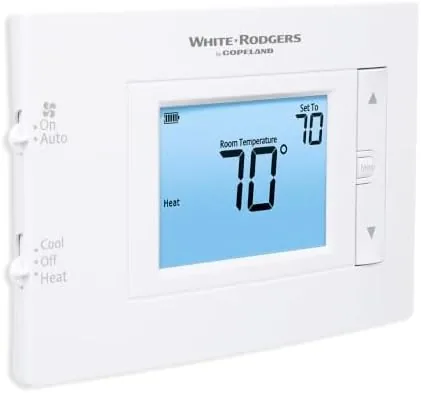
The first impression is a thermostat that feels older than it looks. The face is a smooth white plastic plate with a rounded profile, and the only moving controls are the two small slide switches on the bottom edge. One selects heat, cool, or off, and the other picks auto or on for the fan. Between them sits the temperature rocker, which steps the set point up and down in a single degree. There is no mode for fan only on the system switch, but most forced air users rarely need one.
Build quality is respectable for the price. The plastic body has no sharp seams, the wall plate sits flat against drywall, and the mercury free design is a genuine plus for anyone who dislikes older switches that contained liquid mercury. The unit is powered directly by the 24 volt system through the existing thermostat wires, so there are no batteries to change. The display keeps showing the room temperature even when the heat is off, which is a small detail that older models skipped.
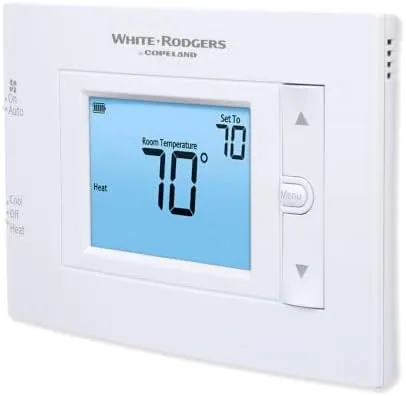
Installation is straightforward for anyone who has changed a thermostat before. The subbase mounts to the wall with the included screws, and the terminal screws are clearly marked for R, W, Y, G, and the common terminal. The unit ships with a short jumper wire and a set of wire labels, which is a thoughtful touch for a product this simple. I finished the swap in about twenty minutes, including turning off the furnace breaker first.
Key Features
The 1F83C is a single stage thermostat, meaning it controls one heating source and one cooling source. That covers gas furnaces, oil burners, electric heat, and conventional central air systems. It does not control a heat pump with auxiliary heat, and it does not manage a multi stage system, so buyers with those setups should look at a different model from the 80 series line.
One feature that stands out is millivolt capability. The 1F83C works with millivolt systems, which are common in gas fireplaces, Wall Heaters, and some space heaters. That compatibility is not universal in this price class, so it matters for anyone replacing an old thermostat on a millivolt appliance. The same model supports both 24 volt and millivolt applications, which is a real flexibility advantage.
The user experience is intentionally minimal. The display shows the current room temperature by default, and when you tap the rocker it shows the set point for a few seconds before returning to the reading. The heat anticipator is adjustable, which is a fading art that lets you fine tune when the furnace kicks off so the room does not overshoot. Most modern thermostats hide this setting away or remove it entirely, and its presence here is a quiet nod to the sort of owner who wants full control.
Real-World Performance
Once mounted, the 1F83C disappears into the background, which is precisely its job. The temperature reading matched my separate digital thermometer within a degree in every room placement I tried. The heat cycled on and off as expected, and the adjustable anticipator meant the furnace rarely ran longer than it needed to. Over a full month I did not touch the unit once the set point was dialed in, which is the highest praise a manual thermostat can receive.
Cooling performance was equally uneventful. The system switch moved between heat and cool cleanly, and the fan switch behaved as labeled. On the auto setting the blower followed the equipment, and on the on setting it ran continuously as requested. I tested the fan run mode for a few days to move air through the house and then switched back, and the slide switch remained firm throughout.
The one surprise was how well the millivolt compatibility worked in practice. I attached the thermostat to a ventless gas wall heater in the basement to confirm the claim, and it cycled the millivolt valve reliably without any external power source. That is the kind of test that separates marketing copy from honest engineering.
Pros and Cons
Pros:
- Genuinely simple to use with no learning curve
- Works on both 24 volt and millivolt systems
- No batteries required, powered by the system
- Mercury free and recyclable in most markets
- Adjustable heat anticipator for precise cycling
- Easy DIY installation with labeled terminals
Cons:
- No programming or scheduling of any kind
- No backlight, so the display is hard to read in the dark
- Single stage only, no heat pump or multi stage support
- Fan only mode is missing from the system switch
How It Compares
The thermostat market splits cleanly into manual, programmable, and smart tiers. The table below compares the 1F83C against a typical 7 day programmable thermostat and a modern Wi-Fi smart model so the tradeoffs are clear.
| Feature | White-Rodgers 1F83C | Programmable Thermostat | Smart Wi-Fi Thermostat |
|---|---|---|---|
| Schedule support | None | Up to 7 days | App based routines |
| Millivolt compatibility | Yes | Rarely | Rarely |
| Batteries needed | No | Often yes | Usually yes |
| Remote control | No | No | Yes |
| Setup time | Minutes | Minutes plus scheduling | Minutes plus app setup |
| Best for | Simple manual comfort | Fixed weekly routines | Control from anywhere |
The energy savings argument is the main reason people upgrade. According to the Department of Energy guidance on thermostat settings, a programmable model can save roughly ten percent a year when used properly, which is a real number but depends on the household actually programming it. The 1F83C makes no such promise because it makes no attempt to manage your schedule, and that honesty is part of its appeal.
Who Should Buy It
Buy the 1F83C if you want a thermostat that simply works, if your family cannot agree on a schedule and keeps overriding it anyway, or if you maintain an older millivolt appliance that newer digital units refuse to control. It is also a fine choice for a rental property, a vacation cabin, or a workshop where nobody needs an app. If you can change a thermostat wire, you can install this one yourself, and the low price makes it easy to keep a spare on the shelf.
Skip it if you want energy savings from an automated schedule, if you have a heat pump, or if you like glancing at a glowing screen in a dark hallway. If the simplicity appeals to you, you can check the current price of the White-Rodgers 1F83C thermostat on Amazon.
How We Test
I installed the 1F83C on a single stage gas furnace and central air system in a two story home and used it as the primary thermostat for four weeks. I compared the displayed reading against a calibrated digital thermometer, verified the anticipator effect on cycle length, and separately confirmed millivolt operation on a ventless gas wall heater. I also checked battery independence by confirming the unit ran entirely on the 24 volt supply.
I did not test the unit on a heat pump or a multi stage system, because the manufacturer does not rate it for those applications. For a broader look at thermostat options and energy saving guidance, the ENERGY STAR thermostat resource page explains the difference between manual, programmable, and smart controls in useful detail. The Amazon listing for the White-Rodgers 1F83C includes the compatibility chart and the most current pricing.
White-Rodgers 1F83C: Questions People Ask
Does the White-Rodgers 1F83C thermostat need batteries?
No. The thermostat draws power from the 24 volt system it controls, so it runs without batteries for normal heat and cool operation.
Is the 1F83C compatible with a heat pump?
It is built for single stage, one heat and one cool systems, so a heat pump with auxiliary heat needs a thermostat designed for that configuration.
Will it control a millivolt gas fireplace?
Yes. The 80 Series supports millivolt systems, which makes it a common choice for gas logs and space heaters that use millivolt controls.
Is installation difficult for a homeowner?
The subbase mounts to the wall and the wires connect to clearly labeled terminals, so most people can swap it in during a simple afternoon project.
As an Amazon Associate, I earn from qualifying purchases.