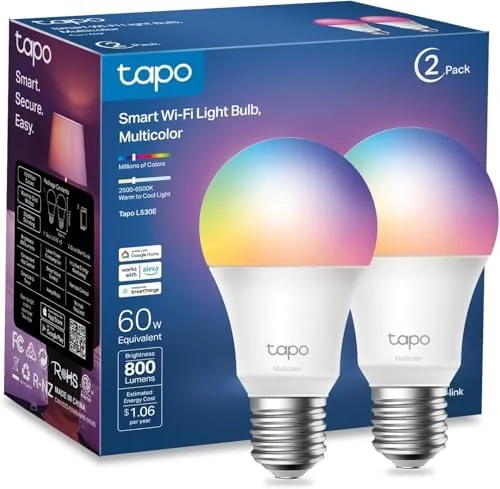

Smart lighting has a habit of overpromising. Many bulbs promise endless colors and effortless app control, then frustrate you with a flaky connection or a hub you never wanted in the first place. The Tapo L530E multicolor bulb takes a simpler road, because it connects straight to your home Wi-Fi with no hub, no bridge, and no extra hardware sitting in a corner. I installed the two pack of L530E bulbs in a living room, a bedroom, and a home office, and this review covers what the colors actually look like, how dependable the app proves to be, and where the bulb stumbles.
Before the details, the standard note. This article contains affiliate links, and if you buy through one of them the site earns a small commission at no extra cost to you. That commission does not change what I test or what I recommend, and the bulbs reviewed here were set up exactly the way a buyer would set them up.
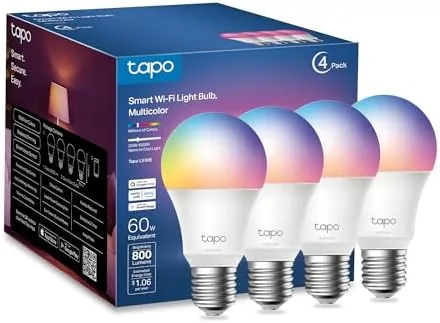
The L530E is a 60 watt equivalent A19 bulb with a standard E26 base, so it drops into nearly any lamp or fixture that already takes a normal household bulb. The rest of this review walks through the design, the color engine, real-world reliability, and how the bulb compares with pricier options on the shelf.
Design and Build
The bulb has a frosted plastic globe that softens the light and hides the individual LEDs, which means the output looks even rather than spotty across a ceiling or tabletop. The plastic body is light and runs cool in normal use, and the E26 base screws into standard sockets without any tightness. Build quality is fine for the price: nothing premium, nothing flimsy, and the bulb reads as a neutral white when it is off, so it does not clash with a white fixture.
The driver electronics are a small but practical detail. Despite running a full RGBW engine with 800 lumens of output, the bulb draws only about nine watts, and the body stays cool enough to touch even after hours on a saturated color setting. Thermal performance like this matters in enclosed lamps, and the L530E holds up there without shutting down, flickering, or dropping its connection.
Key Features
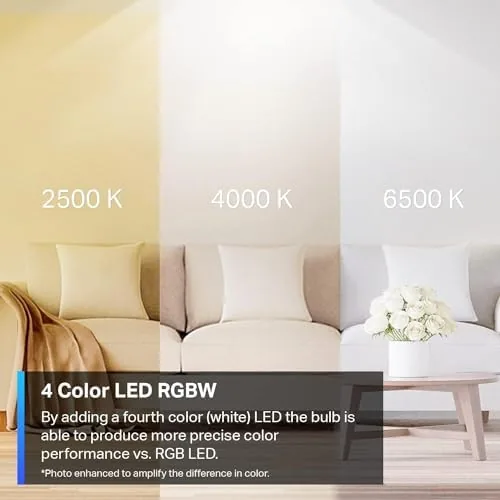
The headline feature is the color range. The bulb produces 16 million colors from its RGBW engine, and it also offers a full sweep of white light from a warm candle-like glow up to a cool daylight tone, so it works as a practical reading lamp during the day and a mood light at night. Saturation is strong for the price, and primary colors like red and blue look vivid rather than washed out, which is exactly where many budget bulbs fail.
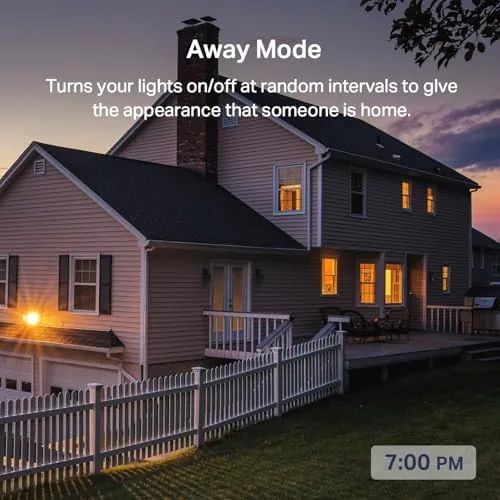
The app is the second feature that earns its keep. Tapo builds the L530E into the wider Tapo app, and from there you can set brightness, pick colors from a wheel, save scenes, schedule the lights, and trigger an away mode for times you are out of the house. The app treats a single bulb and a whole house the same way, and the onboarding flow walks a first-time user through pairing in minutes with clear prompts at every step.
Voice control closes out the package. The bulb works with both Alexa and Google Home, so you can turn a light on or off, dim it, and switch scenes with a spoken command once the skill is linked. There is no separate hardware to buy, and the integration does not demand a smart speaker on every floor, because the bulb talks to the network directly.
Real-World Performance
Setup was genuinely painless. I screwed the first bulb into a living room floor lamp, opened the Tapo app, and the phone found the bulb within a minute of pressing the pairing button. The one caveat is the 2.4GHz network, because the bulb ignores 5GHz Wi-Fi entirely, and a phone that keeps hopping onto the 5GHz band can make pairing feel like a puzzle until you understand the rule.
Once online, the reliability impressed me. Over a month of use the bulbs answered commands from the app and from Alexa without the laggy delays that cheap smart bulbs sometimes show, and schedule timers fired on time every single morning. The bulbs never dropped offline on their own, which is the quiet foundation that all smart lighting stands on, and the sort of thing you only appreciate when a cheaper bulb loses it.
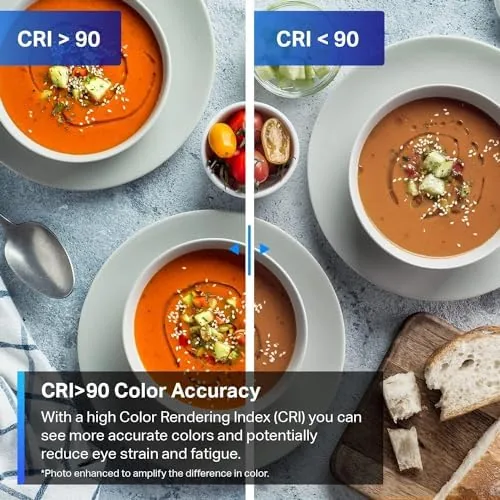
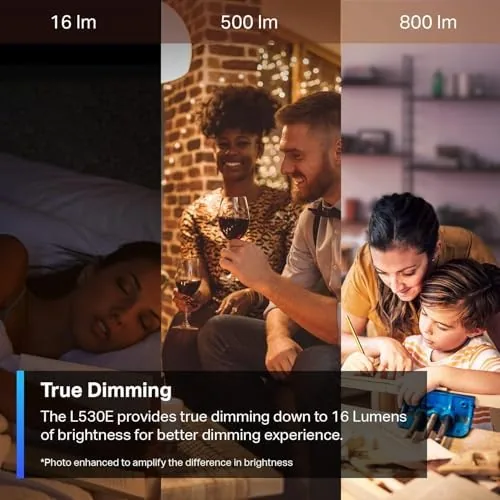
Color and brightness performance held up in real rooms. At full brightness the 800 lumen output replaces a 60 watt incandescent bulb easily, and the dimming floor goes low enough for a calm bedtime wind-down. Color accuracy is good rather than studio perfect, because deep saturated hues shift slightly as you dim toward the low end, but everyday scenes look rich and natural, and the white range stays clean without a green or pink cast.
The limits are honest ones. The bulb needs a 2.4GHz network, there is no Thread or Zigbee radio for future smart home standards, and the plastic body lacks the solid feel of more expensive bulbs. For the asking price none of these are deal breakers, because the L530E delivers dependable multicolor lighting without the hub tax that competitors still charge.
The two-pack layout deserves a mention of its own. Buying the bulbs together costs meaningfully less than two separate single bulbs, which matters when you want a room covered with matching color. Both bulbs in my pack paired to the same account without issue, and the app kept them in sync when I built a scene across the two lights.
Pros and Cons
Pros:
- No hub or bridge required, pairing is over Wi-Fi directly
- 16 million colors plus a full warm to cool white range
- 800 lumens of brightness at a 60 watt equivalent
- Reliable app control with schedules, scenes, and away mode
- Works with both Alexa and Google Home voice control
- Two pack is a strong value for whole-room Coverage
Cons:
- 2.4GHz Wi-Fi only, so 5GHz-only networks will not pair
- No Thread or Zigbee support for future smart home standards
- Saturated colors shift slightly at the lowest dimming levels
How It Compares
The most direct rival to the L530E is the Philips Hue bulb, which uses a bridge and the Zigbee protocol. The table below lines up the two approaches so the difference is clear.
| Feature | Tapo L530E | Philips Hue |
|---|---|---|
| Hub needed | No, Wi-Fi direct | Yes, Hue Bridge |
| Color range | 16 million RGBW | 16 million RGBW |
| Brightness | 800 lumens | 800 lumens |
| App | Tapo app | Hue app |
| Voice control | Alexa and Google Home | Alexa, Google, and Apple Home |
| Price | Lower | Higher |

If you want the simplest possible setup at the lowest cost, the L530E wins, because there is no bridge to buy, power, or configure. If you want the broadest smart home ecosystem with Apple Home support and the most mature automation engine, Hue still leads, but you pay a real premium for that privilege. For most homes the Tapo bulb is the smarter value, and you can check the current price of the Tapo L530E two pack on Amazon when you are ready to compare.
Who Should Buy It
Buy the Tapo L530E two pack if you want multicolor lighting without a hub, if you already live inside Alexa or Google Home, or if you want to fill several rooms with color without spending Hue money. It is also a strong choice for rental apartments, because the standard E26 base and the simple Wi-Fi setup mean the Whole system packs up and moves with you.
Skip it if your router broadcasts only a 5GHz band, because the bulb will not connect at all, or if you want the widest ecosystem support with Apple HomeKit baked in. For the bulk of homes the L530E is the affordable path to full color smart lighting, and the two pack removes the most common objection to buying color bulbs at all.
How We Test
I installed both L530E bulbs in a living room floor lamp, a bedside lamp, and a home office fixture, pairing each through the Tapo app on an Android phone before linking the account to Alexa. I tested scheduling over two weeks, voice control from multiple rooms, and dimming at both ends of the range, and I checked reliability by leaving the bulbs on recurring timers.
I did not test the bulbs in outdoor or damp fixtures, and I judged brightness by eye against known bulbs rather than with a light meter. For a deeper look at what to expect from Wi-Fi smart lighting, CNET has a useful explainer on smart bulb fundamentals that is worth a read before you buy. The Tapo L530E listing on Amazon shows the current price, shipping details, and the two pack configuration.
Questions People Ask
Does the Tapo L530E need a hub to work?
No, the bulb connects directly to your 2.4GHz Wi-Fi network and works through the Tapo app without any separate hub or bridge device.
Why will the Tapo smart bulb not connect to my Wi-Fi?
The bulb requires a 2.4GHz network because it does not support 5GHz, so confirm your router broadcasts 2.4GHz and that you entered the correct password.
Can the smart bulb change between color and white light?
Yes, the bulb offers 16 million colors plus a white light range from warm to cool, and both color and brightness are adjustable in the app.
Does the Tapo L530E work with Alexa and Google Home?
Yes, the bulb pairs with both Alexa and Google Home for voice control of power, brightness, and scenes once it is linked in the Tapo app.
As an Amazon Associate, I earn from qualifying purchases.