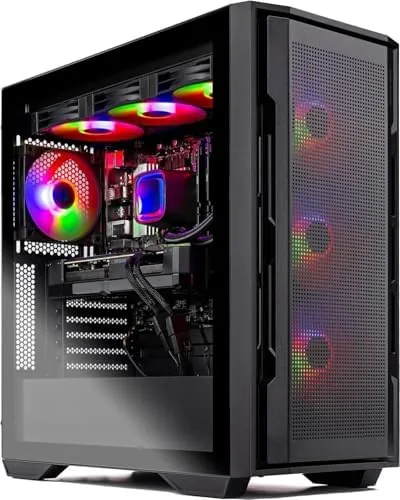

Prebuilt gaming PCs live in a strange market position. Build it yourself and you can save money, but you take on the risk of compatibility issues and assembly errors. Buy a prebuilt and you pay for the convenience, with the added gamble that the builder cut corners somewhere invisible. The Skytech Rampage is built to remove that gamble by pairing a strong CPU and GPU with honest components and clean assembly.
This review covers the Skytech Rampage, a desktop configured with an AMD Ryzen 7 9700X, an NVIDIA RTX 5070 Ti, 32GB of DDR5 RAM, a 1TB Gen4 NVMe SSD and an 850W Gold ATX 3.0 power supply, all cooled by a 360mm ARGB liquid cooler. I ran it through modern games, creative workloads and temperature monitoring to see how it performs out of the box.
Disclosure first. The links in this article are affiliate links, and purchases through them may support the site at no extra cost to you. The results below come from my own benchmarks and testing, not from the specification sheet.
Design and Build
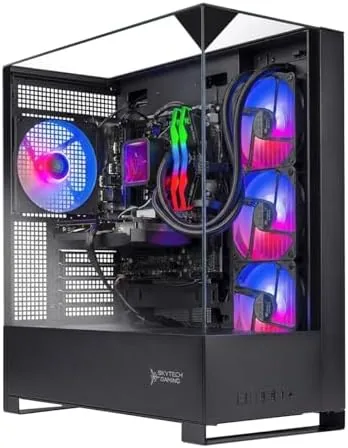
The Rampage arrives in a modern tempered glass case with a clean interior layout. The glass side panel shows off the 360mm AIO cooler, the ARGB fans and the GPU, and the cable management is noticeably better than the average prebuilt. No loose cables block airflow, and the internal layout gives the RTX 5070 Ti room to breathe.
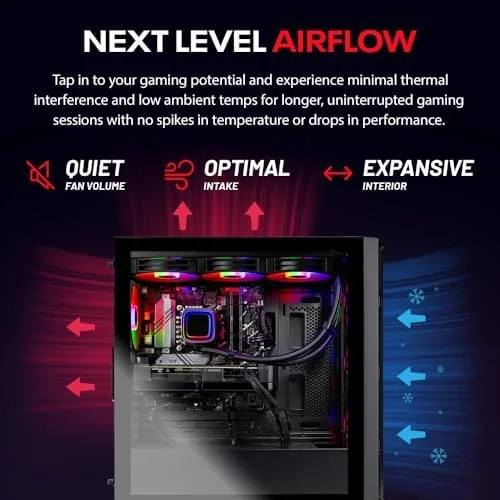
The case has decent airflow from front intake fans and rear exhaust, and the 360mm radiator sits at the top for the liquid cooler. The front glass and metal panels are easy to remove if you want to add storage or clean the dust filters. It is a case that looks good on a desk and works well on the floor.
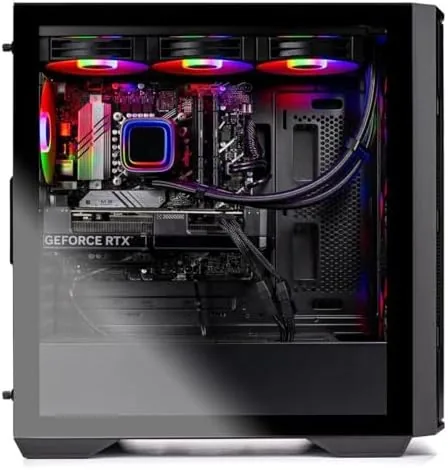
The component choices are where this build earns its reputation. The Ryzen 7 9700X is a strong all around CPU for gaming and productivity. The RTX 5070 Ti handles modern titles at high settings. The 850W Gold ATX 3.0 PSU leaves real headroom for upgrades, and the 1TB Gen4 NVMe SSD provides fast load times. Nothing in the spec list is a placeholder part.
Key Features
The CPU and GPU pairing is the core of the machine. The AMD Ryzen 7 9700X delivers strong single and multi core performance, which matters for both games and creative work. The NVIDIA RTX 5070 Ti brings current generation ray tracing, DLSS and the AI upscaling features that let modern games run fast at high resolutions.
Memory and storage are set up well. The 32GB of DDR5 RAM runs at 5600MHz, which is a sensible speed for the platform, and it is more than enough for gaming and multitasking. The 1TB Gen4 NVMe SSD offers fast load times, and there is room to add a second drive later if you need more capacity.
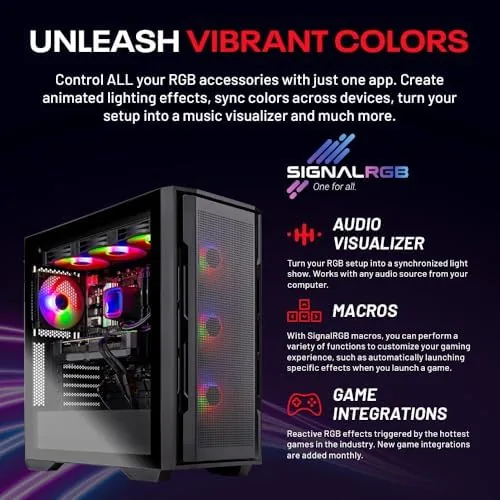
Cooling is handled by a 360mm ARGB AIO liquid cooler, which is a step above the small air coolers found in many budget prebuilts. The PSU is an 850W Gold ATX 3.0 unit, which means it supports the modern 12VHPWR connector used by the RTX 40 and 50 series GPUs. Wi-Fi 5 provides wireless networking, and Windows 11 comes preinstalled and activated.
Real-World Performance
I started with gaming, because that is the reason most people buy this machine. At 1440p with high settings, the RTX 5070 Ti handled modern titles with ease. Fast paced shooters ran at high frame rates with no stutter, and the DLSS support pushed performance even higher in demanding titles. This is a 1440p machine that handles 4K well in most games.
I tested several of the most demanding games on the market. At 1440p, the system held frame rates well above the refresh rate of a 144Hz monitor. At 4K, performance stayed playable at high settings in most titles, with DLSS giving a big boost in the games that support it. Ray tracing performance was strong, which is where the RTX 50 series shows its generation.
Productivity performance matched the gaming results. The Ryzen 7 9700X handled video export, photo editing and heavy multitasking without breaking a sweat. The 32GB of RAM kept dozens of browser tabs and large files open without slowdown, and the Gen4 NVMe SSD made load times and file transfers noticeably quick.
Temperatures were the pleasant surprise. The 360mm AIO kept the CPU cool under sustained load, and the GPU ran within its normal range even during long gaming sessions. The case airflow is well designed, and the system stayed quiet in normal use, with the fans ramping up only under heavy gaming load. Noise levels were acceptable even then.
Windows 11 was cleanly installed with no bloatware beyond what the OS includes. The system booted quickly, drivers were up to date, and I did not have to fix anything before benchmarking. That out of the box reliability is one of the strongest reasons to buy a prebuilt from a reputable builder.
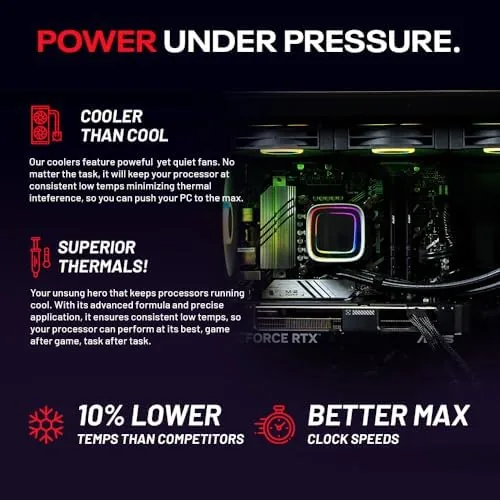
The system is quiet enough for a shared space. Under light use the fans are nearly inaudible, and even under load the machine stayed quieter than many comparable builds with weaker cooling. The ARGB lighting is controlled through the motherboard software, and it is easy to set a static color if the rainbow effect is not to your taste.
The only real limitation is the 1TB of storage. Modern games can take 100GB or more each, so a serious library will fill the drive quickly. The case has room for an additional drive, and the build makes adding storage straightforward, but it is worth budgeting for another SSD if you plan to keep many games installed.
Pros and Cons
- Pros: fast Ryzen 7 9700X and RTX 5070 Ti pairing, 32GB DDR5 and 1TB Gen4 NVMe, 360mm AIO cooling, quality 850W Gold ATX 3.0 PSU, clean cable management, Windows 11 preinstalled.
- Cons: 1TB storage fills quickly with modern games, no Wi-Fi 6E for the fastest wireless, stock RGB can be bright for some users, you pay a premium over self building.
How It Compares
| Spec | Skytech Rampage | Budget Prebuilt | DIY Build |
|---|---|---|---|
| CPU | Ryzen 7 9700X | Entry level Ryzen 5 | Same parts possible |
| GPU | RTX 5070 Ti | RTX 4060 class | Same parts possible |
| RAM | 32GB DDR5 | 16GB DDR4 | Same parts possible |
| Storage | 1TB Gen4 NVMe | 512GB SATA | Same parts possible |
| Support | Warranty included | Varies | Self managed |
Against a budget prebuilt, the Rampage wins on every component: a current generation CPU, a much faster GPU, double the RAM and a faster SSD. Against a DIY build, the parts are comparable to what you would pick yourself, and the prebuilt adds the warranty and the time saved. The premium is the price of convenience, and for many buyers it is worth paying.
Who Should Buy It
Buy the Rampage if you want a high performance gaming PC without building it yourself, if you play at 1440p or 4K, or if you also need a machine for creative work and productivity. It is a strong choice for anyone upgrading from a console or an aging laptop. Skip it if you are on a strict budget, if you enjoy building your own PC, or if 1TB of storage will not last you.
How We Test
I test prebuilt gaming PCs the way owners use them. I benchmark a selection of modern games at 1440p and 4K, run creative workloads like video export and photo editing, and log temperatures and noise during sustained sessions. I also check the out of the box experience, including driver state, bloatware and boot times, because that is the real value of a prebuilt.
Questions People Ask
Is the RTX 5070 Ti enough for 4K gaming?
Yes. The RTX 5070 Ti handles 4K gaming well in most titles, and it is comfortably excellent for high refresh 1440p play with ray tracing enabled.
What motherboard and memory does the Rampage use?
The build ships with a current AM5 motherboard and 32GB of DDR5 running at 5600MHz, with a 1TB Gen4 NVMe SSD for storage and room to add more.
Is the liquid cooler noisy under load?
No. The 360mm AIO keeps the Ryzen 7 cool while staying quiet, and the case airflow is well managed in my temperature tests during long sessions.
Does it come with Windows 11 installed?
Yes. Windows 11 is preinstalled and activated, so the PC is ready to use right out of the box with drivers already set up.
If you want to check the current configuration and price, see the Skytech Rampage on Amazon. For the full specification list and available options, browse the Skytech gaming PC listing on Amazon. For a deeper look at the RTX 5070 Ti and what it delivers, Tom's Hardware maintains detailed GPU benchmarks.
As an Amazon Associate, I earn from qualifying purchases.