
Gaming monitors live on their numbers: refresh rate, response time, contrast, and color coverage, all printed on the box in bold type. The SANSUI 27 inch curved display prints a headline number that gets attention, a 240Hz refresh rate at a price that most 240Hz panels never approach. That combination raises an immediate question, whether the speed holds up in real play or just on paper. This review covers two weeks of fast shooters, racing games, and everyday work on the SANSUI curved panel.
The standard disclosure applies. This article contains affiliate links, and if you buy through one of them the site earns a small commission at no extra cost to you. That commission does not change what I test or how I score a product.
Design and Build
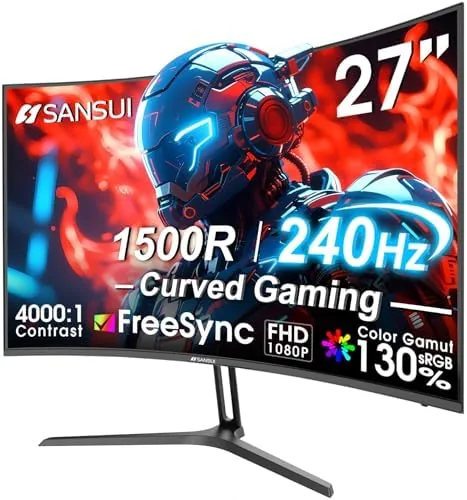
The SANSUI makes a strong first impression. The 27 inch panel bends into a 1500R curve that wraps gently around your field of view, and the stand is a proper metal affair with a solid base that takes up little desk space. The bezels are slim on three sides, and the whole monitor looks more expensive than its price, which is exactly the kind of first impression a budget gaming display wants to make.
The stand offers tilt adjustment and, usefully, a good range of height adjustment, which is uncommon at this price and genuinely appreciated for long sessions. The neck is metal with a cable management hole, and the VESA mount on the rear means a monitor arm is a straightforward upgrade. The ports are a pair of HDMI and a DisplayPort, and the box includes both a DisplayPort and an HDMI cable, so nothing is left to a separate trip.
Build quality is solid throughout. The panel sits rigid in the stand with no wobble, the plastics are sturdy, and the on-screen menu is controlled by a small joystick on the back that is far easier to use than the button rows on cheaper monitors. A low blue light mode sits in the menu for the evenings, and the whole package feels built to be used daily.
Key Features
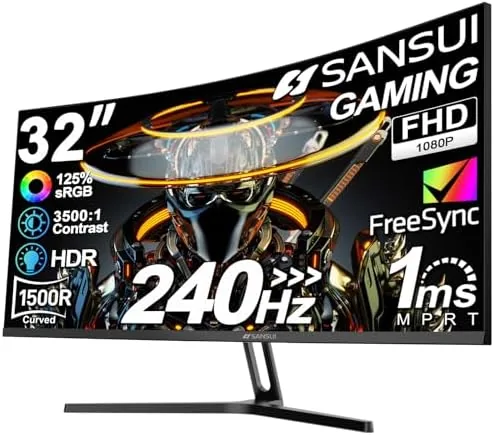
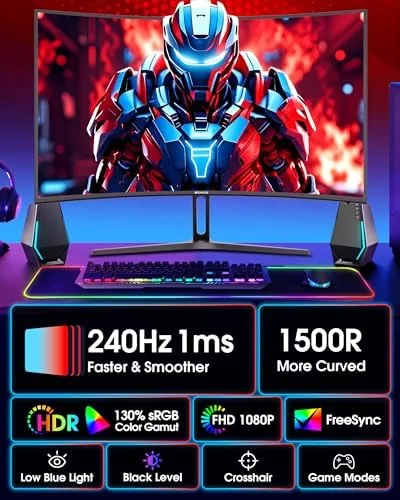
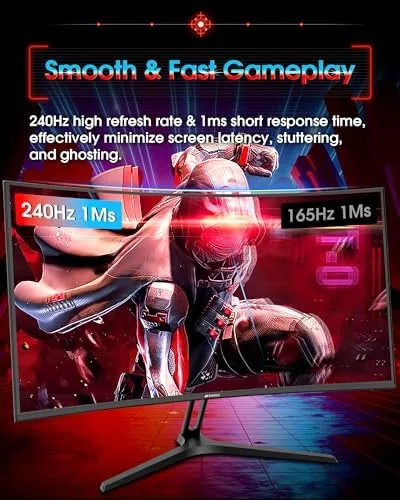
The headline is the 240Hz refresh rate at 1080p. For competitive shooters that number translates directly into smoother motion, less eye strain, and a genuine competitive edge, because the screen shows four frames for every one a 60Hz panel shows. The panel also carries a 1ms MPRT response rating, which keeps fast motion crisp and limits the ghosting that budget panels often suffer.
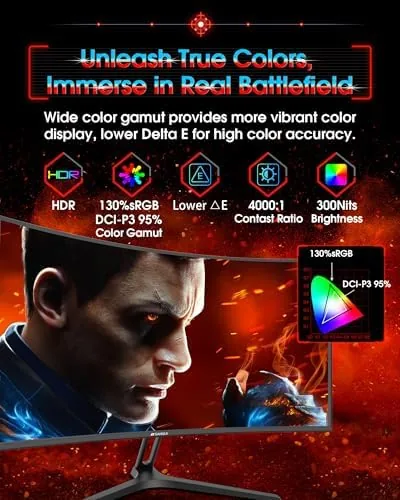
The display is a curved VA panel with a 4000:1 contrast ratio and 130 percent sRGB color coverage. The VA technology is what makes the black levels deep and the image punchy, and the high contrast gives games a rich, vivid look that flat IPS panels in the same price range often miss. HDR is supported at a basic level, which adds some highlight pop to compatible content without the dynamic range of a true HDR display.
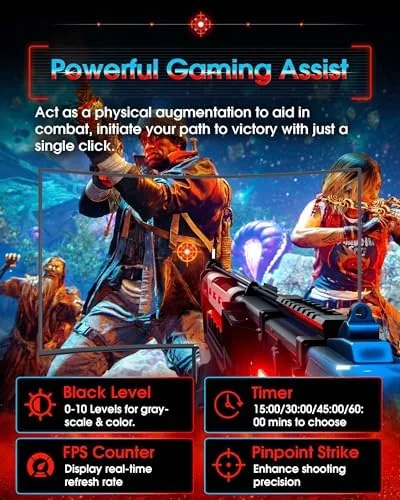
FreeSync support rounds out the gaming package. The monitor syncs its refresh rate with compatible graphics cards to eliminate screen tearing, and it works over DisplayPort with both AMD cards natively and modern NVIDIA cards through adaptive sync. A gaming mode, crosshair overlay, and low blue light preset complete the toolkit, and the quick menu gives fast access to refresh and response settings.
Real-World Performance
I gamed on the SANSUI for two weeks across a fast shooter, a racing title, and a couple of strategy games. The first session answered the big question: the 240Hz refresh is real. In the shooter, motion stayed fluid and readable at high frame rates, and quick turns produced none of the blur or tearing that plagues slower panels. The 1ms response kept fast scene changes clean, and the difference from my usual 144Hz panel was noticeable if not night and day.
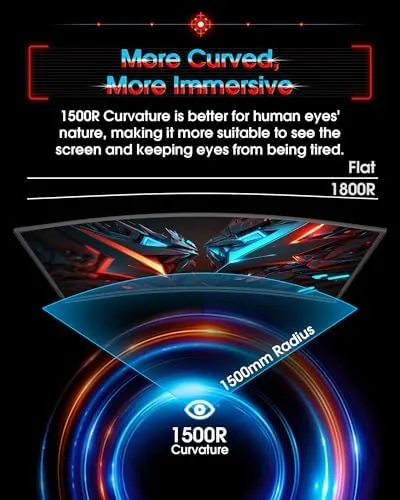
The curved VA panel impressed in the games that show off contrast. The racing title looked rich and saturated, with deep blacks in tunnels and vivid skies that flat panels in this class struggle to match. The 1500R curve fills your peripheral vision at a normal sitting distance, which adds immersion in racing and first-person games, though it is subtle enough that everyday use is unaffected.
Outside gaming the monitor pulled double duty as a work display. Documents and web pages looked clean on the curved panel once I sat centered, and the height-adjustable stand made a comfortable posture easy to find. The honest limitations are resolution and viewing angle. At 1080p on 27 inches, text is slightly soft up close, and VA panels lose some contrast when viewed off-angle, so a single curved screen is not ideal for a two-person shared setup.
The on-screen menu is a quiet strength. The rear joystick makes navigating the settings fast, and the game mode presets genuinely change the picture for different titles, from a brighter mode for dark scenes to a saturated mode for racing. The low blue light preset dropped in well for evening sessions, and the crosshair overlay is a nice extra for shooters. Having these tools at hand meant I tuned the panel to each game rather than settling for one generic look, and the menu settings all held across reboots.
Pros and Cons
Pros:
- Genuine 240Hz refresh at a budget price
- 1ms MPRT response keeps fast motion crisp
- Deep 4000:1 contrast and rich 130 percent sRGB color
- Metal stand with height adjustment included
- FreeSync support works with modern graphics cards
- DisplayPort and HDMI cables in the box
Cons:
- 1080p resolution is soft for a 27 inch panel
- VA viewing angles narrow off-center
- Basic HDR is not a real HDR experience
How It Compares
The SANSUI competes with the value end of the high refresh market, where the AOC C27G2Z and the MSI Optix G272 are the usual alternatives. All three offer a 27 inch full HD panel Built for Speed, so the table below sorts out the details.
| Feature | SANSUI 27 Curved | AOC C27G2Z | MSI Optix G272 |
|---|---|---|---|
| Refresh rate | 240Hz | 240Hz | 170Hz |
| Panel type | Curved VA | Curved VA | Flat IPS |
| Response | 1ms MPRT | 0.5ms MPRT | 1ms GtG |
| Contrast | 4000:1 | 3000:1 | 1000:1 |
| Stand | Metal, height adjustable | Tilt only | Tilt only |
| Curvature | 1500R | 1500R | Flat |
The MSI Optix is a fine flat IPS panel but tops out at 170Hz and lacks the deep contrast of the SANSUI. The AOC matches the refresh rate and uses a similar curved VA panel, but its stand offers no height adjustment and its lower contrast gives the SANSUI the edge in image punch. For the price, the SANSUI delivers the best combination of speed, contrast, and stand quality in this group.
Who Should Buy It
Buy the SANSUI if you play competitive shooters and want 240Hz motion without paying flagship money, if you value deep contrast and vivid color in your games, or if you want a height-adjustable metal stand that is usually reserved for pricier panels. It is a strong pick for a dedicated gaming desk. You can check the current price of the SANSUI 27 inch curved monitor on Amazon when you are ready to buy.
Skip it if you need sharp 1440p text for work, if your setup requires wide viewing angles for shared viewing, or if true HDR matters to you. For a pure gaming desk at this price, the SANSUI is hard to beat.
How We Test
I gamed on the SANSUI for two weeks across a competitive shooter, a racing title, and strategy games, and I judged the 240Hz refresh, response time, and motion clarity in real play at high frame rates. I measured contrast and color impression across different titles, worked on documents to assess everyday use, and verified FreeSync behavior over DisplayPort with a modern graphics card.
I did not use a hardware colorimeter or a high-speed camera for this review, so response and color notes are impressions from extended play rather than lab measurements. For an independent take on where high refresh displays sit in the market, Tom Hardware roundup of the best gaming monitors is a useful reference. The SANSUI 27 inch curved monitor listing on Amazon shows the current price and included cables.
SANSUI Curved Gaming Monitor: Questions People Ask
Is a 240Hz refresh rate worth it for gaming?
For fast shooters and competitive play 240Hz feels dramatically smoother than 60Hz, and the SANSUI makes that motion available at a budget price that most rivals cannot match.
Does the monitor support FreeSync on NVIDIA graphics cards?
Yes, the monitor works with adaptive sync over DisplayPort, so it also pairs cleanly with modern NVIDIA cards for tear-free play without extra configuration.
Is a curved panel good for everyday office work?
The gentle 1500R curve is fine for browsing and documents once you sit centered, though some productivity users prefer a flat panel for precise text work.
What does MPRT 1ms mean?
MPRT 1ms is the moving picture response rating that describes how quickly pixels update, and in practice it keeps fast motion crisp without the heavy ghosting of slower panels.
As an Amazon Associate, I earn from qualifying purchases.