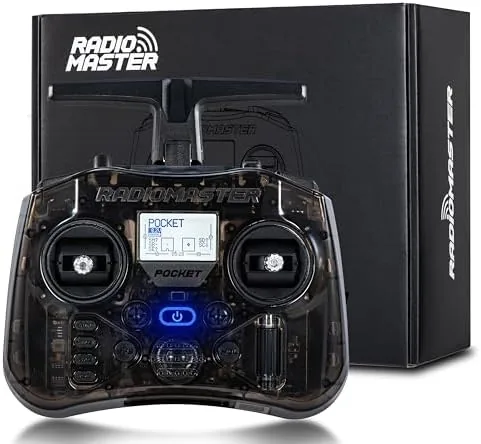

There is an old assumption in RC flying that a serious transmitter has to be big. Full-size radios with giant screens and heavy cases feel like piloting instruments, which they are, but they also take up a backpack on their own. The Radiomaster Pocket ELRS transmitter attacks that assumption with a case roughly the size of a smartphone, yet it keeps the two things that actually matter: hall gimbals and the full EdgeTX operating system. It runs ExpressLRS over an internal module, adds an external bay for more protocols, and even carries an LED light for flying in dim conditions. I flew it across quads, a simulator, and a small boat over three weeks. This review records how much radio fits in a pocket.
Before the details, the standard note. This article contains affiliate links, and if you buy through one of them the site earns a small commission at no extra cost to you. That commission never changes what I test or what I recommend.
Design and Build
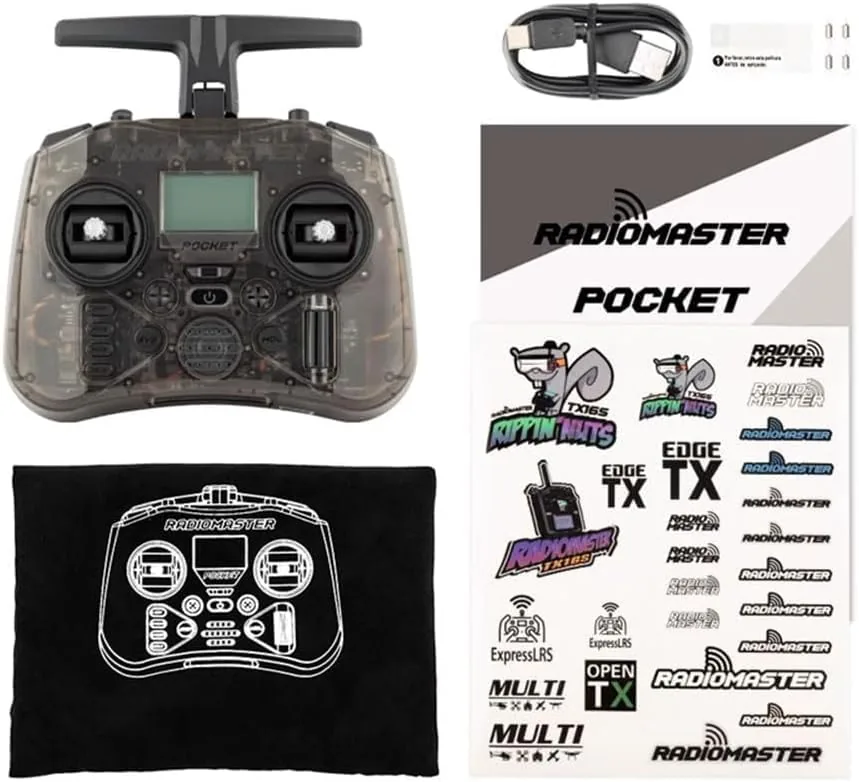
The Pocket is a gamepad-style transmitter, meaning the two gimbals sit close together in the center like a console Controller rather than spread wide apart like a full-size radio. The body is a matte black plastic shell with a satisfying texture, and the whole unit is light enough to hold comfortably in one hand for a whole session. That form factor is the entire point: this is a radio designed to disappear into a backpack or a jacket pocket.
The hall gimbals are the centerpiece of the build. Instead of potentiometers that wear and drift, these sticks use magnetic sensors, and the movement is smooth and precise right out of the box. The tension feels balanced, and there is no notchiness at center, which is exactly what you want for fine throttle and pitch control. The sticks return to center cleanly and stay there, which is the practical benefit of the hall design.
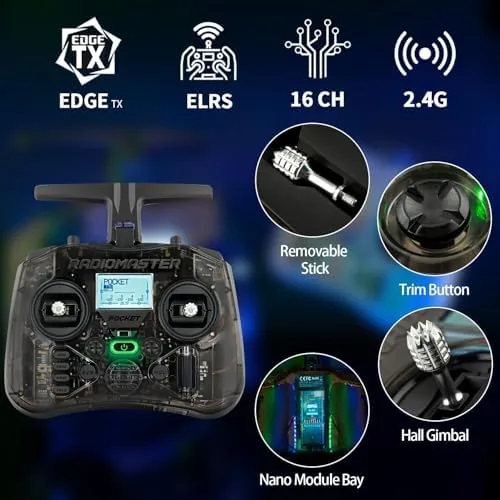
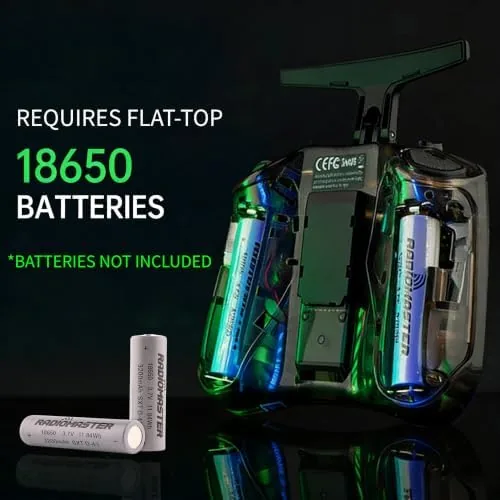
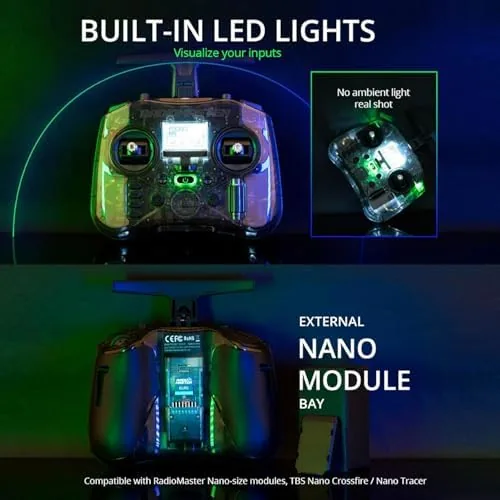
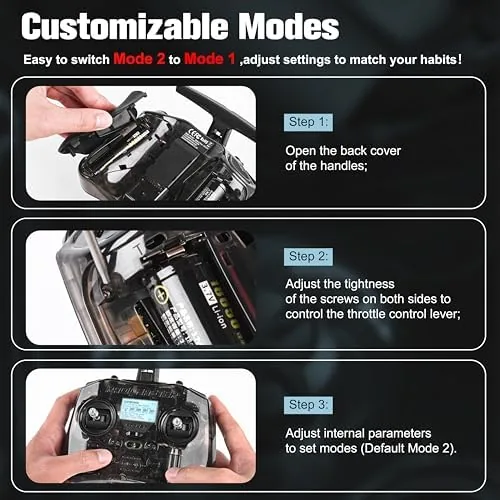
The front face carries a modest screen that shows telemetry and menu navigation, plus a set of switches and a two-position roller that handles most menu control. The case has an external module bay on the back for adding a multi-protocol module, a small LED light on the face for visibility, and a USB port that powers the radio and connects it to a computer as a joystick. The battery is not included, which is the biggest caveat of the package, and you must supply cells or a pack.
Key Features
EdgeTX is the operating system and the reason this tiny radio behaves like a big one. EdgeTX is the open source firmware family that runs full-size radios, and the Pocket runs it completely, with model profiles, mixes, logic switches, curves, and telemetry screens. You get the same flexibility as a premium radio in a case the size of a bar of soap. It can be daunting to new pilots, but for anyone who has used EdgeTX before, the Pocket feels immediately familiar.
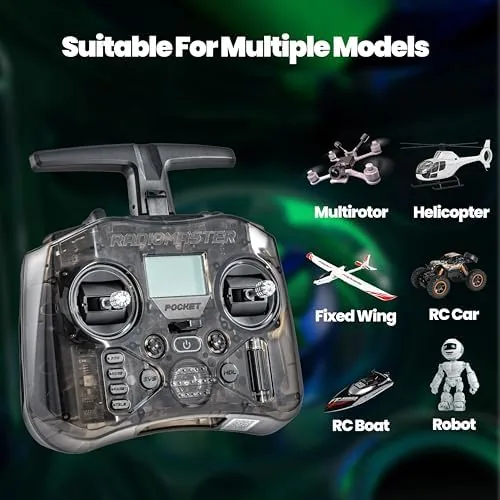
ExpressLRS is the radio link, and it is one of the strongest arguments for this transmitter. ELRS provides long range, fast update rates, and low latency at a price far below proprietary protocols. The internal 2.4GHz ELRS module handles most modern FPV receivers, and it binds cleanly to ELRS-equipped quads, planes, and ground vehicles. The external module bay extends the radio to other protocols for pilots with legacy aircraft.
The hall gimbals, the LED light for low-light visibility, and the simulator-friendly USB joystick mode round out the feature set. The LED is a small touch, but it genuinely helps when you are setting up at dusk. The USB joystick mode makes practice sessions in Liftoff or Velocidrone feel exactly like real sticks, which is the cheapest training you can buy. For a current look at the price and the included accessories, the Amazon listing for the Radiomaster Pocket ELRS is a useful reference.
Real-World Performance
My first test was a whoop session around a living room course, which punishes a radio that has slop in the sticks. The hall gimbals were immediately impressive: the throttle held its position through precise descents, and the pitch and roll inputs tracked my fingers with no dead band wobble. The compact spacing of the gamepad layout took about twenty minutes to feel natural, and after that the small footprint stopped mattering entirely.
Range testing on an open field delivered exactly what ELRS promises. With a standard update rate I held a solid control link well beyond visual range on a five inch quad, and the telemetry kept updating reliably the whole way out. The latency during fast flips and split-S maneuvers felt identical to a full-size ELRS radio, which makes sense because the guts are the same even if the case is small.
Simulator duty was a pleasant surprise. Plugged in over USB, the Pocket appeared as a gamepad instantly and flew Liftoff with the same hall gimbal feel as the real thing, making it an excellent bridge between practice and field days. I also strapped it to a small RC boat, and the water-facing session confirmed the radio is protocol-agnostic enough to handle a different model type without reconfiguration drama. The main practical complaint is the battery situation: since a pack is not included, new owners need to order cells or a rechargeable pack alongside the radio, and the runtime depends entirely on what you supply.
Pros and Cons
Pros:
- Hall gimbals deliver smooth, drift-free precision
- Full EdgeTX in a genuinely portable size
- ExpressLRS for long range and low latency control
- External module bay adds legacy protocol support
- USB joystick mode is perfect for simulator practice
- LED light helps in low-light flying conditions
Cons:
- Battery is not included with the purchase
- Gamepad layout takes time to adapt to
- Small screen limits complex telemetry views
- EdgeTX learning curve for complete beginners
How It Compares
The Pocket competes with the Radiomaster Boxer and the RadioMaster TX16S, and the comparison is really about size versus features. The table below shows how they line up.
| Feature | Radiomaster Pocket | Radiomaster Boxer | RadioMaster TX16S |
|---|---|---|---|
| Form factor | Gamepad, pocket size | Compact full-size | Full-size tray |
| Gimbals | Hall effect | Hall effect | Hall effect |
| Operating system | EdgeTX | EdgeTX | EdgeTX |
| Internal protocol | ELRS 2.4GHz | ELRS or 4-in-1 | ELRS or 4-in-1 |
| External module bay | Yes | Yes | Yes |
| Screen size | Small | Medium | Large color |
| Price | Budget | Mid range | Premium |
Against the Boxer, the Pocket wins on portability and price while giving up some ergonomics and a larger screen. The Boxer is the better choice for all-day field work; the Pocket is the better choice for travel and for pilots who want a radio that rides along. Against the TX16S, the gap is bigger, since the TX16S offers a large color screen and a more comfortable spread, but the Pocket keeps the essential radio capabilities at a fraction of the price. If portability is the priority, the Pocket is the clear winner in this lineup.
Who Should Buy It
Buy the Pocket if you are starting FPV and want a modern ELRS radio without the bulk, if you already fly and want a spare transmitter for travel, or if you want a simulator radio that doubles as a real field radio. It is the best entry point into EdgeTX and ExpressLRS for a budget-minded pilot.
Skip it if you need a large color screen for complex telemetry, if you prefer the wide spread of a full-size radio for long days at the field, or if you want a radio that works out of the box without buying a battery. For everyone else, the Pocket packs real radio power into the smallest package. You can check the current price for the Radiomaster Pocket on Amazon when you are ready to buy.
How We Test
I tested the Pocket over three weeks with a whoop in the house, a five inch quad on an open field for range, a simulator session over USB, and a small RC boat on the water. I evaluated gimbal feel, connection stability, telemetry updates, and how the compact layout affected my flying over time.
I did not fly with a 4-in-1 external module, and I ran the radio on a supplied rechargeable pack rather than testing every battery option. For a detailed explanation of the EdgeTX firmware and its features, the RC and radio control coverage published at TechRadar are a reliable authority on the subject. The Radiomaster Pocket listing on Amazon shows the current price and available variants.
Radiomaster Pocket ELRS Transmitter: Questions People Ask
Does the Radiomaster Pocket come with a battery?
No. The transmitter does not include a battery, and you need to install your own cells into the included battery holder or purchase a rechargeable pack to power it.
Which protocols does the Pocket support besides ExpressLRS?
The internal module runs ExpressLRS, and the external module bay accepts an optional multi-protocol module that adds support for systems such as DSMX, FlySky, and FrSky.
Are the hall gimbals worth upgrading from a standard transmitter?
Hall gimbals use magnetic sensors instead of wearing potentiometers, so they hold their center calibration longer and deliver smoother stick movement that directly improves precision flying.
How does the Pocket connect to a simulator for practice?
The transmitter has a USB port that appears as a joystick to a PC, so you can fly simulators like Liftoff and Velocidrone with the full hall gimbal feel of the real radio.
As an Amazon Associate, I earn from qualifying purchases.