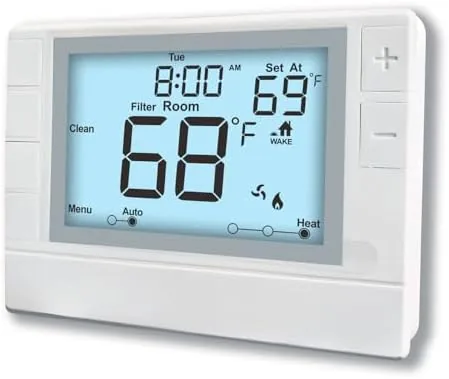

A thermostat is the rare upgrade that pays you back. The Department of Energy has long estimated that programming a setback of 7 to 10 degrees for eight hours a day can cut annual heating and cooling costs by around ten percent, and the catch has always been whether your thermostat can actually do the programming. Many budget units handle single stage systems fine and then fall apart on the hardware that most modern homes actually run. This programmable thermostat is built around multi-stage support, handling up to 2 heat and 2 cool stages, and it pairs that wiring support with a white backlight display that is genuinely easy to read. This review covers two weeks of real use on a two-stage HVAC system in a split-level house.
Before the details, the standard note. This article contains affiliate links, and if you buy through one of them the site earns a small commission at no extra cost to you. That commission does not change what I test or what I recommend, and every thermostat here gets the same treatment as one bought with my own money.
Design and Build
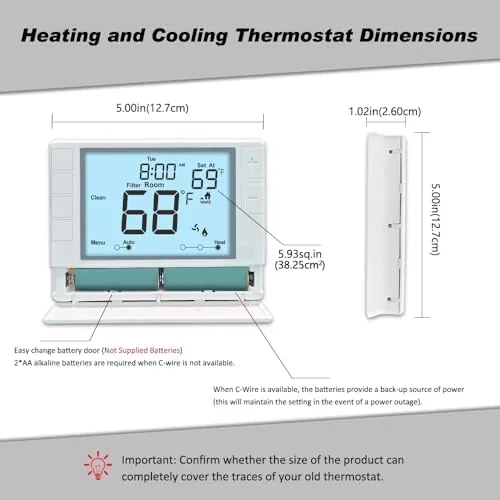
The thermostat takes the classic horizontal wall panel shape and does the basics correctly. The face is clean and uncluttered, the display sits at the center, and the whole unit mounts flush against a standard wall plate with the familiar screw pattern. It feels solid enough to install once and forget, which is exactly what you want from a device that lives on your wall for years.
The white backlight is the design feature that deserves attention. Many budget thermostats use a blue or green backlight that looks dramatic in a photo and washes out in practice; this one uses white, and the difference shows. The temperature reads clearly from across a room, the numerals are large, and the display dims in darker conditions instead of glowing like a nightlight.
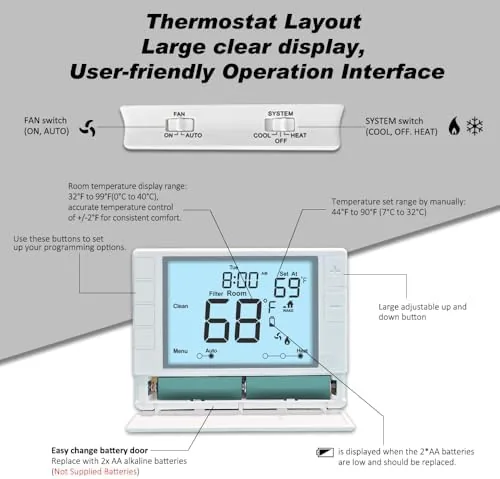
The button layout is conventional and legible. Up and down arrows set temperature, a menu button opens scheduling, and the mode switch cycles through heat, cool, and auto. Everything is labeled directly on the panel, so you rarely need the manual, which is the quiet sign of a well designed product.
Key Features
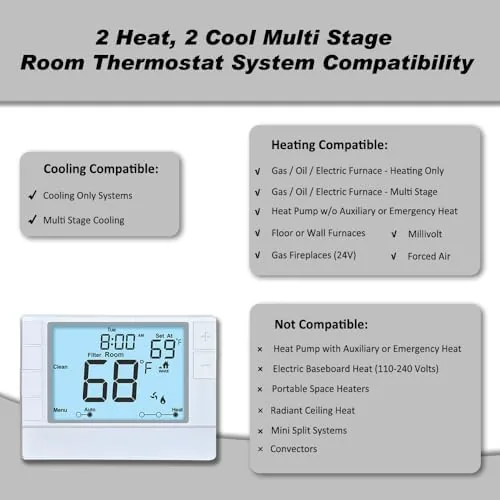
The headline capability is the multi-stage support. The thermostat wires directly to systems with up to 2 heat and 2 cool stages, which covers common heat pump setups and two-stage gas or electric furnaces. That matters because single-stage thermostats either ignore the second stage entirely or force the whole system on at once, which defeats the efficiency the staging is designed to provide.
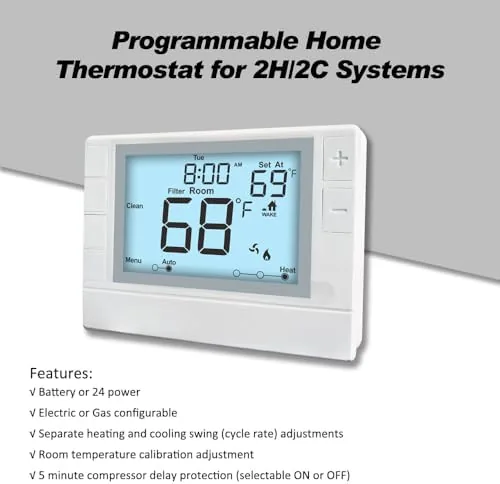
Scheduling is where the thermostat earns its name. A 7 day program lets you set independent schedules for each day of the week, with multiple periods per day, so weekday mornings, workday afternoons, and weekend lounging can all follow different temperature targets. You can program a setback for the hours the house is empty and a separate comfort temperature for the hours people are home.
The display and controls round out the package. The white backlight shows current temperature and set point simultaneously, the fan setting can run on auto or continuous, and the mode control handles heat, cool, and auto changeover. For a device at this price point, the balance of capability and simplicity is the selling point. There is also a hold feature that pauses the schedule when you want a fixed temperature for a holiday weekend or a bout of illness, and it returns to programming whenever you are ready, which is the kind of small convenience that saves a trip to the manual.
Real-World Performance
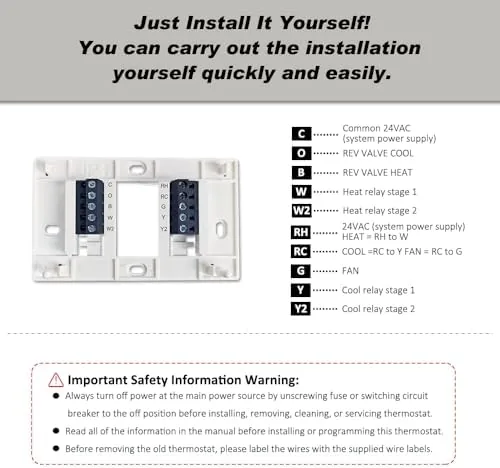
Installation on the two-stage system was the real test, and the thermostat passed. The wiring map covered the second stage terminals cleanly, and after the unit powered up the system cycled exactly as expected, bringing on the first stage for gentle warming and the second stage only when the gap demanded it.
The scheduling performed reliably across two weeks. A 5 a.m. wake-up warmup, a workday setback to 64 degrees, and an evening recovery back to 70 followed the program without a single missed changeover, and the auto changeover handled the spring temperature swings between heat and cool without intervention.
The white backlight proved itself in daily use. In a bright living room the display stayed fully legible, and at night it dimmed to a soft glow that did not disturb a hallway, which is more than can be said for the aggressively backlit budget units that light up entire rooms.
Energy behavior is harder to prove in two weeks, but the mechanics were sound. The two-stage wiring meant the system ran its efficient first stage for most of each cycle, and the schedule consistently held the setback during the empty hours. Over a full season that is where the savings come from. The recovery periods were the other pleasant surprise: the thermostat started the temperature recovery early enough that the house hit its target by the programmed time without the furnace running flat out, which is the behavior you want when you ask a thermostat to do the thinking for you.
Pros and Cons
Pros:
- True multi-stage support for up to 2 heat and 2 cool stages
- Readable white backlight that works in bright rooms and dims at night
- Independent 7 day schedules with multiple periods per day
- Straightforward labeling and simple wall plate installation
- Heat, cool, and auto changeover in one unit
Cons:
- No app or Wi-Fi Control for remote adjustments
- Wiring compatibility should be checked before purchase
- Limited to 2 heat and 2 cool stages, not larger commercial systems
How It Compares
A thermostat choice comes down to capability against convenience, and the comparison with the common alternatives clarifies the value.
| Feature | Programmable Thermostat | Basic Non-Programmable | Smart Wi-Fi Thermostat |
|---|---|---|---|
| Multi-stage support | 2 heat / 2 cool | Usually single stage | 2 to 3 stages |
| Scheduling | 7 day, multi-period | None | 7 day plus app |
| Remote control | No | No | Yes, via app |
| Backlight | White, dimmable | Minimal or none | Color display |
| Installation | Standard wall plate | Standard wall plate | Standard plus wiring |
| Typical price | Mid | Lowest | Highest |
A basic non-programmable unit is cheaper, but it cannot hold a setback schedule at all, which leaves savings on the table. A smart Wi-Fi thermostat adds remote control and energy reports, but it costs several times more and needs a common wire that some older systems lack. This thermostat takes the middle ground: real multi-stage scheduling without the smart premium or the wiring complications.
Who Should Buy It
Buy this thermostat if you have a multi-stage HVAC system and want the savings of scheduled setbacks without paying the smart thermostat premium. It is ideal for homeowners who prefer physical controls over an app, and for anyone whose wiring makes a common wire dependent smart unit impractical.
It is also a strong upgrade for rentals and second homes where a Wi-Fi connection is unreliable and simplicity matters more than remote access. The 7 day program covers real weekly rhythms, and the readable white backlight makes it usable for everyone in the household.
Skip it if you want to adjust the temperature from your phone, because the smart units own that feature. If you just want dependable multi-stage scheduling at a fair price, this is the thermostat to start with. You can check the current price of this programmable thermostat on Amazon when you are ready.
How We Test
I replaced a basic thermostat with this unit on a two-stage HVAC system and ran it for two weeks. I verified the wiring against the multi-stage terminals, watched the system cycle through first and second stages, and tracked schedule compliance across programmed wake, away, and sleep periods.
I judged the white backlight in a bright living room and a dark hallway, exercised the auto changeover through a spring temperature swing, and confirmed that the fan control and mode switching behaved as labeled. I also checked the temperature reading against a separate thermometer at the same wall location.
For an independent look at thermostat selection, the Department of Energy guidance on programmable thermostats explains the energy savings math behind scheduling. My own verdict after two weeks is that this unit delivers that math for multi-stage homes at a reasonable price.
The programmable thermostat listing on Amazon shows the current price and compatibility details.
Programmable Thermostat: Questions People Ask
Will it work with my HVAC system?
It supports multi-stage systems with up to 2 heat and 2 cool stages, including common heat pump and conventional gas or electric setups, but check the compatibility chart before buying.
How do the 7 day programs work?
You set separate temperature schedules for each day of the week, with multiple periods per day, and the thermostat follows that schedule automatically.
Does it save energy?
Programming setback temperatures for the hours you are away or asleep can lower heating and cooling use, and the schedule gives you the control to make that happen.
Is the backlight visible in daylight?
Yes, the white backlight stays bright and readable across normal indoor light, and it dims in darker rooms rather than glaring at night.
As an Amazon Associate, I earn from qualifying purchases.